L'attacco delle volpi
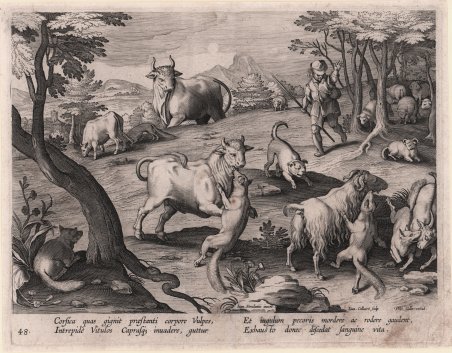
L'attacco delle volpi
Formas de Pago
- PayPal
- Tarjeta de crédito
- Transferencia Bancaria
- Pubblica amministrazione
- Carta del Docente
Detalles
- Año de publicación
- 1596
- Formato
- 260 X 200
- Grabadores
- COLLAERT Jan I
Descripción
Animali attaccati da volpi; in primo piano, due buoi e un ariete sono attaccati da volpi, oltre, un bue e altri animali appaiono sulla cima di una collina; in lontananza si vede un paesaggio montuoso. Come indica l’iscrizione in basso si tratta di una scena ambientata in Corsica. Firmata e titolata sotto l’immagine: 'Ioan. Stradanus invent. / Ioan. Collaert sculp. / Phls Galle excud.' 'Corsica quas.sanguine vita.' Bulino, circa 1596. Della serie ' Venationes Ferarum, Avium, Piscium, da disegni di Jan van der Straet detto Stradano o Stradanus (Bruges 1523 - Firenze 1605), pubblicata ad Anversa da Philip Galle. Di ritorno ad Anversa dal suo lungo viaggio in Italia, lo Stradano conobbe Philip Galle, già allievo di Hieronimus Cock e da poco dedito all’arte dell’editoria. I due progettarono la produzione di una serie di soggetti venatori, ispirati agli arazzi della villa di Poggio a Caiano. Il Galle all’inizio diede alla luce una serie di incisioni senza numerazione, alla quale fece seguita una seconda stesura composta da frontespizio e 44 tavole numerate. La fortuna immediata dell’opera convinse l’editore a proseguire la collaborazione con lo Stradano che venne così impegnato nell’esecuzione di nuovi disegni, con temi venatori esotici ed inusuali. Questo nuovo ciclo fu dapprima pubblicato separatamente, ed in seguito unito al precedente, costituendo la vasta serie di 104 tavole, intitolata appunto ' Venationes Ferarum, Avium, Piscium, Pugnae. ' La serie è databile tra il 1578 (data sul frontespizio) e il 1596. Come già gli arazzi della villa di Poggio a Caiano, l’opera è raggruppata per argomenti suddivisi in tre vaste categorie: animali terrestri, d’aria e d’acqua. All’inizio le scene di caccia furono incise dallo stesso Philip Galle che successivamente impiegò altri membri della sua famiglia ed assistenti vari quali Adriaen e Jan Collaert, Theodor e Cornelis Galle e Carolus de Mallery. Magnifica prova, impressa su carta vergata coeva, rifilata al rame, in buono stato di conservazione. Bibliografia New Hollstein (Dutch & Flemish) / The New Hollstein: Dutch and Flemish etchings, engravings and woodcuts 1450-1700 (476); Baroni Vannucci 1997 / Jan van der Straet, detto Giovanni Stradano, flandrus pictor et inventor (693.48). Animals Attacked by Foxes; in the foreground, two oxes and a ram are attacked by foxes, while another fox watches from the lower left corner; to far right, a shepherd, with a staff, attempts to alert his flock of sheep to the danger; beyond, an ox and other animals appear on the brow of a hill; in the distance a mountainous landscape is seen. As the inscription at the bottom indicates, this is a scene set in Corsica. Signed 'Ioan. Stradanus invent. / Ioan. Collaert sculp. / Phls Galle excud.' Plate numbered 48 in margin, to left. Lettered below the image: Latin text arranged in two columns, 'Corsica quas.sanguine vita.' Engraving, circa 1596. From the "Venationes Ferarum, Avium, Piscium", after Jan van der Straet called Stradano or Stradanus, published by Philip Galle. Once back in Antwerp, after a long trip to Italy, Stradano met Philip Galle, former pupil of Hieronumus Cock, who had recentely devouted himself to the art of printing. They planned together the realization of hunting subjects, inspired by the tapestry of the Villa in Poggio a Caiano. At the beginning, Galle realized a series of engravings without numbers, to which a second edition followed, with title page and 44 numbered plates. The sudden fame of his work convinced the printer to go on with his cooperation with Stradano, who realized new drawings with uncommon and exotic hunting subjects. The new series was published first separately, then together with the first edition, forming a wide series of 104 plates, named Venationes Ferarum, Avium, Piscium, Pugnae. This work can be dated between 1578 (on the front page) and 1596. As for the tapestry of the Villa in Poggio a Caiano, the work is divided in three wide categories: terrestrial, air and water animals. At the beginning the hunting scenes have been engraved by Philip Galle himself, who then hired other members of his family and other assistants, among which Adriaen and Jan Collaert, Theodor and Cornelis Galle and Carolus de Mallery. Magnificent work, printed on contemporary laid paper, trimmed to the platemark, in good condition. Bibliografia New Hollstein (Dutch & Flemish) / The New Hollstein: Dutch and Flemish etchings, engravings and woodcuts 1450-1700 (476); Baroni Vannucci 1997 / Jan van der Straet, detto Giovanni Stradano, flandrus pictor et inventor (693.48). Cfr.
