L’incensiere
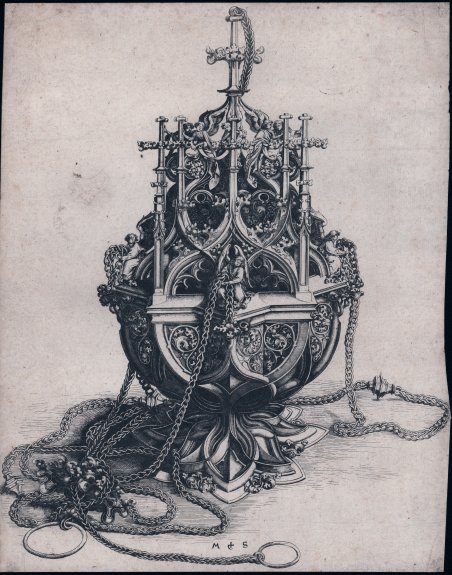
L’incensiere
Formas de Pago
- PayPal
- Tarjeta de crédito
- Transferencia Bancaria
- Pubblica amministrazione
- Carta del Docente
Detalles
- Año de publicación
- 1880
- Formato
- 0 X 0
- Grabadores
- RISTER Martin
- Descripción
- Hollstein vol. XLIX, p. 217, no. 106c; Lehrs 106c; Bartsch VI.162.107; TIB 8,106 c3.
Descripción
Bulino, 1880 circa, firmata M + S. Copia da Martin Schongauer, eseguita da Martin Rister.Magnifico esemplare, stampato su carta vergata, occasionale e lieve foxing, altrimenti in ottime condizioni.Al verso, in alto a destra, timbro di collezione: "A. Chenu. Artiste Décorateur Orléans (non in Lugt): in basso a destra, un secondo timbro di collezione di Pierre Sentuc (Lugt 3608).La rappresentazione di un incensiere nelle più ricche forme decorative tardogotiche è uno dei capolavori di Schongauer. Attraverso la suggestione di un piano di appoggio e le catene sparse sul davanti e sui lati, Schongauer crea uno spazio in cui il bruciatore d'incenso sta in piedi autonomamente. Luce e ombra giocano un ruolo importante. Il punto di vista si trova a livello del gruppo degli angeli superiori, dove tutti i pinnacoli terminano alla stessa altezza. Tutte le parti sottostanti sono riprodotte nella vista dall'alto. L'incisione è un capolavoro in due sensi: sia in termini di espressione grafica, grazie alla maestria con cui un oggetto così complicato è stato catturato spazialmente con le sole linee incise sulla lastra di rame, sia per lo straordinario splendore e la complessità delle forme che ne fanno un capolavoro di oreficeria. Non è quindi del tutto chiaro se la funzione primaria di questo foglio fosse quella di ispirare altri orafi ad imitarlo come modello, o se riproducesse un incensiere realmente esistente, un capolavoro di oreficeria. La splendida incisione di Schongauer, nota in 40 esemplari secondo Lehrs, fu copiata da due orafi contemporanei di Schongauer: il Maestro IC di Colonia, e Israel van Meckenem e, nell’Ottocento, da Martin Rister.Martin Rister (1815 - 1883) era un orafo di Colmar che, naturalmente, aveva grandi capacità come incisore. La sua copia, quasi perfetta, è leggermente più piccola di quella di Israel van Meckenem, ma di qualità eccellente, Engraving, 1880 circa, signed M + S (M with slanting sides). Copy by Martin Rister, after Martin Schongauer. Excellent example, printed on laid paper, occasional light foxing, otherwise in very good condition.On verso, upper right, collection mark: “A. Chenu. Artiste Décorateur Orléans (not in Lugt): at lower right, a second collection mark of Pierre Sentuc (Lugt 3608)Schongauer's Censer is one of his most virtuosic engravings-his nearly flawless control of the burin permitting such extravagant ef-fects as the perfectly executed lengths of chain, casually piled on the table. The rings with which the censer would be carried are invitingly placed in the foreground as though tempting the viewer's grasp. These chains pass through the looped arms of angels on their way to join the body of the incense burner, and the open- ings through which the smoke would pass are outlined in elaborate Gothic tracery. Architectural finials rise past a group of cavorting angels at the top, and the body of the vessel itself stands on a graceful lobed foot. The entire object has been modeled and shaded with a care that would be unusual for a "mere" working drawing. Lehrs considered this, too an actual working model for goldsmith work (see .105), but Flechsig argued that it is instead an illusionistic representation of such an object. This engraving is of such compelling beauty that other engraver-goldsmiths were the ones who copied it: Master IC of Cologne, Isharel van Meckenem, and event the noneteenth-century Colmar goldsmith, Martn Rister.Martin Rister (1815 – 1883) was a Colmar goldsmith who obviously great ability as an engraver. His near-perfect copy is slightly smaller than Israel van Meckenem’s, buti s of excellent quality, and is a much greater rarity than the Schongauer original. Cfr. Hollstein vol. XLIX, p. 217, no. 106c; Lehrs 106c; Bartsch VI.162.107; TIB 8,106 c3.
