La caccia al Cervo
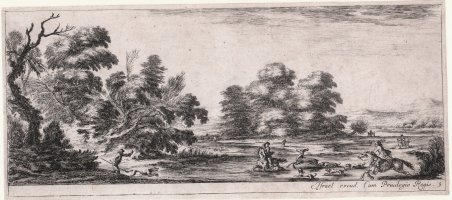
La caccia al Cervo
Formas de Pago
- PayPal
- Tarjeta de crédito
- Transferencia Bancaria
- Pubblica amministrazione
- Carta del Docente
Detalles
- Año de publicación
- 1640
- Formato
- 255 X 110
- Grabadores
- Della BELLA Stefano
Descripción
Acquaforte, metà del XVII secolo. Della serie "Diversi paesaggi". Esemplare di secondo stato di due con l'indirizzo di Israel. Bellissima prova, impressa su carta vergata coeva priva di filigrana, irregolarmente rifilata al rame o con sottili margini, in buono stato di conservazione. Stefano della Bella fu uno degli incisori più interessanti e originali nella Firenze del XVII secolo e può considerarsi l’unico geniale continuatore dell’opera di Jacques Callot. La sua educazione artistica ebbe inizio a Firenze nella bottega degli orafi Gasparo Mola e Orazio Vanni, e la precisione del segno, tipica dell’arte orafa resterà caratteristica del suo stile. Studiò poi presso Giovanni Battista Vanni e forse anche presso il Cantagallina e Cesare Dandini, ma ben presto si dedicò all'incisione. Il suo vero maestro può considerarsi Jacques Callot, l’incisore francese che soggiornò a lungo a Firenze lasciando una forte impronta nel panorama artistico della città. Gli anni più importanti della sua carriera sono quelli che trascorre a Parigi, dal 1639 al 1650, stipendiato da Lorenzo de' Medici: lavorò insieme ad Israel Silvestre, con gli editori Langlois, Ciartres e Pierre Mariette, per stampatori francesi e per commissioni di gran prestigio, come quelle del 1641 per il cardinale Richelieu che gli affidò le illustrazioni delle sue imprese guerresche. Intorno al 1647, durante un viaggio in Olanda, dove eseguì le acqueforti con le vedute del porto di Amsterdam, incontrò Rembrandt e da quella data notiamo una eco profonda dell’arte dell’olandese nella grafica del Della Bella. Etching, middle of the XVII century.From the "Diversi paesaggi". Example of the second state of two, with the imprint of Israel Henriet.A fine impression, on contemporary laid paper, trimmed on platemark or with small margins, in good condition. Stefano della Bella was one of the most interesting and original engravers in 17th-century Florence and can be considered the only brilliant continuator of Jacques Callot's work. His artistic education began in Florence in the workshop of the goldsmiths Gasparo Mola and Orazio Vanni, and the precision of sign, typical of the goldsmith's art, will remain characteristic of his style. He then studied under Giovanni Battista Vanni and perhaps also under Cantagallina and Cesare Dandini, but soon turned to engraving. His real master can be considered Jacques Callot, the French engraver who stayed in Florence for a long time and left a strong imprint on the city's artistic scene. The most important years of his career were the ones he spent in Paris, from 1639 to 1650, salaried by Lorenzo de' Medici: he worked together with Israel Silvestre, with the publishers Langlois, Ciartres and Pierre Mariette, for French printers and for commissions of great prestige, such as those of 1641 for Cardinal Richelieu, who entrusted him with illustrations of his warlike exploits. Around 1647, during a trip to Holland, where he executed etchings with views of the port of Amsterdam, he met Rembrandt, and from that date we note a profound echo of the Dutchman's art in Della Bella's graphic work. Cfr. De Vesme 761 II/II
