La decollazione di San Giovanni Battista
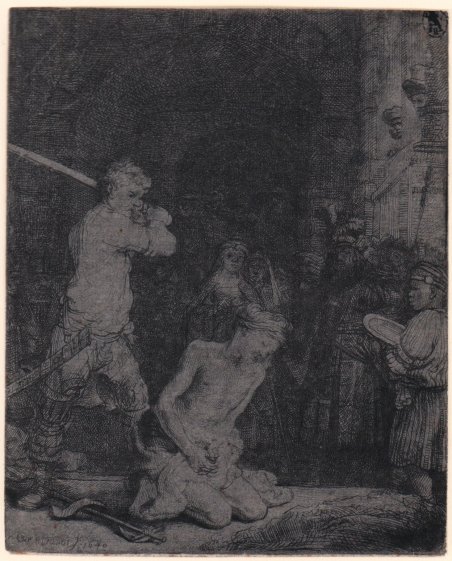
La decollazione di San Giovanni Battista
Formas de Pago
- PayPal
- Tarjeta de crédito
- Transferencia Bancaria
- Pubblica amministrazione
- Carta del Docente
Detalles
- Año de publicación
- 1640
- Formato
- 103 X 129
- Grabadores
- REMBRANDT Harmensz van Rijn detto
Descripción
ESEMPLARE STAMPATO SU CARTA AZZURRAAcquaforte e punta secca, con la firma e la data di Rembrandt, in basso a sinistra: "Rembrandt f. 1640".La stampa mostra il momento immediatamente precedente la decapitazione di San Giovanni Battista: il santo è in ginocchio, mentre un soldato, afferrata la spada con entrambe le mani, è nell’atto di sferrare il colpo mortale. Salomè è tra gli astanti; alla sinistra del santo, un uomo ha in mano il vassoio su cui sarà adagiata la sua testa. Bell’esemplare nel primo stato, di due, stampato su carta azzurra, rifilato ai margini, per il resto molto buono lo stato di conservazione.Le incisioni di Rembrandt stampate su carta azzurra o giapponese sono da considerarsi come prove di stampa, varianti volute dall'artista per provare diversi effetti del proprio lavoro. Sono assolutamente rari nelle raccolte pubbliche e sul mercato (cfr. Rembrandt’s Etchings and Japanese Echizen Paper, Rembrandt House Museum, Amsterdam, 12 June — 20 September 2015).Anthony Griffiths , "Prints and Printmaking: An Introduction to the History and Techniques", Londra 1996, p. 35, scrive "Although in the fifteenth cebturies illustrations in books had been occasionally printed on vellum or blue paper and a few single-sheet prints on silk, it was not until the seventeenth century that artists esplored this field with any enthusiasm. Hercules Segers led the way by sometimes printing on cloth, but the greatest figure was (again) Rembrandt, who experimented with vellum, a variety of imported yellowish Japanese paper, a thin 'Chinese' paper and a rought oatmeal paper". Timbro di collezione nell'angolo superiore destro di Friedrich August II de Saxe (Lugt 971), replicato in forma differente al verso (Lugt 780a).Opera di straordinaria rarità. PRINTED ON BLUE PAPERThe beheading of St John the Baptist; soldier with sword poised, St John kneeling, with Salome amongst onlookers, including a black page with a salver; first state before reworking by another hand. 1640 Etching and drypoint, Lettered with Rembrandt's signature and date, in lower left: "Rembrandt f. 1640".A fine example of the first state of two, printed on blue paper, trimmed to the platemark, generally in good condition.Rembrandt's works printed on blue or Japanese paper are very rare on the market and in the Public Collections (cfr. Rembrandt’s Etchings and Japanese Echizen Paper, Rembrandt HouseMuseum, Amsterdam, 12 June — 20 September 2015).Anthony Griffiths "Prints and Printmaking: An Introduction to the History and Techniques", Londra 1996, p. 35: "Although in the fifteenth cebturies illustrations in books had been occasionally printed on vellum or blue paper and a few single-sheet prints on silk, it was not until the seventeenth century that artists esplored this field with any enthusiasm. Hercules Segers led the way by sometimes printing on cloth, but the greatest figure was (again) Rembrandt, who experimented with vellum, a variety of imported yellowish Japanese paper, a thin 'Chinese' paper and a rought oatmeal paper". Collector's mark at the upper right corner of Friedrich August II de Saxe (Lugt 971) and on verso (Lugt 780a). Cfr. New Hollstein (Dutch & Flemish) 183.I (Rembrandt); White & Boon 1969 92.I
