La figlia di Cimone sostiene il padre carcerato
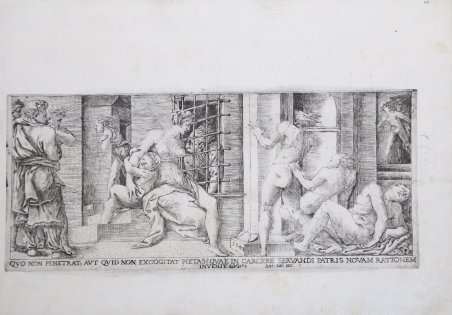
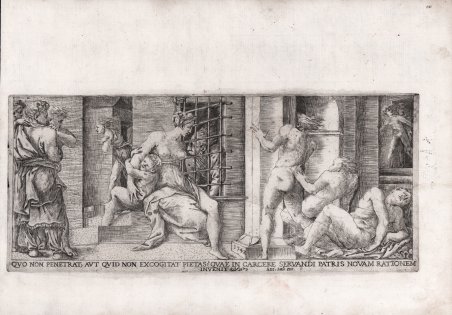
La figlia di Cimone sostiene il padre carcerato
Formas de Pago
- PayPal
- Tarjeta de crédito
- Transferencia Bancaria
- Pubblica amministrazione
- Carta del Docente
Detalles
- Año de publicación
- 1542
- Formato
- 320 X 415
- Grabadores
- REVERDY Georges
Descripción
Bulino, 1542, datato in lastra sul basamento del pilastro. Da un soggetto di Rosso fiorentino. Esemplare nel secondo stato di due, con l’indirizzo di Antonio Salamanca. Bellissima prova, impressa su carta vergata coeva con filigrana “scudo con lettera M e stella” (Briquet 8390-91-92), con inusuali ampi margini, in perfetto stato di conservazione. L’opera raffigura Pero, figlia di Cimone ateniese, che alimenta col proprio latte il vecchio padre, costretto in carcere. Scoperta dalle guardie, sarà rilasciata insieme al padre per la pietas di cui aveva dato prova. L’invenzione del soggetto, dall’Armano attribuito a Raffaello, è stato definitivamente identificato dalla Borea nel rilievo in stucco del Rosso fiorentino sotto l’affresco della Galleria di Francesco I, a Fontainbleau, raffiguranti Cleobi e Micone. Carroll (1987) sostiene che l’incisione non derivasse dallo stucco ma da un disegno perduto di Rosso fiorentino, poiché nella stampa sono presenti elementi assenti nello stucco, vicini comunque allo stile del Rosso. Carroll respinge l'attribuzione del Bartsch a Georges Reverdy, e anche il suggerimento di Zerner del 1972 a Domenico del Barbiere, sulla base di affinità stilistiche. Secondo Massari, la stampa è da attribuirsi a Giulio Bonasone. Attualmente l’opera è attribuita a Georges Reverdy. Il tema della Pietas filiale era molto sentito nell’antica Roma. Non è un caso, infatti, che proprio il soggetto di Cimone e Pero – tradita anche da Valerio Massimo - si trovi già rappresentata a Pompei nella villa di Valerio Frontone. Si narra che a Roma In ricordo di questo esempio di amore filiale che fu eretto nel foro Olitorio, nel 181 a.C., un tempio dedicato alla Pietas, poi sostituito dalla basilica di San Nicola in carcere. L’iconografia conobbe una grande diffusione sia nel Rinascimento che per tutto il Seicento, e di solito è nota con il titolo Carità Romana. Al verso timbro della collezione Benedic Penon (Lugt, 3830). Bibliografia Bartsch, XV.487.2; Borea, Il Primato del Disegno, p. 261 n. 664; Eugene A. Carroll, Drawings, Prints, and Decorative Arts, Washington, National Gallery of Art 1987, 81; Massari, Iulio Bonasone, p. 34, 5; Henri Zerner, 440. ' The daughter of Cimon supports the father prisoner. Engraving, 1542, dated on plate at lower center. After Rosso Fiorentino. Example of the second state of two, with the address of Antonio Salamanca. A fine impression, on contemporary laid paper with “shield with letter M and star” watermark, unusual wide margins, perfect conditions. Pero, who secretly breastfeeds her father, Cimon, after he is incarcerated and sentenced to death by starvation. She is found out by a jailer, but her act of selflessness impresses officials and wins her father's release. After the stucco relief under Rosso Fiorentino's fresco representing Cleobis and Biton in the Galerie Francois I at Fontainebleau. Carroll in Washington 1987 supposes that it was not made directly after the stucco, and because even the figures in the print that are absent from the stucco are very similar to Rosso's manner, the print was most probably made after a lost drawing by him. Carroll rejects Bartsch's attribution to Georges Reverdy, and also Zerner's suggestion of 1972 that its manner was close to Domenico del Barbiere. Massari suggests the attribution to Giulio Bonasone. The subject, known since the last quarter of the 15th century as " RomanCharity," is based on a text of Valerius Maximus, "Factorum et Dictorum Memorabilium Libri IX," but refers to an earlier legend which appeared at Rome at the beginning of the 2nd century BC, in connection with the construction of a temple dedicated to Pietas (Charity), a temple dedicated to Pietas, later replaced by the Church of St. Nicholas in Prison. In the seventeenth and eighteenth centuries, many European artists depicted the scene. Georges Reverdy (1529 fl. - 1564/5 died, also known as Reverdy, Georges; Reverdinus, Cesare; Reverdino, Gaspar) was an engraver. Probably of origins in Piedmont, documented in Lyons from 1529 to 1565, in the last of which he is described as dead. Since his last dated print is from 1564, he probably died the previous year. Wrongly catalogued by Bartsch. It is possible, however, that he went to Italy around 1530, making engravings of religious scenes. A fine example of this rare work. Ex collection Benedic Penon (Lugt, 3830). Bibliografia Bartsch, XV.487.2; Borea, Il Primato del Disegno, p. 261 n. 664; Eugene A. Carroll, Drawings, Prints, and Decorative Arts, Washington, National Gallery of Art 1987, 81; Massari, Iulio Bonasone, p. 34, 5; Henri Zerner, 440. Cfr.
