La Messa di S. Gregorio
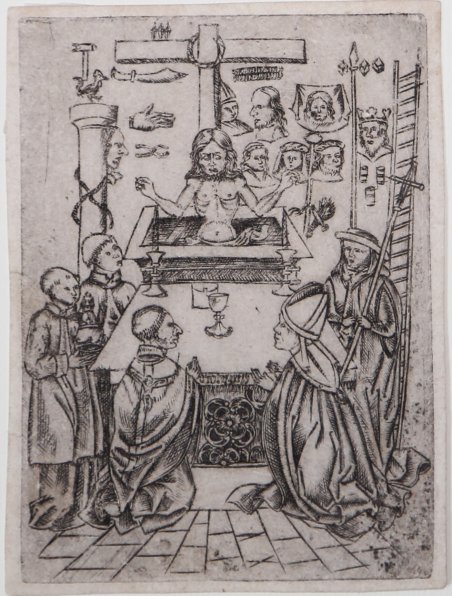
La Messa di S. Gregorio
Formas de Pago
- PayPal
- Tarjeta de crédito
- Transferencia Bancaria
- Pubblica amministrazione
- Carta del Docente
Detalles
- Año de publicación
- 1475
- Formato
- 72 X 98
- Grabadores
- Anonimo
- Descripción
- W. H. Willshire, A descriptive catalogue of early prints in the British Museum. German and Flemish Schools, II, G.93
Descripción
Bulino, 1475-1500 circa, privo di data e di iscrizioni.Bellissima prova, impressa su carta vergata coeva, con sottili margini, in perfetto stato di conservazione.Rarissima incisione anonima è ascrivibile alla scuola tedesca dell’ultimo quarto del XV secoloLa scena raffigura la cosiddetta Messa di S. Gregorio, in cui il Cristo, con gli strumenti della passione, appare sull’altare al papa celebrante.L’immagine divenne molto popolare nel corso del XVI secolo, anche perché spesso associata alle indulgenze. In effetti, agli inizi del secolo, nel Nord Europa, la Messa di S. Gregorio, anzi le 30 messe gregoriane, ricorrono di frequente nei manoscritti tra le pratiche per ottenere l’indulgenza; a partire dal 1425 circa, le indulgenze sono spesso incorporate in stampe o altre opere che raffigurano la Messa di S. Gregorio.Esemplare dalla collezione del British Museum, due timbri al verso, compreso quello di dismissione. (Lugt 302 & 305). Engraving, 1475-1500 circa, unlettered.A very good example, printed on contemporary lad paper, with small margins, perfect condition.The scene depicts the Mass of Saint Gregory. This subject became widespread in medieval art. Such visual manifestations have a variety of precise forms, but they almost always show Gregory and his entourage, usually consisting of clerics, in a church before an altar, often with the saint saying mass. Christ as a Man of Sorrows appears on the altar. Because the St. Gregory Mass shows a bleeding Christ and the celebration of the mass, the image has been used as support for the idea of transubstantiation. Another reason for the popularity of the image of the Mass of St. Gregory may be that such images often carried an indulgence, or a promise of the partial remission of sins of the viewer. In the early fifteenth century the Mass began to appear on Northern European indulgence charts. By the second quarter of the fifteenth century these indulgences were often incorporated in text form in prints and other works which showed the Mass of St. Gregory This small engraving can be attributed to the German school of the last quarter of the fifteenth century.A magnific example of this rare work, a duplicate copy from the British Museum collection; 2 marks on verso (Lugt 302 & 305). Cfr. W. H. Willshire, A descriptive catalogue of early prints in the British Museum. German and Flemish Schools, II, G.93
