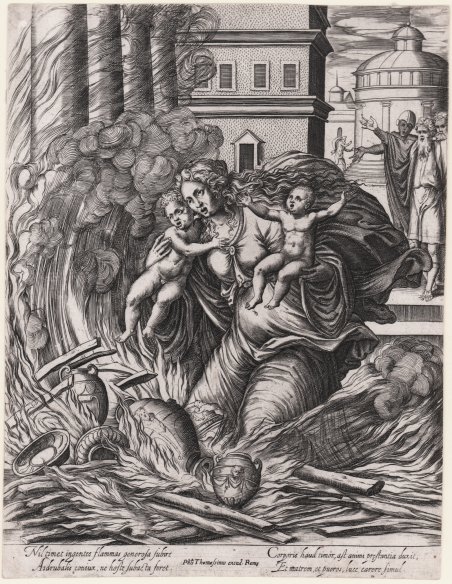
Bulino, avanti il 1562, privo di firma. Da un soggetto di Baldassarre Peruzzi. Esemplare nel secondo stato di due, con l’aggiunta dei versi in basso e della firma dell’editore Philippe Thomassin. Bellissima prova, impressa su carta vergata con filigrana “Reverenda Camera Apostolica”, irregolarmente rifilata al rame, in buono stato di conservazione. Pierre Woeiriot proviene da una famiglia di orefici della Lorena, e fu incisore al bulino e bronziere, molto influenzato dall’arte rinascimentale italiana. Egli incise diverse opere da disegni di artisti italiani; non è sicura la paternità del Peruzzi di questo soggetto, poiché nessun modello è oggi conosciuto. L’episodio raffigurato è narrato da Appiano, ambientato a Cartagine, anno 146 a. C. Scipione Emiliano, assediata la città, per risparmiare ulteriori sacrifici alle sue truppe, emana un bando che avrebbe accordato la salvezza a tutti coloro che si sarebbero arresi. Obbedirono in 50.000, con in testa Asdrubale. Colpita dalla viltà del gesto compiuto dal marito, la moglie di Asdrubale imprecò contro di lui e invocò la vendetta, poi estrasse un pugnale, uccise i figli e si gettò con loro nelle fiamme che i Romani aveva appiccato. Livio riporta l’episodio con qualche variante: la donna si butta tra le fiamme con i figli vivi. Ed è questa la versione seguita dall’incisore: la scena mostra infatti la donna nell’atto di lanciarsi tra le fiamme con in braccio i due figli ancora vivi e terrorizzati. Nell’Indice delle stampe della bottega De Rossi, tra le opere di Baldassare Peruzzi si cita proprio il titolo ' La moglie di Asdrubale che si precipita nel fuoco con due figliuolini ' in braccio, seguito dall’indicazione “intaglio a bulino di Pierre Voeiro in foglio reale”. Del disegno che sarebbe servito da modello, però, nulla si conosce. Bibliografia Le Beau Style p. 178 n. 76; La Bella Maniera, 58; Robert-Dumesnil VII, p. 94, 206. Engraving, before 1562, without signature. After Baldassarre Peruzzi. Example in the second state of two, with the inscription and the signature of Philippe Thomassin. A very good impression, on laid paper with “Reverenda Camera Apostolica” watermark, trimmed to the platemark, in very good conditions. Pierre Woeiriot comes from a family of goldsmiths from Lorraine, and was engraver and bronziere, much influenced by the Italian Renaissance. He recorded several works from drawings by Italian artists; today is not sure the paternity of Peruzzi, since no model is known today. The episode depicted is narrated by Appiano , set in Carthage in the year 146. C. Scipio besieged the city, to save further sacrifices to his troops, issue an invitation that would grant salvation to all who would surrender . They obeyed at 50,000, led by Hasdrubal . Affected by the cowardice of the gesture made by the husband, the wife of Hasdrubal swore at him and called revenge, then pulled out a knife, killed the children and threw them into the flames that the Romans had set. Livio reports the episode with some variations: the woman is thrown into the fire with their children alive. And this is the version followed by the engraver: the scene shows the woman is in the act of launching the flames with his two sons in their arms still alive and terrified. In the Index of prints from the workshop De Rossi, among the works of Baldassare Peruzzi citing its title Hasdrubal 's wife who rushes into the fire with two childrens in arm, followed by “intaglio a bulino di Pierre Voeiro in foglio reale”. Of the drawing that would serve as a model, however, nothing is known . Bibliografia Le Beau Style p. 178 n. 76; La Bella Maniera, 58; Robert-Dumesnil VII, p. 94, 206. Cfr.

 Descubre cómo utilizar
 Descubre cómo utilizar