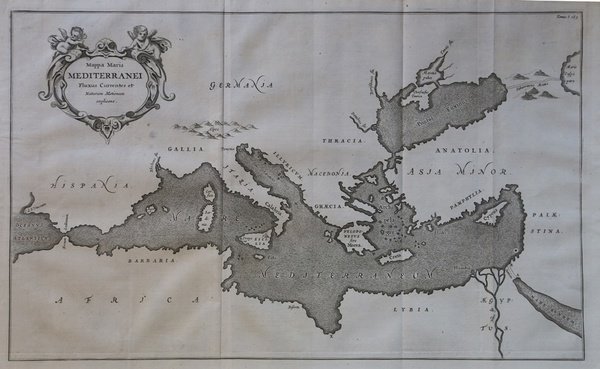
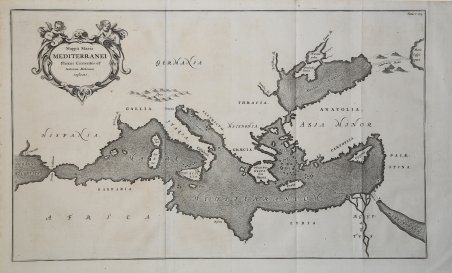
Carta tratta dal Mundus Subterraneus del Kircher, studioso gesuita, uno dei primi scrittori sui fenomeni fisici della terra. Il Kircher teorizzava che tutte le acque della Terra erano connessi tra loro tramite dei tunnel sotterranei che univano oceani e mari. La mappa costituisce la prima rappresentazione delle correnti marine del Mediterraneo. Kircher entrò nella Compagnia di Gesù il 2 ottobre 1618. Insegnava filosofia e matematica in Würzburg, quando le vittorie degli Svedesi in Germania lo costrinsero a rifugiarsi prima in Francia, ad Avignone, poi a Vienna, donde, nel 1635, fu chiamato alla cattedra di matematiche nel Collegio Romano. Si occupò di filologia (Prodromus coptus, Roma 1636; Lingua aegyptiaca restituta, 1643); di fisica (Ars Magnesia, Würzburg 1631; Specula melitensis, Napoli 1638; Ars magnae lucis et umbrae, Roma 1645); di sacra liturgia (Rituale Ecclesiae aegyptiacae, Roma 1647); di astronomia (Itinerarium extaticum, Roma 1655); di storia naturale (Mundus subterraneus, Amsterdam 1665); di matematica (Organum mathematicum, Würzburg 1668); di musica (Musurgia universalis, Roma 1660; Phonurgia nova, Kempten 1673) e d'altro. Tentò anche l'egittologia, cui appartengono i tre volumi intitolati Oedipus Aegyptiacus (Roma 1652), con i quali credette d'avere scoperto la chiave per l'interpretazione dei geroglifici. Voltosi allo studio della civiltà cinese diede in luce la China monumentis qua sacris qua profanis. illustrata (Roma 1667). Il Kircher ha pure un posto ragguardevole nella storia della scienza geografica, non tanto per le ardite e spesso astruse ipotesi formulate (specialmente nel Mundus subterraneus) a spiegare taluni fenomeni fisici, come la circolazione superficiale e sotterranea delle acque, quanto per la raccolta, anche se indigesta e non elaborata, di dati e di fatti su paesi lontani, che egli ebbe da viaggiatori e missionari gesuiti; a lui spetta il merito di aver delineato il primo abbozzo di carta delle correnti marine, e anche quello di aver richiamato l'attenzione sui fenomeni, che oggi diciamo carsici, pur avendo raccolto e divulgato a questo riguardo molte notizie fantastiche e stravaganti, che del resto erano generalmente credute al tempo suo. Il Kircher è anche autore di opere corografiche d'indole storico-geografica, tra le quali la più notevole è forse il suo Latium (1671). Fu pure solerte raccoglitore di antichità classiche, cristiane, orientali e dell'America Meridionale. Dei cimelî da lui raccolti si formò il museo che porta il suo nome, e si conserva nel Collegio Romano (Museo Kircheriano, ora preistorico ed etnografico). Incisione in rame, in eccellente stato di conservazione. The map is taken from Mundus Subterraneus, by Kircher, a Jesuit, one of the firsts writers to describe physical phenomena. Kircher thought that all oceans and seas were connected through subterranean tunnels. The map is the first representation of the Mediterranean marine streams. Kircher entered the Society of Jesus on October 2, 1618. He was teaching philosophy and mathematics in Würzburg, when the victories of the Swedes in Germany forced him to take refuge first in France, in Avignon, then in Vienna, whence, in 1635, he was called to the chair of mathematics in the Colleggio Romano. He dealt with philology (Prodromus coptus, Rome 1636; Lingua aegyptiaca restituta, 1643); physics (Ars Magnesia, Würzburg 1631; Specula melitensis, Naples 1638; Ars magnae lucis et umbrae, Rome 1645); sacred liturgy (Rituale Ecclesiae aegyptiacae, Rome 1647); of astronomy (Itinerarium extaticum, Rome 1655); of natural history (Mundus subterraneus, Amsterdam 1665); of mathematics (Organum mathematicum, Würzburg 1668); of music (Musurgia universalis, Rome 1660; Phonurgia nova, Kempten 1673) and more. He also attempted Egyptology, to which belong the three volumes entitled Oedipus Aegyptiacus (Rome 1652), with which he believed he had discovered the key to the interpretation of hieroglyphics. Turning to the study of Chinese civilization he gave birth to China monumentis qua sacris qua profanis. illustrata (Rome 1667). Kircher also has a notable place in the history of geographic science, not so much for the bold and often abstruse hypotheses he formulated (especially in Mundus subterraneus) to explain certain physical phenomena, such as the surface and subterranean circulation of water, but for the indigestible and unelaborated collection of data and facts about distant countries that he had from Jesuit travelers and missionaries; to him is due the credit of having outlined the first sketch of a map of sea currents, and also that of having called attention to the phenomena, which today we say karst, although he collected and divulged in this respect many fantastic and extravagant reports, which, moreover, were generally believed in his time. Kircher is also the author of chorographic works of a historical-geographical nature, among which the most notable is perhaps his Latium (1671). He was also a diligent collector of classical, Christian, Oriental and South American antiquities. Of the relics he collected, the museum that bears his name was formed and is preserved in the Roman College (Kircherian Museum, now the Prehistoric and Ethnographic Museum). Copperplate, in excellent condition. Cfr.

 Descubre cómo utilizar
 Descubre cómo utilizar