Novissima & exactissima Totius Regni Neapolis tabula praesentis belli statui accomodata et exhibita a Ioanne Bapt. Homanno
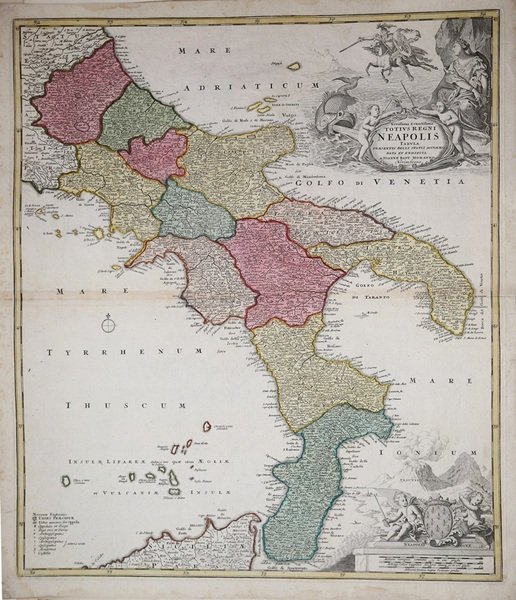
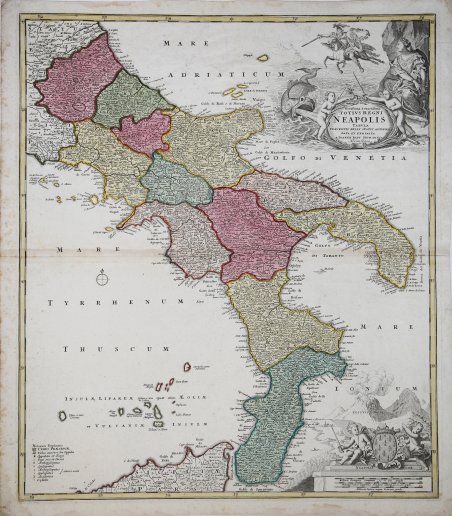
Novissima & exactissima Totius Regni Neapolis tabula praesentis belli statui accomodata et exhibita a Ioanne Bapt. Homanno
Formas de Pago
- PayPal
- Tarjeta de crédito
- Transferencia Bancaria
- Pubblica amministrazione
- Carta del Docente
Detalles
- Año de publicación
- 1716
- Lugar de impresión
- Norimberga
- Formato
- 495 X 568
- Grabadores
- HOMANN Johann Baptist
Descripción
Splendida mappa del Regno di Napoli pubblicata da J. B. Homann, secondo il suo stile cartografico caratterizzato dall'accuratezza e ricchezza dei dettagli. Il grande cartiglio con titolo cartiglio raffigura un feroce mostro marino in procinto di divorare una fanciulla, in aiuto della quale arriva, dall'alto, un cavaliere in sella a Pegaso.La scala delle distanze è decorata da una seconda grande vignetta dispone di una scena che mostra sullo sfondo il Vesuvio in eruzione e, in primo piano, lo stemma reale del Regno di Napoli fiancheggiato da putti. Johann Baptist Homann è stato un geografo e cartografo tedesco; nel 1702 fondò la sua casa editrice. Homann acquisì fama come uno dei principali cartografi tedeschi, e nel 1715 fu nominato geografo imperiale dall'imperatore Carlo VI. Nello stesso anno fu anche nominato membro dell'Accademia Prussiana delle Scienze a Berlino. Nel 1716 Homann pubblicò il suo capolavoro Grosser Atlas ueber die ganze Welt. Numerose mappe furono redatte in collaborazione con l'incisore Christoph Weigel. Homann morì a Norimberga nel 1724. Gli successe suo figlio Johann Christoph (1703-1730). L'azienda continuò dopo la sua morte come azienda degli eredi Homann, gestita da Johann Michael Franz e Johann Georg Ebersberger. Dopo successivi cambiamenti nella gestione, l'azienda si sciolse nel 1852. ' Incisione su rame, coloritura coeva, in ottimo stato di conservazione. This handsome map of southern Italy is a fine example of Homann's cartographic style with incredible detail throughout the countryside and large graphic cartouches. The title cartouche features a ferocious sea monster about to devour a stranded maiden with a knight riding Pegasus across the sky to her salvation. The distance scale features a scene showing an erupting Mount Vesuvius, putti and the royal coat of arms of the Kingdom of Naples. Johann Baptist Homann was a German geographer and cartographer; in 1702 he founded his own publishing house. Homann acquired renown as a leading German cartographer, and in 1715 was appointed Imperial Geographer by Emperor Charles VI. In the same year he was also named a member of the Prussian Academy of Sciences in Berlin. In 1716 Homann published his masterpiece Grosser Atlas ueber die ganze Welt; numerous maps were drawn up in cooperation with the engraver Christoph Weigel the Elder. Homann died in Nuremberg in 1724 and was succeeded by his son Johann Christoph (1703-1730). The company carried on upon his death as Homann heirs company, managed by Johann Michael Franz and Johann Georg Ebersberger. After subsequent changes in management the company folded in 1852. ' Copper engraving, original hand colours, in excellent condition. Cfr.
