Nudo femminile seduto
Nudo femminile seduto | Grabados | Bonnet Louis Marin
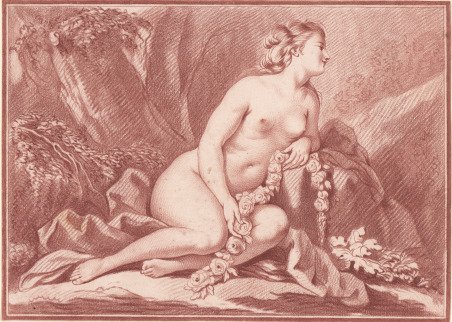
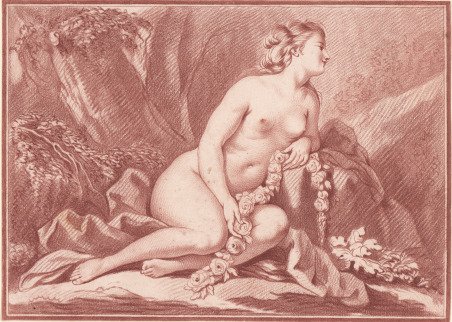
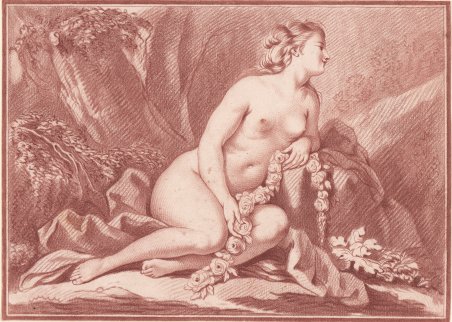
Nudo femminile seduto
Nudo femminile seduto | Grabados | Bonnet Louis Marin
Formas de Pago
- PayPal
- Tarjeta de crédito
- Transferencia Bancaria
- Pubblica amministrazione
- Carta del Docente
Detalles
- Año de publicación
- 1770
- Formato
- 310 X 224
- Grabadores
- Bonnet Louis Marin
Descripción
Figura femminile seduta, seminuda; testa rivolta a destra, braccio destro teso. Stampa alla maniere de crayon, impressa ad inchiostro rosso, 1770 circa, da Francois Boucher. Bellissima impressione, stampata su carta vergata coeva, rifilata al rame, ottimo stato di conservazione. Louis-Marin Bonnet è stato un incisore, pittore ed editore francese di stampe associate allo stile rococò. Sviluppò la maniera del pastello, un processo di incisione che utilizzava il lavaggio e la matita, di cui migliorò la tecnica fino a sviluppare una vera imitazione del pastello. A dimostrazione del suo talento e del suo know-how, nel 1769 incise una Tête de Flore di Boucher, per la cui stampa furono necessarie otto matrici. Il risultato imitava alla perfezione il pastello originale. Per far riconoscere l'interesse della sua invenzione, Bonnet realizzò un piccolo trattato intitolato Le Pastel en Gravure, in cui il processo di stampa viene scomposto, lastra per lastra, il tutto corredato da commenti manoscritti dell'autore. Il suo brillante procedimento a pastello era tuttavia molto costoso da utilizzare e relativamente fragile (le lastre incise si consumavano molto rapidamente), il che indusse Bonnet a semplificare il processo. Le sue incisioni successive utilizzarono un numero minore di lastre, con risultati ovviamente meno raffinati. Fu allievo di Jean-Charles François e Demarteau e compose centinaia di disegni e incisioni, oggi catalogati e presenti in collezioni pubbliche. Frequentò François Boucher, Lagrenée, Huet e Le Prince, dei quali riprodusse diverse opere. La sua bottega (vendita di disegni e stampe) si trovava intorno al 1772 a Parigi, all'angolo tra rue Saint-Jacques e rue de la Parcheminerie, al secondo piano. Aveva anche un indirizzo in rue Galande (1767-1772). Il catalogo della sua collezione, pubblicato da lui stesso nel 1780, contiene 1054 numeri, ma non tutti i pezzi sono opera sua, essendo la maggior parte di essi stati realizzati sotto la sua direzione nella sua bottega. Sono contrassegnati dalla dicitura Bonnet direxit. Si firmava Bonnet, o talvolta Marin, o Tennob. Bibliografia Jacques Hérold Louis-Marin Bonnet (1756-1793). Catalogue de l'Oeuvre Gravé. Paris, 1935; Jean-Richard 1978, L'Oeuvre gravé de François Boucher dans la collection Edmond de Rothschild; Margaret Morgan Grasselli Colorful impressions: the printmaking revolution in eighteenth-century France. Washington D.C., 2003. Seated female figure, semi naked; head turned to right, right arm outstretched. Crayon manner printed in red, 1770 circa, after Francois Boucher. A fine impression, printed on contemporary laid paper, trimmed to the platemark, very good condition. Louis-Marin Bonnet was a French engraver, painter and publisher of prints attached to the Rococo style. He developed the manner of pastel, a process of engraving derived from the manner of pencil. As a demonstration of his talent and know-how, in 1769 he engraved a Tête de Flore after Boucher, which required eight matrices to print. The result imitates to perfection a real pastel. In order to have the interest of his invention recognized, Bonnet produces a small treatise entitled Le Pastel en Gravure, invented and executed by Louis Bonnet where the printing process is broken down, plate by plate, all accompanied by handwritten comments by the author. His brilliant pastel process was nevertheless very expensive to implement and relatively fragile (the engraved plates wore out very quickly), which led Bonnet to simplify the process. His later engravings use fewer plates, with obviously less fine results. He was a pupil of Jean-Charles François and Demarteau and composed hundreds of drawings and engravings, now catalogued and present in public collections. He frequented François Boucher, Lagrenée, Huet and Le Prince whose works he reproduced. His workshop (sale of drawings and prints) was located around 1772 in Paris at the corner of the rue Saint-Jacques and the rue de la Parcheminerie, on the second floor. He also had an address on rue Galande (1767-1772). The catalog of his collection, published by him in 1780, counts 1054 numbers, but all the pieces are not of his hand, the majority having been carried out under his direction within his workshop. These are marked Bonnet direxit. He signed either Bonnet, or sometimes Marin, or Tennob. Bibliographic references Jacques Hérold Louis-Marin Bonnet (1756-1793). Catalogue de l'Oeuvre Gravé. Paris, 1935; Jean-Richard 1978, L'Oeuvre gravé de François Boucher dans la collection Edmond de Rothschild; Margaret Morgan Grasselli Colorful impressions: the printmaking revolution in eighteenth-century France. Washington D.C., 2003. Cfr.