Onori resi a Psiche
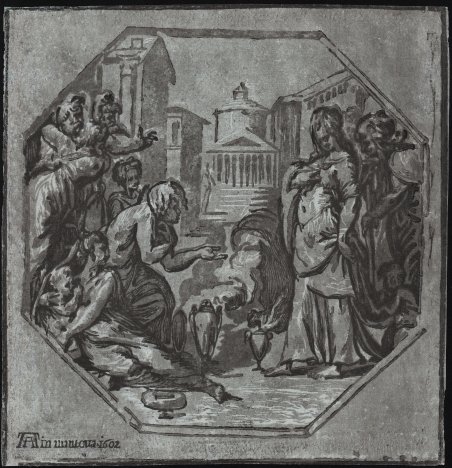
Onori resi a Psiche
Formas de Pago
- PayPal
- Tarjeta de crédito
- Transferencia Bancaria
- Pubblica amministrazione
- Carta del Docente
Detalles
- Año de publicación
- 1540
- Formato
- 260 X 270
- Grabadores
- ROSSIGLIANI detto "Il Vicentino" Niccolò
Descripción
Chiaroscuro a tre legni, circa 1540. Esemplare nel secondo stato, con il monogramma e l’indirizzo dell’editore Andrea Andreani e la data, aggiunti in basso a destra AA in mantova 1602. Ottima impressione, stampata con tono su carta coeva di colore azzurro, piccolo restauro perfettamente eseguito agli angoli di sinistra, leggerissime abrasioni visibili al verso, per il resto in ottime condizioni. La composizione deriva da una decorazione per il soffitto di Palazzo Grimani a Venezia, oggi perduta, realizzata da Francesco Salviati nel 1539. Bartsch e molti studiosi successivi attribuirono la stampa ad Antonio da Trento, ma Passavant, seguendo l'opinione di Mariette, la assegnò correttamente a Niccolò Rossigliani detto il Vicentino. Più recentemente, anche S. Boorsch attribuisce quest’opera al Vicentino, venendo seguita da Naoko Takahatake ('The chiaroscuro woodcut in Renaissance Italy', Los Angeles 2018, cat. 62-63), che concorda con l'attribuzione al Vicentino: “Poco dopo il suo arrivo a Venezia nell'estate del 1539, Francesco Salviati (1510-1563) era al lavoro su Onori resi a Psiche, un dipinto ottagonale commissionato per ornare un soffitto nel palazzo di Giovanni Grimani a Santa Maria Formosa. Il palazzo ospitava un’importante collezione di antichità ed era decorato con temi antichi, tra cui l'attuale soggetto delle Metamorfosi di Apuleio raffigurante la bella principessa Psiche ammirata dai suoi cittadini. Prima grande opera del Salviati in città, il dipinto - ritenuto perduto nell'Ottocento, fino alla sua recente riscoperta - ricevette il superlativo plauso del suo caro amico e conterraneo toscano Giorgio Vasari, che lo descrisse come "l'opera più bella del pittura che c'è in tutta Venezia". La stampa si discosta dal dipinto in numerosi dettagli: la posizione di Psiche e la posizione della sua mano destra sono modificate; la figura dietro di lei è tagliata meno strettamente e tiene un bastone assente nel dipinto; e l'elaborato prospetto urbano della stampa sostituisce il tempietto isolato (piccola struttura rotonda del tempio) e suggestioni di antiche rovine. Le differenze tra la stampa e il dipinto finito possono indicare che l’intagliatore ha lavorato da un disegno preliminare di qualche tipo. Come ha rivelato lo studio del dipinto di Andrea De Marchi, Salviati ha apportato modifiche al progetto nel corso della sua esecuzione. Sebbene Salviati non abbia sviluppato una collaborazione duratura con nessun singolo incisore, ha dimostrato interesse a far diffondere i suoi progetti sotto forma di stampe per tutta la sua carriera. Vasari ricorda come il Salviati avesse lasciato dei disegni a Bologna da incidere a Girolamo Fagiuoli, poco prima del suo arrivo a Venezia. Mentre molte stampe dopo Salviati sono sia non firmate né datate, alcune di esse possono essere datate al 1540, tra cui questa Onori resi a Psiche. Pierre Jean Mariette ha correttamente identificato la stampa non firmata come opera di Niccolò Vicentino. Alcuni scrittori successivi, tra cui il Bartsch, hanno attribuito, invece, l’intaglio ad Antonio da Trento. Tuttavia, nella suddivisione del disegno su tre blocchi, Onori resi a Psyche ricorda molto il Cristo risana i lebbrosi firmato dal Vicentino. In entrambe le stampe, il blocco centrale rende schematicamente l'architettura sullo sfondo, mentre il blocco scuro rafforza i contorni e le ombre in primo piano per trasmettere una prospettiva atmosferica. Anche il carattere del taglio è simile, con contorni fluidi e lunghe linee parallele leggermente ondulate di ombreggiatura profonda. Inoltre, la delineazione delle alte luci sul piano terra trova uno stretto parallelo nella Morte di Aiace, sempre firmata” (cf. N. Takahatake, 'The chiaroscuro woodcut in Renaissance Italy', p. 161). Bibliografia Bartsch XII.125.26 (Antonio da Trento); Le Blanc II. 218.8 ; Passavant VI.222.26; Davis, Mannerist Prints, no. 53 (Niccolò Vicentino); Matile 2003, n. 70 (Niccolò Vicentino); . Chiaroscuro woodcut from three blocks, circa 1540. Example in the second state of two, inscribed with publisher's address and date lower left 'AA in mantoua. 1602'. A very good impression, printed with tone on contemporary blue paper, small restoration perfectly carried out in the lower and upper left corners, very light abrasions visible on verso, otherwise in excellent condition. The composition derives from Francesco Salviati's ceiling decoration of 1539 in the Palazzo Grimani near Santa Maria Formosa, Venice. Bartsch and many later writers attributed the print to Antonio da Trento, but Passavant, following Mariette's opinion, correctly assigned it to Niccolò Rossigliani called Vicentino. Also S. Boorsch attributes this work to Vicentino; Naoko Takahatake ('The chiaroscuro woodcut in Renaissance Italy', Los Angeles 2018, ' cats. 62-63), agrees with the attribution to Vicentino: “Shortly after his arrival in Venice in the summer of 1539, Francesco Salviati (1510-1563) was at work on Honors Rendered to Psyche, an octagonal painting commissioned to adorn a ceiling in Giovanni Grimani's palazzo at Santa Maria Formosa. The palazzo housed an important collection of antiquities and was decorated with ancient themes, including the present subject from Apuleius's Metamorphoses depicting the beautiful princess Psyche admired by her citizens. Salviati's first major work in the city, the painting-thought to have been lost in the nineteenth century, until its recent rediscovery-received the superlative praise of his close friend and fellow Tuscan Giorgio Vasari, who described it as “the most beautiful work of painting that there is in all Venice”. The print departs from the painting in a number of details: Psyche's stance and the position of her right hand are modified; the figure behind her is less tightly cropped and holds a stick absent in the painting; and the print's elaborate urban prospect replaces the isolated tempietto (small, round temple structure) and suggestions of ancient ruins. The differences between the print and finished painting may indicate that the blockcutter worked from a preliminary drawing of some kind. As Andrea De Marchi's study of the painting has revealed, Salviati made changes to the design in the course of its execution. Although Salviati did not develop a lasting partnership with any single printmaker, he demonstrated an interest in having his designs disseminated in the form of prints throughout his career. Vasari records how Salviati had left drawings in Bologna to be engraved by Girolamo Fagiuoli, just prior to his arrival in Venice. While many prints after Salviati are both unsigned and undated, a number of them can be dated to the 1540s, including Honors Rendered to Psyche. Pierre Jean Mariette correctly identified the unsigned print as the work of Niccolò Vicentino after Salviati. Some later writers, including Bartsch, have attributed the cutting to Antonio da Trento. However, in its partitioning of the design over three blocks, Honors Rendered to Pryche strongly resembles Vicentino's signed Christ Healing the Lepers. In both prints, the mid-block schematically renders architecture in the background, while the dark block reinforces outlines and shadows in the foreground to convey atmospheric perspective. The character of the cutting is also similar, with flowing contours and long, slightly wavering parallel lines of deep shading. Moreover, the delineation of highlights on the ground plane finds a close parallel in the signed Death of Ajax (B.XII.99.9)” (cf. N. Takahatake, 'The chiaroscuro woodcut in Renaissance Italy', p. 161). Bibliografia Bartsch XII.125.26 (Antonio da Trento); Le Blanc II. 218.8 ; Passavant VI.222.26; Davis, Mannerist Prints, no. 53 (Niccolò Vicentino); Matile 2003, n. 70 (Niccolò Vicentino); Gnann 2013, nn. 102-103 (Niccolò Vicentino); Naoko Takahatake, The chiaroscuro woodcut in Renaissance Italy, 2018, cat. 62-63. ' Cfr.
