Padua
Padua | Grabados | PROBST Georg Balthasar
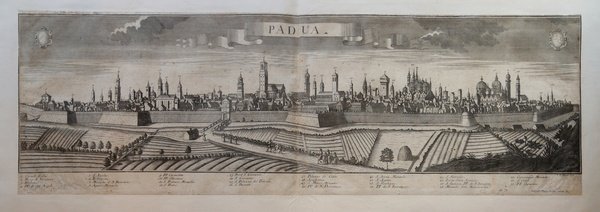
Padua
Padua | Grabados | PROBST Georg Balthasar
Formas de Pago
- PayPal
- Tarjeta de crédito
- Transferencia Bancaria
- Pubblica amministrazione
- Carta del Docente
Detalles
- Año de publicación
- 1735
- Lugar de impresión
- Augsburg
- Formato
- 325 X 990
- Grabadores
- PROBST Georg Balthasar
- Idiomas
- Italiano
Descripción
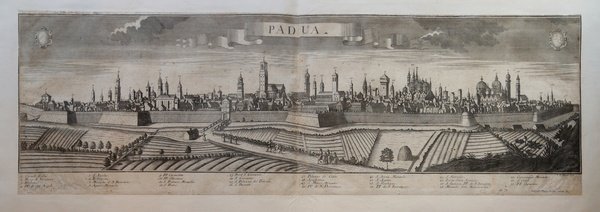
Spettacolare veduta panoramica di Padova progettata da Friedrich Bernhard Werner ' (1690-1776) e stampata dalla tipografia di Georg Balthasar Probst (1643-1748) ad Augsburg. Esemplare del primo stato di due, con l’imprint di Georg Balthasar Probst, non descritto da Ghironi Padova – Piante e vedute (1449 – 1865), che data la stampa al 1735 circa. Il secondo stato della veduta di Padova vede l’imprint di Johann Friedrich Probst (1719-1781). “Ricavata da un disegno di Friedrich Bernhard Werner, l'incisione, appartenente ad una serie di oltre 100 vedute, forse 137, che i Probst stamparono durante la loro attività editoriale (Thieme, Becker, XXVII, 411), è una rappresentazione assai pregevole della città, che verrà ampiamente ripresa dalla cartografia edita, soprattutto ad Augusta, nel corso del XVIII secolo. Tra le caratteristiche di questa panoramica si rileva l'esasperato verticalismo dei più cospicui edifici cittadini, voluto nell'intenzione di offrire un'immagine il più possibile completa e chiara di ciascuno di essi. Oltre a questo fatto, è da evidenziare da un lato il carattere goticheggiante conferito a molti edifici e dall'altro che il n. 15 nell'elenco dei toponimi è riferito erroneamente al palazzo del Podestà, anziché alla torre dell'Orologio, e che il successivo n. 16 individua il Duomo ancora privo della sua cupola che sarà costruita solo nel 1754 (Cessi, Gaudenzio, 1958, 96, n. 71). Relativamente alla datazione, è da dire che, se colorati, i due stemmi delineati nella carta avrebbero potuto offrire precisi indizi per fissare l'epoca di incisione del rame. Nell'esemplare esaminato le due armi gentilizie descrivono semplicemente i contorni delle figure araldiche e non presentano le normali grafie per l'identificazione dei vari smalti. Pur con queste lacune, è possibile ipotizzare che in alto a destra si trovi lo stemma «d'azzurro con banda ondata d'oro» dei Soranzo, mentre nell'angolo opposto vi sia quello «partito d'argento e di nero, con scaglione de' colori opposti» dei Renier (cfr. Freschot, 1707, 213, 405). Se la congettura fosse confermata da una copia colorata coeva, le due insegne nobiliari potrebbero collegarsi ai nomi di Giacomo Soranzo e Paolo Renier, rispettivamente podestà e capitano di Padova del 1735. Di conseguenza, la data dell'incisione del rame, perchè dedicato a questi due governatori della città, cadrebbe attorno all'epoca della loro presenza in Padova. Originario della Slesia, il pittore, incisore e cronista Friedrich Bernhard Werner (Reichenan, 1680 Breslau, 1778) viaggio a lungo in Europa realizzando un notevole numero di vedute di città, le quali, una volta incise, furono stampate e diffuse tanto in fogli quanto in raccolte. Nel 1730 soggiornò in Italia (precisamente a Mantova, Bologna, Roma, Napoli, in Sicilia e, probabilmente, anche nel Veneto) per formare la sua serie di vedute italiane. Di queste un blocco è sicuramente originale, mentre il restante è il risultato di rielaborazioni di precedenti disegni di vari autori (Thieme, Becker, XXXV, 406). Ritornato in Germania, il Werner passò i suoi disegni a Georg Balthasar Probst (Augusta, 1673 ivi, 1748), il quale, dopo aver ereditato la ditta dal suocero, Jeremias Wolf (Augusta, 1663 o 1673 ivi, 1724), aveva in quel periodo interesse ad assicurarsi le migliori opere circolanti ad Augusta per migliorare il livello qualitativo della sua produzione (Thieme, Becker, XXXVI, 206). Scomparso Georg Balthasar, l'attività editoriale di questa casa continuò sotto la direzione di Johann Friedrich Probst (1719-1781), di cui però non è noto, supposto che vi fosse, il nesso di parentela (Thie- me. Becker, XXVII, 411). L'excudit rilevabile nella veduta di Padova indica che la sua tiratura avvenne per l'appunto negli anni in cui la ditta fu diretta da Johann Friedrich, quindi successivamente al 1748; fatto, questo, che però nulla toglie all'ipotesi di una elaborazione della lastra attorno al 1735” (cfr. Padova . Spectacular panoramic view of Padua designed by Friedrich Bernhard Werner (1690-1776) and printed by Georg Balthasar Probst's (1643-1748), print seller in Augsburg. Example of the first state of two, with the imprint of Georg Balthasar Probst, not described by Ghironi Padova – Piante e vedute (1449 – 1865), which dates the printing to about 1735. The second state of the view of Padua sees an imprint by Johann Friedrich Probst (1719-1781). "Derived from a drawing by Friedrich Bernhard Werner, the engraving, belonging to a series of more than 100 views, perhaps 137, that the Probsts printed during their publishing activity (Thieme, Becker, XXVII, 411), is a very fine depiction of the city, which would be widely taken up by cartography published, especially in Augsburg, during the 18th century. Among the features of this overview is the exaggerated verticalism of the most conspicuous city buildings, intended with the intention of providing as complete and clear an image of each of them as possible. In addition to this fact, it should be pointed out, on the one hand, the Gothic character given to many of the buildings and, on the other hand, that No. 15 in the list of place names refers erroneously to the Palazzo del Podestà, rather than to the Clock Tower, and that the subsequent No. 16 identifies the Duomo still lacking its dome, which would not be built until 1754 (Cessi, Gaudentius, 1958, 96, no. 71). Relative to dating, it must be said that, if colored, the two coats of arms outlined in the map could have offered precise clues to fix the time of copperplate engraving. In the example examined, the two coats of arms simply describe the outlines of the heraldic figures and do not have the normal spellings for identifying the various enamels. Even with these gaps, it is possible to conjecture that in the upper right corner is the coat of arms "azure with wavy band of gold" of the Soranzo family, while in the opposite corner is that "party of silver and black, with scagliione of opposite colors" of the Renier family (cf. Freschot, 1707, 213, 405). If the conjecture were confirmed by a coeval colored copy, the two noble insignia could link to the names of Giacomo Soranzo and Paolo Renier, podestà and captain of Padua in 1735, respectively. Consequently, the date of the copperplate engraving, because it is dedicated to these two governors of the city, would fall around the time of their presence in Padua. A native of Silesia, the painter, engraver and chronicler Friedrich Bernhard Werner (Reichenan, 1680 Breslau, 1778) traveled extensively in Europe producing a considerable number of views of cities, which, once engraved, were printed and circulated in sheets as well as in collections. In 1730 he sojourned in Italy (specifically in Mantua, Bologna, Rome, Naples, Sicily, and probably Veneto) to form his series of Italian views. Of these one block is definitely original, while the remainder are the result of reworkings of earlier drawings by various authors (Thieme, Becker, XXXV, 406). Returning to Germany, Werner passed his drawings on to Georg Balthasar Probst (Augsburg, 1673 ivi, 1748), who, having inherited the firm from his father-in-law, Jeremias Wolf (Augsburg, 1663 or 1673 ivi, 1724), had at that time an interest in securing the best works circulating in Augsburg in order to improve the quality level of his production (Thieme, Becker, XXXVI, 206). After Georg Balthasar's demise, the publishing activity of this house continued under the direction of Johann Friedrich Probst (1719-1781), whose kinship, however, assuming there was one, is not known (Thie- me. Becker, XXVII, 411). The excudit detectable in the view of Padua indicates that its printing took place precisely in the years in which the firm was directed by Johann Friedrich, thus after 1748; a fact, however, that does not detract from the hypothesis of an elaboration of the plate around 1735" (cf. Padova – Piante e vedute (1449 – 1865), no. 67). Cop. Cfr.