Porto di Claudio a Ostia
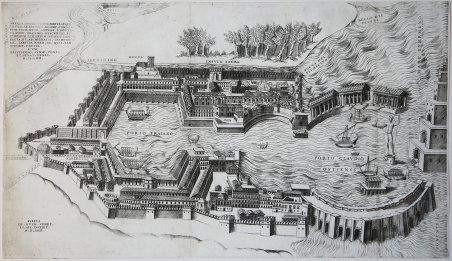
Porto di Claudio a Ostia
Formas de Pago
- PayPal
- Tarjeta de crédito
- Transferencia Bancaria
- Pubblica amministrazione
- Carta del Docente
Detalles
- Año de publicación
- 1554
- Formato
- 705 X 400
- Grabadores
- TRAMEZINO o TRAMEZINI Francesco & Michele
Descripción
Bulino, 1554, inciso da Giulio de Musi per l'editore Michele Tramezino.Esemplare nel primo stato di cinque descritto in Bifolco-Ronca (2018) - primo di tre per Alessia Alberti - con la data originaria del 1554, che viene successivamente cambiata in 1558.Come diverse altre opere pubblicate dalla tipografia di Francesco e Michele Tramezino, la lastra venne acquistata da Antonio Lafreri, che la inserisce nel suo "Speculum Romanae Magnificentiae" (cfr. Alberti n. A 113, Speculum di Padova BC (I. 3282, tav. 32).Iscritto firmato e datato in alto a sinistra: « ANTIQVA SPECIES VRBIVM PORTVS ATQVE / OSTIÆ(*) AB DIVERSIS RO[MANIS] IMP[ERATORIBVS] CONDITA/RVM ITEM DVOR[VM] AMPLISS[IMORVM] PORTVVM / CLAVDII TRAIANIQ[VE] DESCRIPTIO PER PYRRHVM LIGORIVM NEAPOLITANVM / FACTA ET AB MICHAELE TRAMEZINO EX TABVLIS AENEIS IN QVAS EAM INCIDIT EXCVS[S]A / CVM / PRIVILEGIO SVMMI PONT[IFICIS] ET SENAT[VS] VENET[I] MDLIIII » [Immagine delle città di Porto e di Ostia fondate da diversi imperatori romani, e raffigurazione dei due amplissimi porti di Claudio e di Traiano, fatta da Pirro Ligorio, di Napoli, e da Michele Tramezzino stampate da lastre di bronzo su cui egli le incise - Con privilegio del Sommo Pontefice e del Senato di Venezia nel 1554.]Si tratta di una ricostruzione storica ad opera dell’archeologo Pirro Ligorio, che raffigura il porto voluto dall’imperatore Claudio, poi ampliato da Traiano. I lavori iniziarono tra il 42 ed il 46, e fu realizzato un porto aperto a ponente, protetto da due moli. Tuttavia, i continui insabbiamenti che subiva, indussero a ulteriori lavori che portarono alla costruzione di un ulteriore bacino interno, ad oriente, terminato sotto l’imperatore Traiano nell’anno 103. L’opera, sebbene a carattere topografico, rientra nel filone delle antichità romane, finalizzate a far conoscere al grande pubblico la maestosità delle architetture romane. Si tratta del prototipo delle piante sul porto di Ostia, sebbene alcuni studiosi (cfr. Marigliani p. 86) sostengano che la prima opera a stampa si deve ad Antonio Labacco nel 1552. Tuttavia, il Libro d’Antonio Labacco appartenente a l’architettura nel qual si figurano alcune notabili antiquita di Roma, che contiene una pianta del porto di Ostia, non viene stampato prima del 1559. Il Ligorio fu direttamente coinvolto nel rilievo e nel disegno dell’antico porto di Ostia; è conosciuto un manoscritto ad inchiostro, a lui attribuito (mm 700x1150), conservato all’Istituto Nazionale d’Archeologia e Storia dell’Arte di Roma (Lugli, fig. 1). Una seconda stesura dell’opera viene edita nel 1558. La lastra può essere identificata con quella presente nel catalogo di Antonio Lafreri, in cui confluirono molte opere del Tramezzino, elencata tra le Città & Fortezze come “Porto d’Hostia” (numero 136). Attraverso un percorso editoriale che non siamo riusciti a ricostruire, fu acquistata da Giovan Battista de Rossi, autore di una ristampa che conserva la data 1558. Dalla tipografia de Rossi fu pubblicata una successiva stesura, con data 1691 (Lugli 1947). L’ultima edizione della lastra fu curata, due secoli dopo, da Carlo Losi (cfr. Bifolco-Ronca, 2018, tav. 1164). Lo ' Speculum ' ebbe origine nelle attività editoriali di Antonio Salamanca e Antonio Lafreri (Lafrery). Durante la loro carriera editoriale romana, i due editori - che hanno lavorato insieme tra il 1553 e il 1563 - hanno avviato la produzione di stampe di architettura, statuaria e vedutistica della città legate alla Roma antica e moderna. Le stampe potevano essere acquistate individualmente da turisti e collezionisti, ma venivano anche acquistate in gruppi più grandi che erano spesso legati insieme in un album. Nel 1573, Lafreri commissionò a questo scopo un frontespizio, dove compare per la prima volta il titolo Speculum Romanae Magnificentiae. Alla morte di Lafreri, due terzi delle lastre di rame esistenti andarono alla famiglia Duchetti (Claudio e Stefano), mentre un altro terzo fu dis. Engraving, 1554, by Giulio de Musi for the publisher Michele Tramezino.Example of the first state of five described in Bifolco-Ronca (2018) - first of three for Alessia Alberti - with the original date of 1554, which is later changed to 1558.Like several other works published by the typography of Francesco and Michele Tramezino, the plate was purchased by Antonio Lafreri, who included it in his "Speculum Romanae Magnificentiae" (see Alberti n. A 113, Speculum of Padua BC (I. 3282, table 32).Inscribed signed and dated at the top left: "ANTIQVA SPECIES VRBIVM PORTVS ATQVE / OSTIÆ AB DIVERSIS RO[MANIS] IMP[ERATORIBVS] CONDITARVM ITEM DVOR[VM] AMPLISS[IMORVM] PORTVVM CLAVDII TRAIANIQ[VE] DESCRIPTIO PER PYRRHVM LIGORIVM NEAPOLITANVM FACTA ET AB MICHAELE TRAMEZINO EX TABVLIS AENEIS IN QVAS EAM INCIDIT EXCVS[S]A CVM / PRIVILEGIO SVMMI PONT[IFICIS] ET SENAT[VS] VENET[I] MDLIIII ".It is a historical reconstruction by the archaeologist Pirro Ligorio, which depicts the port wanted by Emperor Claudius, later enlarged by Trajan. The work began between 42 and 46, and it was made an open port to the west, protected by two piers. However, the continuous silting up that it underwent, led to further works that led to the construction of a further inner basin, to the east, finished under the Emperor Trajan in the year 103. The work, although topographic, is part of the Roman antiquities, aimed at making known to the general public the majesty of Roman architecture. It is the prototype of the plans on the port of Ostia, although some scholars (cf. Marigliani p. 86) claim that the first printed work is due to Antonio Labacco in 1552. However, the Book of Antonio Labacco belonging to the architecture in which there are some notable antiquities of Rome, which contains a plan of the port of Ostia, is not printed before 1559. Ligorio was directly involved in the survey and design of the ancient port of Ostia; an ink manuscript, attributed to him (mm 700x1150), preserved at the National Institute of Archaeology and Art History of Rome (Lugli, fig. 1) is known. A second draft of the work was published in 1558. The plate can be identified with the one in Antonio Lafreri's catalog, in which many works by Tramezzino, listed among the Cities & Fortresses as "Porto d'Hostia" (number 136). Through an editorial path that we have not been able to reconstruct, it was purchased by Giovan Battista de Rossi, author of a reprint that preserves the date 1558. A subsequent draft was published by de Rossi's printing house, dated 1691 (July 1947). The last edition of the plate was edited, two centuries later, by Carlo Losi (see Bifolco-Ronca, 2018, tav. 1164). The work belongs to the Speculum Romanae Magnificentiae, the earliest iconography of ancient Rome. ' The Speculum originated in the publishing activities of Antonio Salamanca and Antonio Lafreri (Lafrery). During their Roman publishing careers, the two editors-who worked together between 1553 and 1563-started the production of prints of architecture, statuary, and city views related to ancient and modern Rome. The prints could be purchased individually by tourists and collectors, but they were also purchased in larger groups that were often bound together in an album. In 1573, Lafreri commissioned a frontispiece for this purpose, where the title Speculum Romanae Magnificentiae appears for the first time. Upon Lafreri's death, two-thirds of the existing copperplates went to the Duchetti family (Claudio and Stefano), while another third was distributed among several publishers. Claudio Duchetti continued the publishing activity, implementing the Speculum plates with copies of those "lost" in the hereditary division, which he had engraved by the Milanese Amborgio Brambilla. Upon Claudio's death (1585) the plates were sold - after a brief period of publication by the heirs, particularly in the figure of Giacomo Gherardi - to Giovanni Orlandi, who in 1614 sold his printing house to the Flemish publisher Hendr. Cfr.
