Réveil (Allegoria della Gloria)
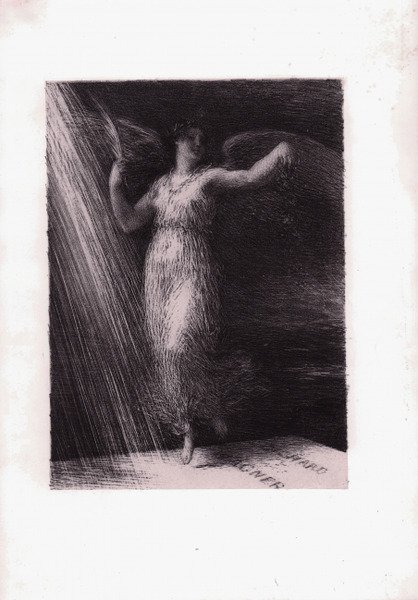
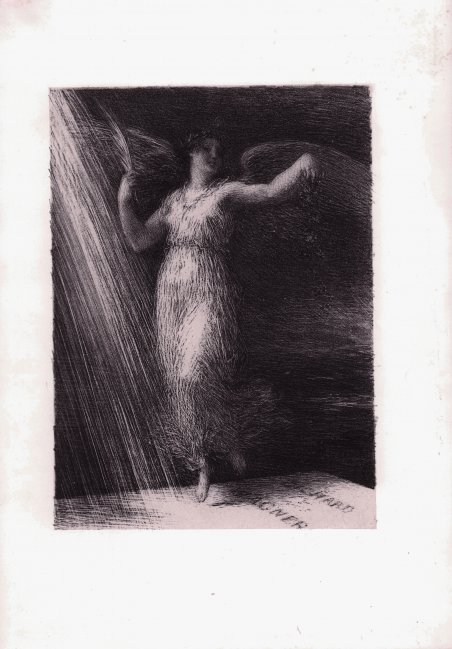
Réveil (Allegoria della Gloria)
Formas de Pago
- PayPal
- Tarjeta de crédito
- Transferencia Bancaria
- Pubblica amministrazione
- Carta del Docente
Detalles
- Año de publicación
- 1886
- Formato
- 150 X 210
- Grabadores
- FANTIN-LATOUR Henri
Descripción
Litografia, 1886. Illustrazione finale per la pagina 328 della serie di 14 litografie per l’opera di Adolphe Julliens (1803-1879) ‘Richard Wagner: Sa Vie et ses Oeuvres’, pubblicato a Parigi nel 1886 da Libraire de L'Art e stampato da Lemercier et Cie (fl.1827-1899) La scena raffigura la Gloria, personificata da una figura femminile alata che porta una foglia di palma, sparge fiori sulla tomba di Wagner. Henri Fantin Latour (Grenoble 1836 - Buré, Orne, 1906) fu per qualche tempo, a Parigi, nello studio di G. Courbet; ma soprattutto si formò copiando al Louvre i maestri dei secc. 16º e 17º. Ammirò Manet e gli impressionisti, ma non fece mai parte del loro gruppo. Fu amico di J. Whistler, del quale condivise lo spirito di fine psicologismo che pervade le sue opere. Tra i suoi dipinti più noti, conservati al museo d'Orsay a Parigi: Omaggio a Delacroix (1864), Studio a Batignolles (1870), Angolo di tavola (1872), Intorno al pianoforte (1885), ritratti di gruppo di pittori, poeti, musicisti, in cui, come nei numerosi ritratti individuali, la personalità del modello è interpretata con profonda intimità. Una sensibile osservazione della realtà si ritrova anche nelle nature morte, mentre un mondo irreale traspare da alcuni dipinti (La notte, 1897, Parigi, museo d'Orsay) e in numerose litografie ispirate dalla sua passione per la musica di Schumann, Wagner e Berlioz. Bibliografia Hédiard, Fantin-Latour: Catalogue de l'oeuvre lithographie du Maître 74; Fantin-Latour 1911 - Catalogue de l'Oeuvre Complet de Fantin-Latour 1291. Lithograph, 1886. Final plate illustration ' for ' page 328 in the series of 14 lithographs in ' Adolphe Julliens’ (1803–1879) Richard Wagner: Sa Vie et ses Oeuvres, published in 1886 Paris by Libraire de L’Art and printed by ' Lemercier et Cie ' (fl.1827–1899) in Paris. Glory, personified by a winged female figure carrying a palm leaf, scatters flowers on Wagner's tomb. Henri Fantin Latour (1836 – 1904) As a master of still-life painting, Henri Fantin-Latour is celebrated for his exquisitely detailed flower paintings and portraits of fellow intellectuals of the Parisian art world. Raised by a father who was an artist, Fantin-Latour began his artistic training from the early age of 10. He attended École des Beaux-Arts in Paris, where he developed his keen observation skills and dexterity by copying the works of old masters at Musée du Louvre. With the skills acquired through the time spent at the Louvre, Fantin-Latour began to create portraits. He submitted them to the Salon in 1859 only to face rejection, which led him to direct his attention to floral still-life paintings. These works were first exhibited in London at the Royal Academy in 1864 and became extremely popular. His works in the 1870s were marked by purity and simplicity of composition, whereas his still-lifes in the 1880s were constructed with a more complex and detailed arrangement. With the extraordinary eye for detail that he had developed as a portrait painter, Fantin-Latour was able to depict each flower with remarkable specificity. Despite the popularity he had gained from still-life paintings, Fantin-Latour continued to engage with portraits which eventually allowed him to establish himself in the market. Fantin-Latour gained prestige for his group portraits of fellow artists, such as Homage to Delacroix, 1864—currently in the collection of Musée d'Orsay, Paris—known for its exceptional virtuosity and swift brush strokes. The portraits highlight his relationship with other contemporaries, like Édouard Manet and James McNeill Whistler, with whom he shared artistic sensibilities. In the last years of his life, Fantin-Latour focused on lithography, producing numerous prints of imaginative and mythological subjects. With a profound understanding of the technique, he elaborated the figures with various ranges of black and white tones. He continued to expand his practice in lithography until the end of his life. Fantin-Latour died in 1904. References: Hédiard, Fantin-Latour: Catalogue de l'oeuvre lithographie du Maître 74; Fantin-Latour 1911 - Catalogue de l'Oeuvre Complet de Fantin-Latour 1291. Cfr.
