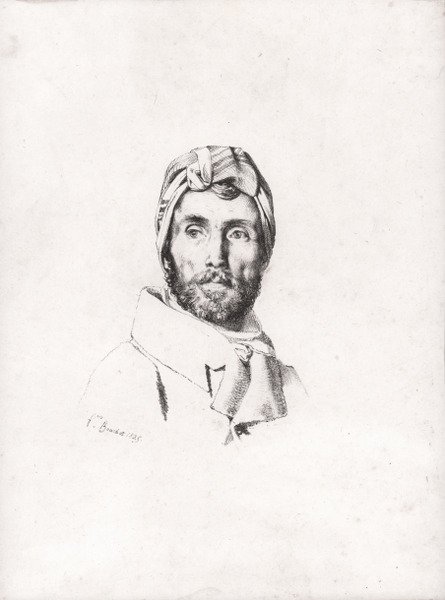
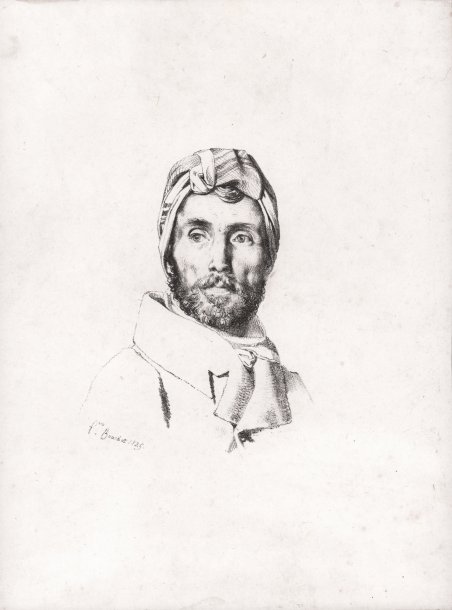
Litografia, 1825, firmata e datata in basso a sinistra. Magnifica prova, impressa su carta coeva, in perfetto stato di conservazione. Pierre-Narcisse Guérin (Parigi, 13 maggio 1774 – Roma, 6 luglio 1833) è stato un pittore francese. Dopo un viaggio in Italia iniziato nel 1797 a seguito della vittoria dell'ambito "prix de Rome", rientrò a Parigi nel 1810, dove aprì uno studio che ben presto divenne assai noto e frequentato, e dal quale uscirono i più ardenti pittori romantici: Théodore Géricault, Ary Scheffer, Léon Cogniet, Victor Orsel, Paul Huet, Eugène Delacroix, Édouard Cibot. Professore presso la Scuola di Belle arti nel 1814, membro dell'Accademia di Belle arti di Francia nel 1815, direttore dell'Accademia di Francia a Roma dal 1818 al 1828, Guérin ebbe una carriera assai brillante. François Bouchot (Parigi, 29 novembre 1800 – Parigi, 7 febbraio 1842) è stato un pittore e incisore francese. Non ebbe lunga vita, ma si distinse per i bei ritratti e i soggetti storici, in particolare quelli che riguardavano l'epopea napoleonica. Studiò disegno e tecnica d'incisione con Richomme, divenendo poi allievo favorito di Jean-Baptiste Regnault e quindi di Guillaume Lethière. Vinse il Prix de Rome nel 1823. Rientrato un anno dopo in Francia, iniziò ad esporre al Salon dalla fine del 1824, e non smise mai di esporre finché visse. Realizzò diverse opere su commissione del re Luigi Filippo, fra cui, nel 1837, La battaglia di Zurigo del 25 settembre 1799, destinata alla Galleria delle Battaglie del Castello di Versailles. Fu anche l'autore del quadro sul colpo di Stato del 18 brumaio, che rappresenta Bonaparte al Consiglio dei Cinquecento di Saint-Cloud, il 10 novembre 1799. Quest'opera è oggi esposta al Museo del Castello di Versailles. Famoso il ritratto che egli fece del celebre soprano Maria Garcia, altrimenti nota con il nome di La Malibran o Maria Malibran, mentre interpreta Desdemona nell'Otello di Rossini, nel 1834, appena due anni prima che la grande cantante morisse: la tela è conservata nel Museo della vita romantica di Parigi. Nel 1836, l'architetto Alphonse de Gisors, incaricato della sistemazione della cappella del Palazzo del Luxembourg, gli affidò gli affreschi della cappella, ma Bouchot morì prima dell'apertura del cantiere, nel 1842, all'età di 42 anni. Rara. Lithograph, 1825, signed and dated at lower left. Magnificent proof, printed on contemporary paper, in perfect condition. Pierre-Narcisse Guérin (Paris, May 13, 1774 - Rome, July 6, 1833) was a French painter. After a trip to Italy began in 1797 following the victory of the coveted "prix de Rome", returned to Paris in 1810, where he opened a studio that soon became well known and frequented, and from which came the most ardent romantic painters: Théodore Géricault, Ary Scheffer, Léon Cogniet, Victor Orsel, Paul Huet, Eugène Delacroix, Édouard Cibot. Professor at the School of Fine Arts in 1814, member of the Academy of Fine Arts of France in 1815, director of the Academy of France in Rome from 1818 to 1828, Guérin had a very brilliant career. François Bouchot (Paris, November 29, 1800 - Paris, February 7, 1842) was a French painter and engraver. He did not have a long life, but distinguished himself for the beautiful portraits and historical subjects, particularly those relating to the Napoleonic epic. He studied drawing and engraving technique with Richomme, then became a favorite pupil of Jean-Baptiste Regnault and then Guillaume Lethière. He won the Prix de Rome in 1823. Returned a year later in France, began to exhibit at the Salon from the end of 1824, and never stopped exhibiting as long as he lived. He produced several works on commission from King Louis-Philippe, including, in 1837, The Battle of Zurich on September 25, 1799, destined for the Battle Gallery of the Chateau de Versailles. He was also the author of the painting on the coup d'état of 18 Brumaire, which represents Bonaparte at the Council of Five Hundred of Saint-Cloud, on November 10, 1799. This work is now exhibited at the Museum of the Castle of Versailles. Famous is the portrait that he made of the famous soprano Maria Garcia, otherwise known as La Malibran or Maria Malibran, while playing Desdemona in Rossini's Otello, in 1834, just two years before the great singer died: the canvas is preserved in the Museum of Romantic Life in Paris. In 1836, the architect Alphonse de Gisors, in charge of the arrangement of the chapel of the Luxembourg Palace, entrusted him with the frescoes of the chapel, but Bouchot died before the opening of the site, in 1842, at the age of 42 years. Rare. Cfr.

 Descubre cómo utilizar
 Descubre cómo utilizar