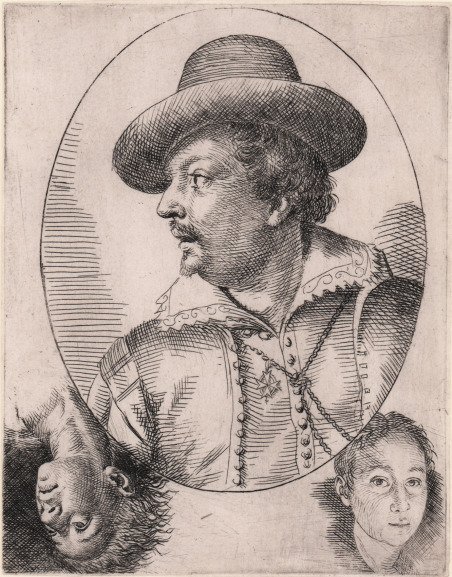
Acquaforte e bulino, 1625, ' ante litteram. ' Magnifica prova del raro primo stato di due, avanti la firma e la data, impressa su carta vergata coeva, rifilata al rame, in eccellente stato di conservazione. ' Disegnatore, pittore e stampatore, figlio del padovano Ludovico Leoni (1542–1612), un fabbricante di medaglie e di ritratti a rilievo su cera, da cui il soprannome "Padovanino". Celebre per i suoi ritratti di tutta l’aristocrazia romana degli inizi del XVII secolo, il Leoni, romano di nascita, deve il suo soprannome alla città natale del padre, anch’egli pittore di ritratti. Controversa l'identità del volto raffigurato: secondo il Mariette, grande appassionato di disegni ed incisioni del Leoni, si tratterebbe di Mario Nuzzi detto “Mario de’ Fiori”, mentre più ragionevolmente si tratta del suo amico Tommaso Salini, ipotesi confermata dalla leggenda aggiunta nella prova del secondo stato. Ai lati del ritratto principale, un curioso accostamento di due testine incise al bulino, ad avvalorare il fatto che la lastra non gli fu commissionata, ma venne realizzata in tutta libertà. Nel 1603 fu coinvolto nel celebre processo contro il Caravaggio accusato di diffamazione, insieme con altri compari, da Giovanni Baglione: secondo la deposizione proprio di Tommaso Salini Leoni sarebbe stato tra gli autori con Orazio Gentileschi di parte di quei versi infamanti; ma fu discolpato completamente dalla testimonianza del Caravaggio, il quale affermò di conoscere il Leoni solo di vista e di non avergli mai parlato. Pittore, incisore ma innanzitutto straordinario disegnatore di ritratti, immortalò su un numero sterminato di fogli di carta azzurra i volti della Roma del primo Seicento: papi, cardinali, nobiluomini e dame, ma anche scienziati, matematici, artisti e poeti. I suoi ritratti detti "alla macchia" (Baglione, p. 321), cioè tirati a memoria dopo aver visto il modello quasi di sfuggita, conquistarono un pubblico amplissimo per la straordinaria resa realistica, cui contribuì certamente l'artificio della tecnica à trois crayons (matita nera, sanguigna e gesso bianco). Bibliografia Bartsch 7 I/II; Petrucci, Il Caravaggio acquafortista, pp. 35/46. Etching and engraving, 1625, unlettered. A magnificent impression of the rare first state of two, before the letters, printed on contemporary laid paper, trimmed to the platemark, in excellent condition. Famous for his portraits of all the Roman aristocracy in the early 17th century, the Roman-born Leoni owes his nickname to the birthplace of his father, who was also a portrait painter. The identity of the face depicted is controversial: according to Mariette, a great fan of Leoni's drawings and engravings, it is Mario Nuzzi, known as "Mario de' Fiori", while it is more likely to be his friend Tommaso Salini, a hypothesis confirmed by the legend added on the examples of the second state. On either side of the main portrait is a curious juxtaposition of two engraved heads, confirming the fact that the plate was not commissioned. Ottavio Leoni was the son of the Paduan-born Ludovico Leoni (1542–1612), a maker of medals and wax relief portraits. Although Ottavio was active entirely in Rome, where his father had also worked and died, he was often known as ‘il Padovanino’ because of the family origins. In 1603 Ottavio was involved in a libel action against Caravaggio by the painter Giovanni Baglione, whose life provides the best source of information on Leoni’s life. One witness at the trial, Tommaso Salini, claimed he had received verses criticizing Baglione written by Orazio Gentileschi and ‘Ottavio Padovano’. Caravaggio testified that he knew Leoni without having ever spoken to him. The following year Leoni was admitted to the Accademia di S Luca in Rome and in 1614 became its principal. It was at this time, according to Baglione, that he painted two canvases, a Martyrdom of St Martina and an Ascension (both untraced). In 1621 Leoni became a member of the Accademia dei Virtuosi del Pantheon, the body to which he presented in 1628 an oil portrait of Gregory XV. He portrayed the faces of early 17th century Rome on an endless number of sheets of blue paper: popes, cardinals, noblemen and ladies, but also scientists, mathematicians, artists and poets. His portraits known as "alla macchia" (Baglione, p. 321), i.e. drawn from memory after having seen the model almost in passing, won a very wide public for their extraordinary realistic rendering, to which the artifice of the à trois crayons technique (black pencil, sanguine and white chalk) certainly contributed. Bibliografia Bartsch 7 I/II; Petrucci, Il Caravaggio acquafortista, pp. 35/46. Cfr.
 Descubre cómo utilizar
 Descubre cómo utilizar