Romanae urbis situs, quem hoc Christi anno 1549 habet
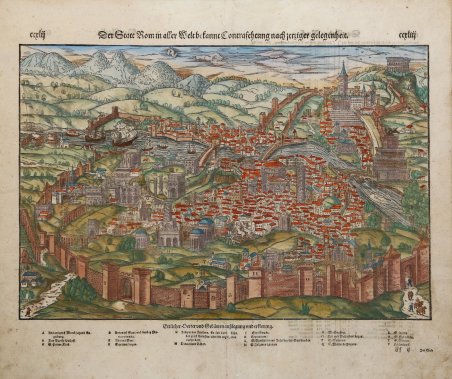
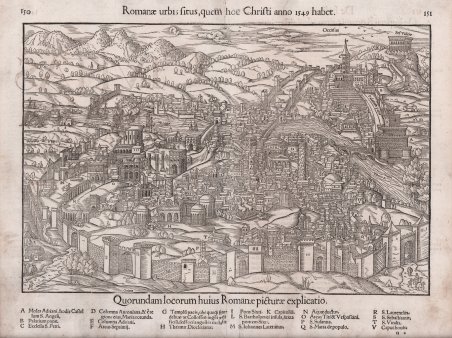
Romanae urbis situs, quem hoc Christi anno 1549 habet
Formas de Pago
- PayPal
- Tarjeta de crédito
- Transferencia Bancaria
- Pubblica amministrazione
- Carta del Docente
Detalles
- Año de publicación
- 1550
- Lugar de impresión
- Basilea
- Formato
- 400 X 313
- Grabadores
- Münster Sebastian
- Materia
- Piante e Panorami di Roma
Descripción
Bella veduta prospettica di Roma tratta dalla ' Cosmographiae Universalis, edizione in latino, stampata a Basilea, nel 1550. La veduta di Munster cattura con raffinatezza le mura fortificate e i Sette Colli della Città Eterna, con attività significative lungo il fiume Tevere. Molti dei principali monumenti di Roma sono chiaramente identificabili. In basso una legenda che individua circa 23 punti di riferimento. "Seppure incisa mezzo secolo dopo le piante del Bergomense e dello Schedel, la veduta ritrae la città come si presentava alla fine del '400 attingendo al medesimo prototipo comunemente indicato nel panorama di Mantova a sua volta ripreso da un presunto ma tuttora sconosciuto panorama inciso nella bottega di Francesco Rosselli verso il 1485. L'immagine venne inserita in una delle opere più note del '500, la Cosmographiae Universalis per la prima volta edita in latino nel 1550 e poi ristampata più volte in italiano, francese e tedesco. […] è stata più volte rilevata dai critici l'assenza del Colosseo dall'autore stesso curiosamente giustificata alla lettera G della legenda "per mancanza di spazio". Oltre ai Dioscuri presso le Terme di Diocleziano, presenti anche nelle piante di Bergomense e Schedel, è qui indicata acnhe la statua equestre del Marco Aurelio nella sua originale collocazione presso San Giovanni in Laterano da cui fu spostata nel 1538 per la visita di Carlo V a Roma e collocata da Michelangelo in Campidoglio. È ancora in piedi la Meta Romuli sebbene demolita nel 1499 e le due edicole alla fine di Castel Sant'Angelo demolite dopo il Sacco di Roma del 1527. L'edificio più recente raffigurato è il Belvedere Vaticano (1485/87)" (cfr. Marigliani p. 118). La ' Cosmographiae Universalis ' di Sebastian Münster (1488-1552), stampata per la prima volta Basilea nel 1544 dall’editore Heinrich Petri, venne più volte aggiornata e aumentata di nuove carte geografiche e rappresentazioni urbane nelle sue numerose edizioni che arrivano all’inizio del secolo successivo. Münster aveva lavorato a raccogliere informazioni al fine di ottenere un'opera che non deludesse le aspettative e, dopo un'ulteriore pubblicazione in tedesco abbellita da 910 stampe su legno, giunse nel 1550 all'edizione definitiva in latino, illustrata da 970 silografie. Vi furono poi numerose edizioni in diverse lingue, fra cui latino, francese, italiano, inglese e ceco. Dopo la sua morte di Münster (1552), Heinrich Petri prima, e il figlio Sebastian poi, continuarono la pubblicazione dell’opera. La ' Cosmographia universalis ' fu uno dei libri più popolari e di successo del XVI secolo, e vide ben 24 edizioni in 100 anni: l'ultima edizione tedesca venne pubblicata nel 1628, molto tempo dopo la morte dell'autore. La ' Cosmographia ' conteneva non solo le ultime mappe e vedute di tutte le città più famose, ma anche una serie di notizie enciclopediche di dettagli relative al mondo conosciuto, e sconosciuto. Il particolare successo anche commerciale di quest'opera fu dovuto in parte alle belle incisioni (tra i cui autori si possono citate Hans Holbein il Giovane, Urs Graf, Hans Rudolph Manuel Deutsch, David Kandel). Silografia, ' in ottime condizioni. Bibliografia A. P. Frutaz, "Le piante di Roma", XCVIII, tav. 170; C. Marigliani, "Le Piante di Roma delle collezioni private", tav. 14; M. Gori Sassoli (a cura di), "Roma Veduta" p. 140, n. 6; Scaccia Scarafoni, n. 126. Munster's view captures a fine sense of the fortified walls and Seven Hills of the Eternal City, with significant activity along the Tiber River. Many of Rome's great landmarks are clearly identifiable in this important early view. The key at the bottom locates approximately 23 landmarks.Although engraved half a century later from the maps by Bergomensis and Schedel, the view depicts the city as it was at the end of the 15th century, drawing on the same prototype commonly indicated in the panorama of Mantua in turn taken from a still unknown panorama engraved in the workshop of Francesco Rosselli around 1485. The image was included in one of the most famous works of the '500, the Cosmographiae Universalis for the first time published in Latin in 1550 and then reprinted several times in Italian, French and German. The absence of the Colosseum - justified by the author himself by the letter G of the legend "for lack of space" - has been noted several times by critics. In addition to the Dioscuri at the Baths of Diocletian, also present in the plants of Bergomensis and Schedel, the equestrian statue of Marcus Aurelius in its original location near San Giovanni in Laterano, from which it was moved in 1538 for the visist of Charles V in Rome and placed by Michelangelo in the Capitoline Hill, is here indicated. It is still standing the Meta Romuli although demolished in 1499 and the two "edicole" at the end of Castel Sant'Angelo, demolished after the Sack of Rome of 1527. The most recent building depicted is the Vatican Belvedere, built in 1485/87. (see Marigliani p. 118). Plate taken from the ' Cosmographiae Universalis, Latin edition, Basel, half of the 16th Century. The ' Cosmographiae Universalis ' of Sebastian Münster (1488-1552), printed for the first time in Basel in 1544 by the publisher Heinrich Petri, was updated several times and increased with new maps and urban representations in its many editions until the beginning of the next century. Münster had worked to collect information in order to obtain a work that did not disappoint expectations and, after a further publication in German embellished with 910 woodblock prints, arrived in 1550 to the final edition in Latin, illustrated by 970 woodcuts. There were then numerous editions in different languages, including Latin, French, Italian, English and Czech. After his death in Münster (1552), Heinrich Petri first, and then his son Sebastian, continued the publication of the work. The ' Cosmographia universalis ' was one of the most popular and successful books of the 16th century, and saw as many as 24 editions in 100 years: the last German edition was published in 1628, long after the author's death. The ' Cosmographia ' contained not only the latest maps and views of all the most famous cities, but also a series of encyclopedic details related to the known, and unknown, world. The particular commercial success of this work was due in part to the beautiful engravings (among whose authors can be mentioned Hans Holbein the Younger, Urs Graf, Hans Rudolph Manuel Deutsch, David Kandel). Woodcut, ' in perfect condition. BibliografiaA. P. Frutaz, "Le piante di Roma", XCVIII, tav. 170; C. Marigliani, "Le Piante di Roma delle collezioni private", tavv. 11/14; M. Gori Sassoli (a cura di), "Roma Veduta" p. 140, n. 6; Scaccia Scarafoni, n. 126. Cfr.
