Rovine romane
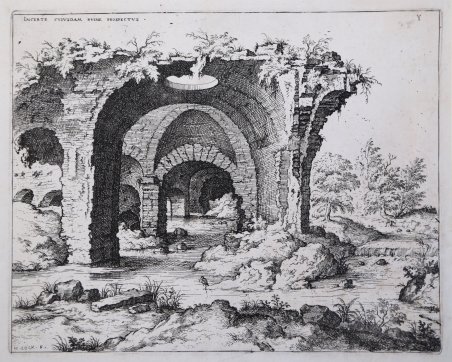
Rovine romane
Formas de Pago
- PayPal
- Tarjeta de crédito
- Transferencia Bancaria
- Pubblica amministrazione
- Carta del Docente
Detalles
- Año de publicación
- 1550
- Formato
- 284 X 226
- Grabadores
- COCK Hieronimus
Descripción
Acquaforte, 1550, firmato in lastra, in basso a sinistra “H. Cock. F.” In alto a sinistra Incerte cuisdam ruine prospectus”. Bella prova, impressa su carta vergata coeva, con margini, in ottimo stato di conservazione. Questa incisione appartiene alla celebre suite Monimenta Praecipua Aliquot Romanae Antiquitatis Ruinarum Monumenta […], edita ad Anversa nel 1551. Le stampe della serie riproducono delle vedute che Cock aveva disegnato a Roma (1546-1548) e, eventualmente, bozzetti di altri artisti. Il corpus comprende alcune delle rovine più grandi di Roma, la Basilica di Costantino, il Colosseo e il Palatino, ma nessuna è topograficamente accurata né strutturalmente precisa, al punto che il famoso archeologo famoso e topografo Christian Hulsen fu portato a concludere che la loro divergenza dai resti fisici li ha resi "senza valore". Tuttavia, la precisione archeologica non era l’obiettivo perseguito da Cock, dal momento che la sua finalità dichiarata era quella di fornire un repertorio di motivi architettonici ad uso degli artisti nordici che non potevano studiare le antichità di prima mano. La popolarità della serie fu tale da essere ristampata nel 1570; la casa editrice di Cock produsse altri due compendi di rovine romane nel 1561 e il 1562. A differenza dei suoi contemporanei Antonio Lafreri e Antonio Salamanca, che proposero le immagini ricostruite dei singoli edifici, Cock mostra in queste incisioni il suo gusto per le rovine inserite nei paesaggi. Questa incisione, ad esempio, nonostante la sua iscrizione, che letteralmente significa “veduta di una qualche rovina oscura”, non è aderente “al vero” (come si sostiene nel lungo titolo), ma è un vero e proprio capriccio. Un ruscello che si origina da una piccola cascata sullo sfondo, si snoda poi in tre rami, di cui uno attraversa l'architettura come un canale. L’apertura nella volta a botte non è presente in nessuna architettura romana antica, e non è chiaro quale funzione avrebbe potuto avere un simile edificio. Etching, 1550, signed on platea t lower left “H. Cock. F.”. Inscribed at top left “Incerte cuisdam ruine prospectus”. Good example, printed on contemporary laid paper, with margins, in very good condition. From the series Monimenta Praecipua Aliquot Romanae Antiquitatis Ruinarum Monumenta […] published in Antwerp in 1551. The prints of the series reproduces views that Cock drawn in Rome (1546-48) and possibly sketches by other artists. The corpus comprised some of Rome's grandest ruins, the Basilica of Constantine, the Colosseum, and the Palatine, but none is topographically accurate nor structurally precise, causing the reversed celebrated archaeologist and topographer Christian Hulsen to conclude that their divergence from the physical remains made them “worthless." However, archaeological precision was not uppermost in Cock's mind, for his avowed intention was to provide a building repertoire of motifs for the use of northern artists unable to study the antiquities at first hand. The popularity of the prints was such that the Monumenta was reprinted in 1570, and Cock’s publishing house issued two other compendia of Roman ruins in 1561 and 1562. Unlike his contemporaries Antonio Lafreri and Antonio Salamanca who speculatively reconstructed individual buildings, Cock exhibited a taste for ruins in the landascape and the entrophy of the ruins themselves (which he the emphasized in the title print of the Monumenta with a poem by Cornelis Grapheus). ' This View of Unidentified Ruins- such a despite its inscription, which translates literally as"a view of some obscure ruin is not "true to life" (as the preface claims) but is really a capriccio. A brook wends its unconvincing way from the background over a small waterfall to fork three ways, with two branches flowing off the margins, and the third winding back through the architecture like a canal. This structure is evidently a pastiche. The oculus piercing the barrel vault appears in no authentic Roman architecture and was derived either from observing the apertures in a collapsed vault at the Colosseum or possibly the refectory of the convent of Santa Caterina da Siena a Largo Magnanapoli, where sich a skylight was cut through the ancient vault. The parabolic stone arch (unknown in Western architecture before preface the seventeenth century) overlying a flattened one is equally improbable. Finally, it is unclear what function such an edifice could have had, though what appears to be a raked wall for seating can be glimpsed at the left middle distance, suggesting that this caprice began life as another view of the oculus Colosseum or the waterlogged Circus Maximus. (Fabio Berry) Cfr. Barryte, p. 516 n. 114.1; Hollstein, 45
