San Girolamo penitente
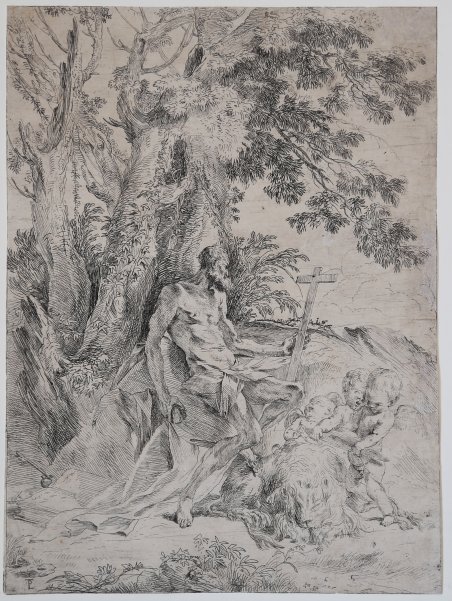
San Girolamo penitente
Formas de Pago
- PayPal
- Tarjeta de crédito
- Transferencia Bancaria
- Pubblica amministrazione
- Carta del Docente
Detalles
- Año de publicación
- 1635
- Formato
- 227 X 306
- Grabadores
- TESTA detto "Il Lucchesino" Pietro
- Descripción
- Bartsch, 15; Bellini 9; Cropper 8
Descripción
Acquaforte, 1631 – 1637 circa, monogrammata nell’immagine in basso a sinistra. Primo stato di tre. Bella prova, impressa su carta vergata coeva, rifilata alla linea marginale, con filigrana "scudo con drago”, rare e lievissime fioriture, alcuni restauri al verso, nel complesso in ottimo stato di conservazione. Al verso, timbro di collezione simile a Lugt 617.Questa composizione è strettamente correlata alla versione verticale della versione de "Il Giardino della Carità" nonostante la differenza di soggetto. Testa ha infatti trattato il tema della penitenza di san Girolamo in modo lirico e non c'è alcuna suggestione del deserto che Baldinucci e altri descrivono riferendosi a questa immagine. Anche se il santo guarda sulla croce e si stringe a una roccia, il calamaio e il libro messi da parte, non è immaginato nel deserto, descritto nelle sue lettere, ma siede in un paesaggio assolato e verdeggiante che ricorda più l’Arcadia classica.I piccoli angeli coronano gioiosamente il leone docile e addormentato con un cappello da cardinale, attributo tradizionale di San Giorgio.Le linee incise non sono così vicine come nel Giardino della Carità, né i contorni sono così fortemente delineati. Sembrerebbe quindi che San Girolamo sia più vicino a "Tre Santi Lucchesi che intercedono con la Vergine per le vittime della peste”, riferibile al 1630-31. In entrambi i lavori Testa ha tentato di sfruttare la stessa interazione tra il foglio bianco e il tratteggio parallelo, a cui spesso aggiunge tratti curvilinei per ottenere un gioco di luce sulla superficie della carta. Nel disegno preparatorio al Louvre le linee sono molto più nitide, rivelando una stretta affinità con gli studi per Il martirio di Sant'Erasmo. La vicenda artistica di Pietro Testa, detto il Lucchesino dalla sua città d’origine, è assai tormentata. Poco o nulla si sa del suo primo apprendistato nella città natale. Arrivato a Roma nel 1629, fu probabilmente dapprima a scuola presso il Domenichino, poi presso la bottega di Pietro da Cortona, suo vero maestro. Il carattere introverso dell’artista gli procurò comunque sempre difficoltà con ' i suoi colleghi: il Cortona infatti fu costretto a cacciarlo dalla sua scuola per l’atteggiamento di sprezzante superiorità assunta dall’allievo . Il Testa frequentò allora la casa del suo primo mecenate, il celebre collezionista Cassiano del Pozzo, per il quale eseguì disegni dall’antico. Fu probabilmente nella sua casa che conobbe il pittore Nicolas Poussin, che influenzerà profondamente la sua arte sia nella sua prima fase di adesione tizianesca ' al movimento neo-veneto, sia nel periodo più maturo, a partire dagli anni 1635 in poi, caratterizzati da un intellettualismo classicheggiante. Resta comunque il fatto che le sue incisioni (che ammontano a 40 tavole circa) furono considerate fin dall’antichità, a partire dal Sandrart e dal Baldinucci, le opere grafiche più importanti del '600 italiano. Etching, 1631 – 1637 circa, inscribed in the image with Testa’s monogram in the lower left corner. First state of three.Good example, printed on contemporary laid paper, with „shield with dragon”, trimmed at margins, occasional light foxing, some restorations on verso, otherwise in good condition.On verso, collector’s mark similar to Lugt 617 Cropper writes: “This composition is closely related to the vertical version of “The Garden of Charity” despite na's the difference in subject. Testa has in fact treated e ohis the theme of Saint Jerome's penitence in a lyrical and manner, and there is no suggestion of the desert inspired that Baldinucci and others describe in referring to hings this image. Although the saint gazes upon the cross and clasps a rock with which to beat his breast, his inkwell and book set aside, he is not imagined in the wilderness described in his letters, but sits in a sunny and verdant landscape more reminiscent her and of the classical Arcadia. Feathery overhanging buted branches of a powerfully twisted tree entwined with ivy that also appears in The Garden of Charity and in several other works of this decade provide an idyllic shade for his meditation. Little angels playfully crown the docile and sleeping lion with a cardinal's hat, Saint Je-rome's traditional attribute. The etched lines are not as close together as in The Garden of Charity, however, nor are the contours so strongly delineated. It would thus seem that Saint ni, Jerome dates somewhat closer to “Three Lucchese Saints Interceding with the Virgin for the Victims of the Plague” or around 1630-31. In both works Testa attempted to exploit the same loose interplay between the white paper and the parallel hatching, to which he here often adds curling twists to achieve a flickering quality of sunlight across the surface of the paper. In the preparatory drawing in the Louvre the lines are much sharper, revealing a close affinity with studies for The Martyrdom of Saint Erasmus.The strong contrast between the single lines of the foliage to the right, with their rich, dark burr, and the very delicate delineation of the little angels and the lion's mane suggests that the image may slen have been etched in stages. All impressions reveal drav considerable foul biting and roughness of finish on the plate. Pietro Testa was called Lucchesino for he was born in Lucca. There are but a few news about his apprenticeship in his hometown; for sure, he went to Rome in 1629 to study in the school of Domenichino first and then, towards the end of the year, he moved to the studio of his real master, Pietro da Cortona. His introvert temper caused him a lot of troubles; Cortona, in fact, was obliged to send him away due to his hostile and disdainful behaviour. Testa went then to the house of his first patron, the famous collector Cassiano del Pozzo, and for him he realized his drawings from antiques. Maybe it was in this house that he met Nicolas Poussin who deeply influenced his art both in the neo-Venetian phase and the intellectual classicist one, from 1635. His engravings though, about 40 pieces, have been considered, starting from Sandrart and Bladinucci, the most important graphic works of the Italian XVII century. Cfr. Bartsch, 15; Bellini 9; Cropper 8
