Sileno sostenuto da un giovane baccante
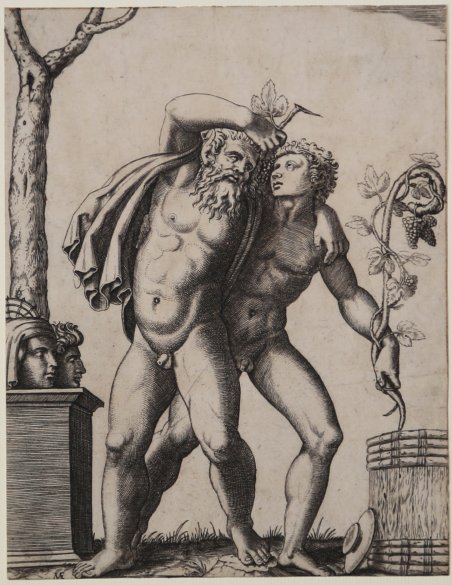
Sileno sostenuto da un giovane baccante
Formas de Pago
- PayPal
- Tarjeta de crédito
- Transferencia Bancaria
- Pubblica amministrazione
- Carta del Docente
Detalles
- Año de publicación
- 1520
- Formato
- 137 X 270
- Grabadores
- RAIMONDI Marcantonio
- Descripción
- Bartsch, XIV, 222, 294; Passavant, VI, 29, 181; Delaborde, 135.
Descripción
Bulino, 1520-1525 circa, firmato in lastra col il monogramma "MAF" in basso a sinistra.Magnifica prova, ricca di toni e ben contrastata, impressa su carta vergata coeva con filigrana “doppio cerchio con croce di S. Andrea”, irregolarmente rifilata ai margini, con parziale perdita di inciso su tre lati: circa 1 cm nel margine superiore e circa 0,5 cm ai due lati. L'antico prototipo del "Sileno supportato da un giovane baccante"a partire dal XIX secolo ' è stato riconosciuto come parte di un rilievo che si trovava un tempo a Villa Albani, a Roma. Come da sua consuetudine, Marcantonio non ha riprodotto tutti gli elementi dell'antico rilievo, ma ha aggiunto alcuni dettagli descrittivi come l'albero nella parte sinistra, la botte di vino, la coppa di vino rovesciata e il "tirso" ricoperto di vite tenuto dal giovane baccante. Inoltre, ha dato alla composizione un carattere pittorico aggiungendo una linea di terra con erba e alcune striature simili a nuvole nel cielo; quindi, non ha tentato di creare l'effetto di un rilievo come aveva fatto nella precedente incisione dei "Due Fauni che trasportano un bambino in una cesta” (Bartch XIV, 186, 230), basato su un antico rilievo.Circa l’autore della composizione, le opinioni degli studiosi hanno sempre oscillato tra Raffaello e Giulio Romano. In recenti studi è stato sostenuto, su basi più convincenti, il nome di Giulio Romano per le somiglianze tra quest'opera e la contemporanea incisione di Marcantonio, su disegno di Giulio, ' "Ercole e Anteo". Il carattere forte ed espressivo delle figure e lo sforzo muscolare conferiscono alla scena una certa tensione, caratteristica frequente dei dipinti di Giulio, come la "Lapidazione di Santo Stefano" (Genova, S. Stefano) del 1523. Engraving, circa 1520-1525, signed with monogram MAF al lower left.Magnificent proof, printed on contemporary laid paper, with “double circle with St. Andrew cross” watermark, irregularly trimmed affecting the image on three sides, lack of circa 1 cm on the upper side and circa 0.5 cm foe both lateral sides, otherwise excellent proof."The ancient protorype for “Silenus Supported by a Young Bacchan” has been identified since the 19th century as part of a relief that was formerly in the Villa Albani in Rome. Characteristically, Marcantonio has not reproduced all of the elements in the ancient relief, bur added certain descriptive details such as the tree in the lefthand side, the wine barrel, the upturned wine cup and the vine-covered “thyrsus” held by the young bacchant. He also gave the composition a pictorial character by adding a ground line with grass and a few cloud-like striations in the sky; thus he did not attempt to create the effect of a neutral relief ground as he had in the earlier engraving of “Two Faun Carrying a Child in a Basket”, also after an ancient relief. Opinions have always fluctuated between Raphael and Giulio Romano as the possible author of the engraving 's design. Recent scholars have convincingly suggested that it was by Giulio because of the similarities between this work and Marcantonio's contemporary engraving after Giulio's design of “Hercules and Antaeus”. The strong, expressive character of the figures and their muscular, driven movement gives the feeling of tension and anxiety so often characteristic of Giulio's paintings, such as the “Stoning of St. Stephen” (Genoa, S. Stefano) of a 1523. The treatment of the anatomy of the figures is also typical of Giulio: there is a superficial emphasis upon muscularity and movement without functional articulation of anatomy, evident in the surface patterning of Silenus's torso and in the flattening of the chest of the young bacchant. Marcantonio's own technical handling of this engraving is especially comparable to his Hercules and Antaeus, a work dat-able ca. 1520-22. The lines of modeling are bold and regular and the harsh, brilliant lighting is treated decoratively: whole areas are cast into deep shadow, such as the torso of the bac-chant, while that of Silenus is contrastingly lit very brightly.Marcantonio’s regular techinique and decorative lighting, combined with Giulio’s harshly image that little in common with Marcantonio’s earlier works after the antique that reflect the graceful movement and gentle expression of Raphael’s figure style.” (cf. I. H. Shoemaker, The Engravings of Marcatonio Raimondi, n. 52, pp. 164-165) Cfr. Bartsch, XIV, 222, 294; Passavant, VI, 29, 181; Delaborde, 135.
