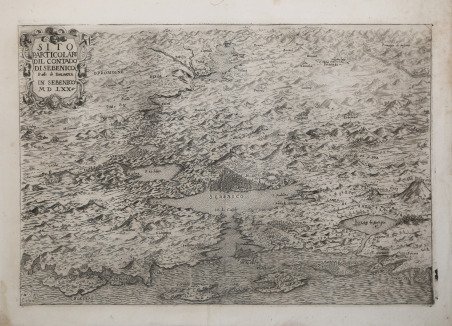
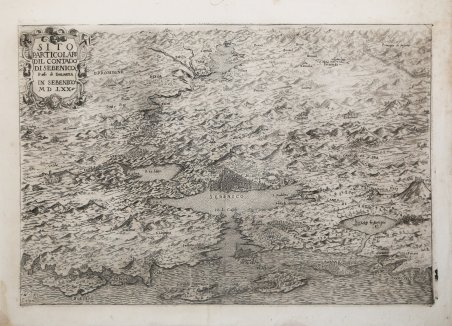
In alto a sinistra, in una targa dai bordi ornati, è impresso il titolo: SITO PARTICOLARE DIL CONTADO DI SEBENICO. Parte di DALMATIA IN SEBENICO MDLXX. In basso a sinistra, appena leggibile. Troviamo l’imprint editoriale: Ad sign: Colunt .V. Carta priva di scala grafica, orientazione e graduazione ai margini. ' Acquaforte e bulino, dimensioni mm 290x430. Esemplare di primo stato con l’imprint Ad sign: Colunt .V. chiaramente visibile e non abraso. ' Di tale tiratura si conosce il solo esemplare dell’atlante descritto da Meurer (cfr. The Strabo Illustratus Atlas, 2002, nn. 73-74) ora alla Bayerische Staatsbibliothek. ' “Carta anonima della regione di Sebenico e della Dalmazia centrale, che Meurer attribuisce al sebenicense Martino Rota, forse basandosi su quanto affermato in precedenza da Roberto Almagià: “sebbene negli esemplari da me visti non porti la firma del Rota, risale pur certamente a lui”. Dissociandoci da Meurer, per ragioni stilistiche assegniamo l’opera alla mano dell’incisore Natale Bonifacio, anch’egli originario della città dalmata. La carta ricorda infatti, in maniera molto evidente, altri prodotti cartografici del Bonifacio, in particolare, la tipologia del cartiglio. ' La peculiarità della carta è l’indirizzo in basso a sinistra Ad sign: Colunt. identificativo della tipografia di Paolo Forlani, che in questo caso potrebbe aver partecipato all’opera in qualità di editore. Il luogo di stampa indicato nel cartiglio – in Sebenico MDLXX – ci induce a credere che il Bonifacio abbia preparato la lastra nella sua città natale, o quantomeno vi avesse l’intenzione di stamparla. Sebbene non si possa escludere che esistano tirature della carta stampate a Sebenico, probabile che Bonifacio, rinunciando al suo progetto, si sia affidato poi a Forlani per la stampa. Secondo Meurer, l’opera ha una sua prova di stampa, priva dell’indirizzo del Forlani; tuttavia, sembra evidente che si tratti, in realtà, di una prova successiva, con l’indirizzo abraso e le cui tracce sono ancora visibili nella stampa” (cfr. S. Bifolco, F. Ronca, Cartografia e topografia italiana del XVI secolo, 2018: Tav. 641). ' Magnifica prova, impressa su carta vergata coeva con filigrana “scudo con scala e stella a sei punte” (Woodward nn. 244-250), con margini, in eccellente stato di conservazione. Foglio di estrema rarità, conosciuto in un solo esemplare di questa tiratura e in soli 9 esemplari istituzionali per la prova del secondo stato, con l’indirizzo abraso o parzialmente abraso: Chicago, Newberry Library; Milano, Raccolta Bertarelli; Modena, Biblioteca Estense; Monaco di Baviera, Bayerische Staatsbibliothek; Parigi, Bibliothèque Nationale; Roma, Alessandrina; Salisburgo, Universitätsbibliothek; Torino, Archivio di Stato; Venezia, Museo Correr (fonte, Cartografia e topografia italiana del XVI secolo, p. 1392). Natale Bonifacio (1538 – 1592) nacque a Sebenico, all’epoca del dominio della Repubblica di Venezia, da nobile famiglia. Poco si conosce dei primi anni della sua vita, ma intorno al 1570 lavorò a Venezia e a questo periodo appartengono numerose carte, datate tra il 1568 e il 1570, in seguito inserite nel Civitatum aliquot insignorum et locorum magis monitorum exacta delineation cum additione aliquot Insularum principalium edito da Ferrando Bertelli nel 1568, e da Donato Bertelli nel 1574. Dal 1575 fu a Roma, dove è autore di numerose incisioni. Tra queste citiamo il Cristo Benedicente, noto in tre stati (Lafreri, Duchetti e Orlandi); il Toro Farnese, dedicato ad Alessandro Farnese e edito dal Duchetti e inserito nello Speculum Romanae Magnificentiae. Le opere da lui incise recano spesso solo la sigla N.B.f(ecit); in altre, come la carta della Calabria di Prospero Parisio (1589), si firma invece Natalis Bonifacius Sabenice incidebat Romae. Paolo Forlani (attivo a Venezia tra il 1560 e il 1574), nasce a Verona, probabilmente nella terza decade del XVI secolo. Già da gi. In the upper left, in a plate with ornate borders, is engraved the title: SITO PARTICOLARE DIL CONTADO DI SEBENICO. Part of DALMATIA IN SEBENICO MDLXX. In the lower left corner, barely legible. We find the editorial imprint: Ad sign: Colunt .V. Map without graphic scale, orientation and graduation in the margins. ' Etching and engraving, dimensions 290x430 mm. First state, with the imprint Ad sign: Colunt .V. clearly visible and not abraded. ' Of this first state, only one example is known from the atlas described by Meurer (see The Strabo Illustratus Atlas, 2002, nos. 73-74) now in the Bayerische Staatsbibliothek. ' An anonymous map of the region of Sibenik and central Dalmatia, which Meurer attributes to Martino Rota from Sibenik, perhaps based on what Roberto Almagià had previously stated: "although in the specimens I have seen it does not bear Rota's signature, it certainly belongs to him". Disassociating ourselves from Meurer, for stylistic reasons we assign the work to the hand of engraver Natale Bonifacio, who was also a native of the Dalmatian city. The map is in fact very reminiscent of other cartographic products of Bonifacio, in particular the type of cartouche. The peculiarity of this work is the address at lower left Ad sign: Colunt. identifying the printing house of Paolo Forlani, who in this case may have participated in the work as publisher. The place of printing indicated in the cartouche - in Sebenico MDLXX - leads us to believe that Bonifacio prepared the plate in his native city, or at least had the intention of printing it there. Although we cannot exclude that there is an early issue printed in Sibenik; it is probable that Bonifacio, having given up his project, then entrusted Forlani with the printing. ' According to Meurer, the work has its own proof, lacking Forlani's address; however, it seems clear that it is, in fact, a later proof, with the address abraded and whose traces are still visible in the print (cf. S. Bifolco, F. Ronca, Cartografia e topografia italiana del XVI secolo, 2018: Tav. 641). Magnificent proof, printed on contemporary laid paper with watermark "shield with ladder and six-pointed star" (Woodward nn. 244-250), with margins, in excellent state of preservation. ' Work of extreme rarity, known in only one copy of this first issue and in only 9 institutional copies for the second state (with the address abraded or partially abraded): Chicago, Newberry Library; Milan, Bertarelli; Modena, Biblioteca Estense; Munich, Bayerische Staatsbibliothek; Paris, Bibliothèque Nationale; Rome, Alessandrina; Salzburg, Universitätsbibliothek; Turin, Archivio di Stato; Venice, Museo Correr (source, Cartografia e topografia italiana del XVI secolo, p. 1392). Natale Bonifacio (1538 - 1592) was born in Sibenik, at the time of the dominion of the Republic of Venice, to a noble family. Little is known of the early years of his life, but around 1570 he worked in Venice and to this period belong numerous maps, dated between 1568 and 1570, later included in the Civitatum aliquot insignorum et locorum magis monitorum exacta delineation cum additione aliquot Insularum principalium edited by Ferrando Bertelli in 1568, and by Donato Bertelli in 1574. From 1575 he was in Rome, where he is the author of numerous engravings. Among these we mention the Cristo Benedicente, known in three states (Lafreri, Duchetti and Orlandi); the Toro Farnese, dedicated to Alessandro Farnese and published by Duchetti and inserted in the Speculum Romanae Magnificentiae. The works engraved by him often bear only the initials N.B.f(ecit); in others, such as the map of Calabria by Prospero Parisio (1589), he signed Natalis Bonifacius Sabenice incidebat Romae. Paolo Forlani (active in Venice between 1560 and 1574), was born in Verona, probably in the third decade of the sixteenth century. Already as a young man he showed his predisposition for drawing and artistic subjects, so he left Verona to move to Venice,. Cfr.

 Descubre cómo utilizar
 Descubre cómo utilizar