Questo sito usa cookie di analytics per raccogliere dati in forma aggregata e cookie di terze parti per migliorare l'esperienza utente.
Leggi l'Informativa Cookie Policy completa.

Sei in possesso di una Carta del Docente o di un Buono 18App? Scopri come usarli su Maremagnum!

Grabados

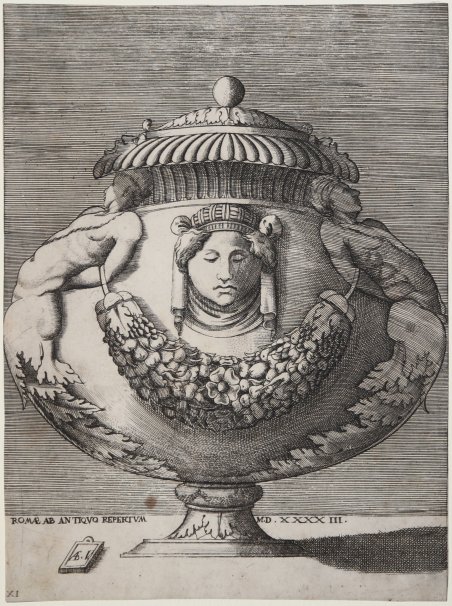
Vaso con maschera e festone

375,00 €

Antiquarius Libreria

(Roma, Italia)

Habla con el librero

Formas de Pago

Detalles

Descripción

Bulino 1543, datato e monogrammato in lastra in basso. Della serie “Differenti soggetti di Vasi dall’antico”. Esemplare del secondo stato con il numero XI aggiunto in basso a sinistra. Splendida prova, impressa su carta vergata coeva priva di filigrana, rifilata al rame, in ottimo stato di conservazione.Lit: De Jong/De Groot, 'Ornamentprenten in het Rijksmuseum I, 15de & 16de eeuw', Amsterdam 1988, cat. No.650; Fuhring in his review of the latter in Print Quaterly vol VI, No.3, September 1989, pp.322-334; and Miller, 'Sixteenth- century Italian ornament prints in the Victoria and Albert Museum', 1999, cat. No.68. An antique vase decorated with men whose bodies terminate in foliate scroll, flanking a single festoon and a woman's head.Engraving 1543, lettered at bottom 'Romae ab antiquo repertum MDXXXXIII' 'AEV' in tablet at lower left.Belonging to the series "Differenti soggetti di Vasi dall'antico" ("Different types of ancient vases").Example in the second state with the number XI added at lower left. Beautiful proof, on contemporary laid paper, trimmed at the platemark, very good conditions.From a series of prints engraved by Enea Vico and depicting antique vases, a number of which were after Agostino Veneziano, perhaps in turn connected to similar designs by Giulio Romano. The series exists in two states before and with the numbers. Editions of the second state were published by Antonio Lafrery (Lafrery volume, V&A) and Pietro de' Nobili (Berlin 1125). Miller notes that the two plates engraved after Agostino Veneziano (numbered I and XIIII in the second state) do not appear in the first state; as they open and close the set, she suggests they were perhaps meant to fool the unsuspecting buyer into thinking he was buying the Agostino Veneziano set, and that they were not engraved by Vico.Lit: De Jong/De Groot, 'Ornamentprenten in het Rijksmuseum I, 15de & 16de eeuw', Amsterdam 1988, cat. No.650; Fuhring in his review of the latter in Print Quaterly vol VI, No.3, September 1989, pp.322-334; and Miller, 'Sixteenth- century Italian ornament prints in the Victoria and Albert Museum', 1999, cat. No.68. Cfr.
Logo Maremagnum es