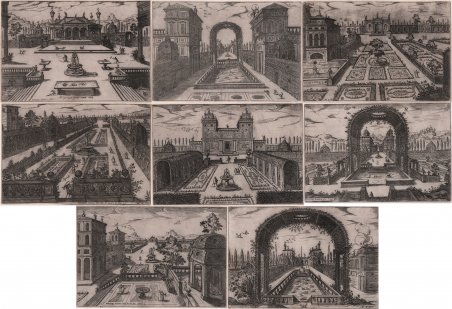
Suite di 8 incisioni all’acquaforte, 1601, firmate e datate in lastra in basso. Esemplari di probabile secondo stato con l’indirizzo di Mattheus Greuter aggiunto in basso "M. Greuter exc. 1623".Bellissime prove, impresse su carta vergata coeva con filigrana “cerchio con tre monti” (simile a Briquet 11933 e presente in quattro incisioni), rifilate al rame, in ottimo stato di conservazione. La suite dei giardini del Maggi unisce elementi di fantasia a particolari architettonici esistenti in Roma, quali la Basilica di San Lorenzo fuori le Mura, Villa Medici e i Giardini del Quirinale. Disegnatore ed incisore romano, è autore della Bichierografia, una raccolta di 1600 disegni per vetri realizzata nel 1604 e dedicata al Cardinale Francesco Maria del Monte. Nel 1609 concluse un accordo di lavoro con l’editore Giovanni Orlandi, realizzando molte incisioni di chiese. Le sue lastre sono citate nell’elenco di vendita del Vaccari del 1614. Importante la sua opera di incisore di paesaggi e antichità, come la serie: Libro di tutte le guglie, (1600) e Ornamenti delle fabbriche antiche e moderne dell’alma città di Rome,1600. Il Gandellini riporta sull'autore le seguenti parole: "romano, pittore di paesi fu buon disegnatore, e buon prospettivista, ed intagliò ad acquaforte molte vedute ben intese, e con buon gusto formate; molte facciate di chiese di Roma. Fece anche una prospettiva grandissima di Roma ricavata, e disegnata in piano, con tutte le strade, piazze, chiese, palazzi, e case private, la qual'opera non potendo quel pover'uomo finire per mancanza di denaro, ne ridurre a quella perfezione, a cui l'avrebbe ridotta , se avesse avuto commodo, fu poscia intagliata in legno da Paolo Maupin. Intagliò insieme con Domenico Barriera diverse fontane di Roma, di Tivoli, e di Frascati. Disegnò le nove chiese, che si visitano per l'Indulgenza, colla chiesa di S. Maria del Popolo, e loro Altari Privilegiati; ma da altri furono a bulino intagliate. Il Maggi fu uomo allegro, e faceto, mentre inventava, e raccontava le più bizzarre cose del Mondo, e fuor di modo ridicole, ed ebbe la vena nella poesia burlesca. Morì a Roma sopra i 50 anni, ed operava nell'anno 1609". Opere non descritte nella letteratura. Suite of 8 etchings, 1601, signed and dated at lower edge. Examples in what seems to be the second state, with the address of Mattheus Greuter on lower part"M. Greuter exc. 1623". Beautiful works, printed on contemporary laid paper with “circle with three mountains” watermark (like Briquet 11933 and seen in four more engravings), trimmed to platemark, in excellent condition. Maggi’s suite of the gardens combines fictitious elements with architectural details that really existed in Rome, such as the Basilica of San Lorenzo outside the Walls, Villa Medici and the Gardens of the Quirinale. A Roman illustrator and engraver, he realized the collection called Bichierografia, 1600 drawings for windows which he finished in 1604 and dedicated to Cardinal Francesco Maria del Monte. In 1609 he signed a working agreement with the publisher Giovanni Orlandi, for whom he realized engravings depicting churches. His plates have been mentioned in Vaccari's selling list of 1614. His production of landscapes and antiques engravings was very significant, such as the series: Libro di tutte le guglie, 1600 ( depicting the spires of Rome) and Ornamenti delle fabbriche antiche e moderne dell’alma città di Roma, 1600 (depicting the decorations of ancient and modern factories in Rome). Gandellini wrote about this artist that he was a very skilled Roman painter, illustrator and engraver, mentioning some of the subjects he realized, especially the churches one has to visit to receive the Indulgence, such as S. Maria del Popolo. He also related about a huge perspective work depicting the city of Rome and the fact that Maggi was not able to finish it for he had not enough money to carry on with the project as he had wished; for that reason, it was finally carved on wood blocks by Paolo Maupin. Gandellini mentioned also the fact that the artist worked together with Domenico Barriera to depict fountains in Rome, Tivoli and Frascati. He closes the description of Maggi mentioning the fact that he had been quite a good-humoured man, who enjoyed funny stories. The series presented hereby is very rare. Cfr. Opere non citate nei repertori consultati.

 Descubre cómo utilizar
 Descubre cómo utilizar