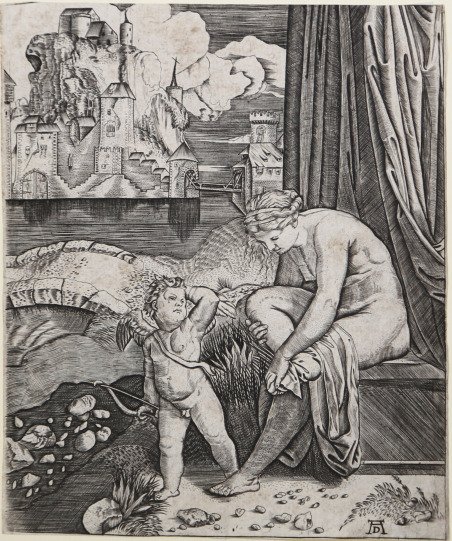
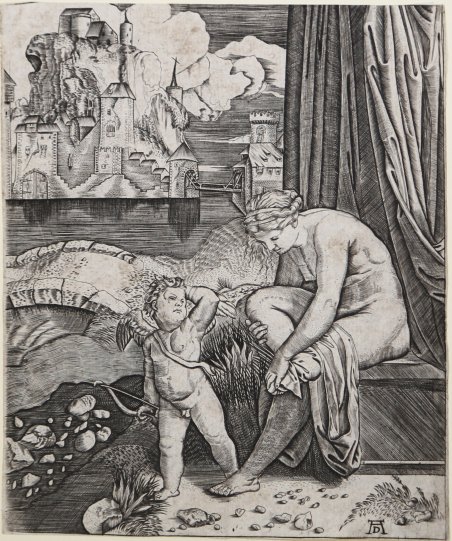
Bulino, 1520-30 circa, monogrammata AD (monogramma di Duerer), in basso a destra. Da un’incisione di Marcantonio Raimondi. Buona prova, impressa su carta vergata coeva, rifilata al rame, assottigliamento della carta in corrispondenza degli angoli, per il resto in ottimo stato di conservazione.Rispetto all’incisione dello stesso soggetto realizzata da Marcantonio Raimondi, che risulta in controparte, questa copia mostra sullo sfondo, attraverso una sorta di finestra, un paesaggio tipicamente nordico. Lo stile incisorio rimanda alla scuola del Raimondi. Si è pensato che il soggetto dell’incisione possa essere la settima scena, perduta, sulla parete nord della stufetta vaticana del cardinal Bibbiena, decorata da Raffaello e dalla sua cerchia con episodi della vita di Venere. Circa l’identificazione con la perduta scenetta del Bibbiena, cfr. Oberhuber, p. 335 e Mason, n. 69.Dell’incisione del Raimondi esistono varie repliche che ne attestano il vasto successo, tra cui quella di Altdorfer.La scena è di una raffinatezza delicata: Venere seduta, nuda, con un’espressione dolce e assorta, è chinata in avanti nell’atto di asciugarsi un piede con una veste. Accanto a lei, in piedi è Cupido alato, con il suo arco nella sinistra, e la mano destra tra i riccioli. Dalla finestra alle loro spalle, si scorge un paesaggio collinare. Il drappeggio sulla sinistra, con le sue pieghe, conferisce profondità spaziale alla scena. Bibliografia Barstch: XIV, p. 224; Delaborde, p. 161 n. 115; Hind, V, n. 44; Passavant, III, p. 281 n. 43; Raphael Invenit, p. 63 n. VII. 4. Engraving, about 1520-30, unsigned. Single state. A good proof, printed on contemporary laid paper, trimmed to copperplate, restoration at upper right corner perfectly executed, otherwise in excellent condition. Copy in reverse after Marcantonio Raimondi, with a landscape setting in place of the room with a window. The buidings in the background are suggested by those in Dürer’s Hercules of about 1500, the stone bridge and stream with stones on the bank are copied from Dürer’s Virgin and Child with the Monkey of about 1498.It is thought that the subject of the engraving may be the seventh scene, lost, on the north wall of the Stufetta by Cardinal Bibbiena, decorated by Raphael and his circle with episodes from the life of Venus.About identification with the lost scene of Bibbiena, see. Oberhuber, p. 335 And Mason 335, n. 69. Raimondi’s engraving is available in several replicas that attest to the vast success, including that of Altdorfer. The scene is of a delicate refinement: Venus sitting, naked, with a sweet and thoughtful, is leaning forward in the act of wiping foot with a robe. Beside her, standing is winged Cupid with his bow in his left hand and the right hand between the curls. From the window behind them, you can see a hilly landscape. The draping on the left, with its folds, gives spatial depth to the scene. Bibliografia Barstch: XIV, p. 224; Delaborde, p. 161 n. 115; Hind, V, n. 44; Passavant, III, p. 281 n. 43; Raphael Invenit, p. 63 n. VII. 4. Cfr.

 Descubre cómo utilizar
 Descubre cómo utilizar