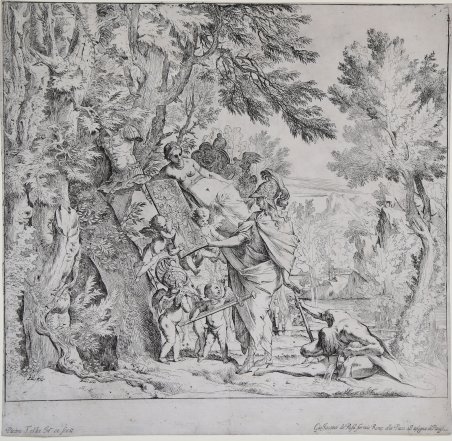
Acquaforte, circa 1640, firmata in lastra in basso a sinistra. Esemplare nel secondo stato di due, con l’indirizzo dell’editore Giacomo de’ Rossi. Magnifica prova, ricca di toni, impressa su carta vergata coeva con filigrana “giglio su tre monti nel doppio cerchio” (Heawood 1624 databile 1637/46), rifilata al rame, alcune pieghe di carta, per il resto in eccellente stato di conservazione. La scena si riferisce all’episodio dell’Eneide di Virgilio nel quale Venere scende sulla Terra per consegnare al figlio Enea le armi forgiate per lui da Vulcano. Enea è raffigurato in ammirazione dello scudo, mentre due putti gli porgono la spada e l’elmo. Magnifica prova di questa famosa incisione del Testa. La vicenda artistica di Pietro Testa, detto il Lucchesino dalla sua città d’origine, è assai tormentata. Poco o nulla si sa del suo primo apprendistato nella città natale. Arrivato a Roma nel 1629, fu probabilmente dapprima a scuola presso il Domenichino, poi presso la bottega di Pietro da Cortona, suo vero maestro. Il carattere introverso dell’artista gli procurò comunque sempre difficoltà con ' i suoi colleghi: il Cortona infatti fu costretto a cacciarlo dalla sua scuola per l’atteggiamento di sprezzante superiorità assunta dall’allievo . Il Testa frequentò allora la casa del suo primo mecenate, il celebre collezionista Cassiano del Pozzo, per il quale eseguì disegni dall’antico. Fu probabilmente nella sua casa che conobbe il pittore Nicolas Poussin, che influenzerà profondamente la sua arte sia nella sua prima fase di adesione tizianesca ' al movimento neo-veneto, sia nel periodo più maturo, a partire dagli anni 1635 in poi, caratterizzati da un intellettualismo classicheggiante. Resta comunque il fatto che le sue incisioni (che ammontano a 40 tavole circa) furono considerate fin dall’antichità, a partire dal Sandrart e dal Baldinucci, le opere grafiche più importanti del '600 italiano. Etching, circa 1638-40. In wide bottom margin 'Pietro Testa in et fecit' and with publication line 'Gio Jacomo de Rossi formis Rome alla Pace all'insegna di Parigi'.Example of the seocnd state, with de Rossi' address.A fine impression, printed on contemporary laid paper with "double encircled fleur-de-lys and three mounts" watermark (Heawood 1624, circa 1637/46),trimmed to the platemark, few light vertical folds, othrwise very good condition.The scene represents the story of Venus giving arms to Aeneas, based on Virgil's account in the Aeneid (8, lines 597-731). To aid Aeneas in his battle against Turnus and in the eventual founding of Rome, Venus appeals to Vulcan to make weapons for her son. As Aeneas marshalls in his forces, Venus waits until she sees him alone in a secluded vale beside the cool stream od Caere. She appears to gim in person and sets up the shining arms on an oak tree. At the bottom of the shield presented to Aeneas the she-wolf suckles Romulus and Remus, descendants of Aeneas and the mythical founders of Rome, beside the Tiber. At the top sits Augustus Caesar, the first Roman emperor, with the orb of empire in his right hand. To the left is a cuirass, a military trophy, and beneath his feet are conquered peoples. Behind him to the right are the silver goose and temple that Vulcan placed on the shield to prophesy the arousal of Manlius by the cackling of the Capitoline geese to defend Rome against the Gauls. ' Magnificent proof of this famous work of Pietro Testa. Pietro Testa was called Lucchesino for he was born in Lucca. There are but a few news about his apprenticeship in his hometown; for sure, he went to Rome in 1629 to study in the school of Domenichino first and then, towards the end of the year, he moved to the studio of his real master, Pietro da Cortona. His introvert temper caused him a lot of troubles; Cortona, in fact, was obliged to send him away due to his hostile and disdainful behaviour. Testa went then to the house of his first patron, the famous collector Cassiano del Pozzo, and for him he realized his drawings from antiques. Maybe it was in this house that he met Nicolas Poussin who deeply influenced his art both in the neo-Venetian phase and the intellectual classicist one, from 1635. His engravings though, about 40 pieces, have been considered, starting from Sandrart and Bladinucci, the most important graphic works of the Italian XVII century. Cfr. Cropper 1988 59.II; Bartsch, XX, 24; Bellini 17 II/II; Massari, Tra Mito e Allegoria, p. 520, 213.

 Descubre cómo utilizar
 Descubre cómo utilizar