Visione dell’uomo ricco nell’inferno o Parabola del Ricco e Lazzaro
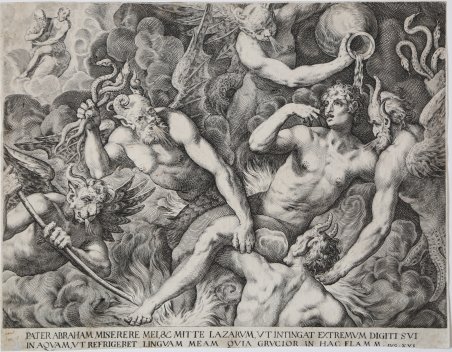
Visione dell’uomo ricco nell’inferno o Parabola del Ricco e Lazzaro
Formas de Pago
- PayPal
- Tarjeta de crédito
- Transferencia Bancaria
- Pubblica amministrazione
- Carta del Docente
Detalles
- Año de publicación
- 1595
- Formato
- 400 X 311
- Grabadores
- SADELER Aegidius II
Descripción
Bulino, 1595, nel margine inferiore “Pater Abraham miserere mei, & mitte Lazarum, ut intingam extremum digiti sui / in aquam, ut refrigeret linguam meam quia grucior in hac flamma. Lvc.xvI” (Luca, 16:24). Primo stato, avanti le sigle, la data e l’indirizzo editorale: "Iacobo Palmo Inuent: EG: Sadeler scalps: Monachij 1595" and "Marco Sadeler excudit.".Bell’esemplare, impresso su carta vergata coeva, con filigrana poco leggibile, rifilato ai margini, irregolarmente nel margine inferiore, dove qualche lettera è intaccata alla base, risultando comunque leggibile, occasionali fioriture, nel complesso in ottimo stato di conservazione.L’incisione, che deriva da un soggetto di Jacopo Palma il Vecchio, ed è incisa da Aegidius Sadeler II, nel 1595, e pubblicata da Marco Sadeler.Illustra la parabola dell’uomo ricco e Lazzaro, narrata nel Vangelo di Luca (16:19-26) Or vi era un uomo ricco, che si vestiva di porpora e bisso, e ogni giorno se la godeva splendidamente. Vi era anche un mendicante chiamato Lazzaro, che giaceva alla sua porta tutto coperto di piaghe ulcerose e desiderava saziarsi delle briciole che cadevano dalla tavola del ricco, e perfino i cani venivano a leccare le sue piaghe. Or avvenne che il mendicante morí e fu portato dagli angeli nel seno di Abrahamo; morí anche il ricco e fu sepolto. E, essendo tra i tormenti nell'inferno, alzò gli occhi e vide da lontano Abrahamo e Lazzaro nel suo seno. Allora, gridando, disse: "Padre Abrahamo, abbi pietà di me, e manda Lazzaro a intingere nell'acqua la punta del dito per rinfrescarmi la lingua, perché soffro terribilmente in questa fiamma”. Ma Abrahamo disse: "Figlio, ricordati che tu hai ricevuto i tuoi beni durante la tua vita e Lazzaro similmente i mali; ora invece egli è consolato e tu soffri. Oltre a tutto ciò, fra noi e voi è posto un grande baratro, in modo tale che coloro che vorrebbero da qui passare a voi non possono; cosí pure nessuno può passare di là a noi”. Engraving, 1595, lettered and signed in lower margin, in three lines: Pater Abraham miserere mei, & mitte Lazarum, ut intingam extremum digiti sui / in aquam, ut refrigeret linguam meam quia grucior in hac flamma. Lvc.xvI” (Luke 16:24). First state, before the publisher’address and the data: "Iacobo Palmo Inuent: EG: Sadeler scalps: Monachij 1595" and "Marco Sadeler excudit.".Good example, printed on contemporary laid paper, trimmed at margins, irregularly the lower, unreadable watermark, occasional foxing, generally in good condition.This engraving, after Jacopo Palma il Vecchio, illustrates parable of Jesus appearing in the Gospel of Luke (16:19-26): “There was a rich man who was dressed in purple and fine linen and lived in luxury every day. At his gate was laid a beggar named Lazarus, covered with sores1 and longing to eat what fell from the rich man’s table. Even the dogs came and licked his sores. “The time came when the beggar died and the angels carried him to Abraham’s side. The rich man also died and was buried. In Hades, where he was in torment, he looked up and saw Abraham far away, with Lazarus by his side. 24 So he called to him, ‘Father Abraham, have pity on me and send Lazarus to dip the tip of his finger in water and cool my tongue, because I am in agony in this fire.’“But Abraham replied, ‘Son, remember that in your lifetime you received your good things, while Lazarus received bad things, but now he is comforted here and you are in agony. And besides all this, between us and you a great chasm has been set in place, so that those who want to go from here to you cannot, nor can anyone cross over from there to us.’Engraved by Aegidius Saleder II in 1595 and published by Marco Sadeler.The plate show the rich man lying at centre, surrounded and tormented by demons, water being poured over his head, Abraham with Lazarus on his lap on clouds in top left corner. Cfr. Hollstein XXI.16.42.i/ii – TIB.32.7201.043
