Veduta dell'avanzo della Casa di Nicolò di Rienzo.
Veduta dell'avanzo della Casa di Nicolò di Rienzo. | Prints | PIRANESI Giovan Battista
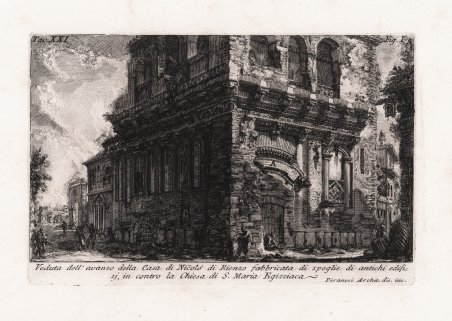
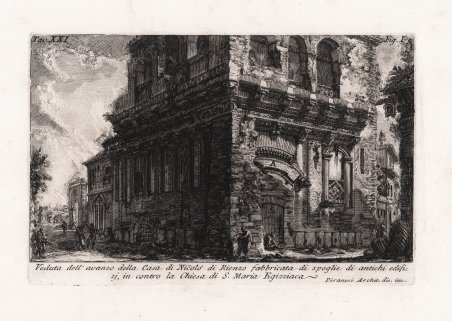

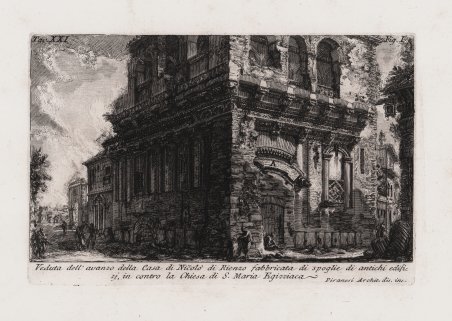
Veduta dell'avanzo della Casa di Nicolò di Rienzo.
Veduta dell'avanzo della Casa di Nicolò di Rienzo. | Prints | PIRANESI Giovan Battista
Payment methods
- PayPal
- Credit card
- Bank transfer
- Pubblica amministrazione
- Carta del Docente
Details
- Year of publication
- 1756
- Place of printing
- Roma
- Size
- 217 X 142
- Engravers
- PIRANESI Giovan Battista
- Inscription description
- Focillon n. 183; Wilton-Ely n. 318.
Description
Acquaforte e bulino, 1756 circa, firmata in lastra in basso a destra. Dalla serie Le Antichità Romane, prima edizione del 1756 edita da Bouchard e Gravier. Meravigliosa prova, ricca di toni, impressa a inchiostro bruno su carta vergata coeva, con pieni margini ed in perfetto stato di conservazione.Henry Focillon, nel suo saggio del 1918, suppone che il Piranesi prepari ed incida le tavole per l’opera tra il 1750 ed il 1756, tuttavia, elementi architettonici fanno risalire alcune al 1746. In realtà le tavole più antiche utilizzate nella raccolta risalgono probabilmente ad anni ancora precedenti, come sembra suggerire sia l’estrema complessità dell’opera, legata ad un lunghissimo lavoro di preparazione e ricerca, sia l’oscillazione stilistica riscontrabile comparando le varie tavole. Ad ogni modo, la grandiosità delle Antichità Romane del Piranesi non sta solamente nel grande lavoro grafico prodotto dall’artista: l’opera risulta infatti fondamentale come innovazione metodologica nel settore dell’archeologia a lei contemporanea, con l’utilizzo di scritti che sono essenziali per comprendere il pensiero dell’autore e l’innovazione del metodo piranesiano. Si può quindi sostenere, come giustamente fa notare il Focillon, che l’artista veneziano fondi l’archeologia moderna. Questa innovazione comporta, però, un enorme stacco e una grande divergenza con il pensiero e la cultura ufficiale ed accademica del periodo - di derivazione anglosassone - causando enormi polemiche di cui Piranesi fu bersaglio, e il fiorire di una negativa aneddotica intorno alla sua persona, il cui scopo era quello di ristabilire l’egemonia minacciata della cultura “classica”. Il principale pensiero espresso nelle Antichità Romane consiste nel documentare e conservare in effige un patrimonio monumentale che andava di giorno in giorno sgretolandosi, linea di condotta che andava contro l’atteggiamento culturale di amatori ed antiquari, il cui piacere era puramente estetico, non disdegnando all’occorrenza, l’asporto di frammenti anche vistosi di antichità a titolo di puro collezionismo o alla stregua di souvenir. La principale novità della sua impostazione, consiste nell’unificare in un solo momento le operazioni di scavo, di rilievo, le indagini strutturali e la misurazione con lo studio delle fonti letterarie, a cui egli fa riferimento diretto. Questo momento di unificazione è rappresentato dallo studio topografico, che unito alla tecnica di rilievo, alla conoscenza dei materiali e delle tecniche antiche, allo scavo ed al sopralluogo dava luce all’archeologia, ovvero lo studio della storia antica. Etching with engraving, 1756, signed at lower right. From the Antichità Romane, first edition by the French publisher Bouchard and Gravier in 1756. A great impression, printed with brown ink on contemporary laid, strong, paper, with margins, perfect conditions.The first edition of this work, in four volumes, was published in Rome in 1756 at the printing-works of Angelo Rotili at the Massimo alle Colonne Palace, by Bouchard and Gravier, book-dealers and tradesmen located in Rome near the church of St. Marcel at the Via del Corso. This collection included a portrait of Piranesi, engraved by Felice Porziani, and a dedication to James Caulfield, count of Charlemont. This dedication was later abolished in the aftermath of a quarrel, described by Piranesi in his Lettere di Giustificazione [Letters of Justification] (1757), which also gave rise to three different versions of this first original edition (May 1756). These different versions are distinguishable from the title-page of the first volume, which initially was dedicated to the Irish aristocrat, then exhibited a cancelled dedication and coat of arms and, finally, bore a Latin motto written by the artist "Aevo Suo Posteri set Utilitari Publicae".Henry Focillon, in his 1918 treatise, presumed that Piranesi prepared and engraved the plates for this collection between 1750 and 1756, although some architectural features could have a few of them dating back to 1746. Actually, the oldest plates included in this collection probably date back even further, as suggested by the extraordinary complexity of this work, due to a prolonged phase of preparation and research, together with the stylistic alterations which can be observed by comparing the different plates.The magnificence of Piranesi's Antichità Romane, however, is not only in the artist's large graphic output. Indeed, this work is of primary importance from the standpoint of methodological innovation within the framework of contemporary archaeology, with the utilisation of texts which are of essential importance for the comprehension of the author's ideas and of the innovations implied in Piranesi's methodology. It can be asserted, as correctly emphasised by Focillon, that the Venetian architect founded modern archaeology. However, this new-fashioned approach implied an important disassociation and a significant deviation from the convictions and the official and academic culture of the time, which was of Anglo-Saxon derivation. This gave rise to a serious controversy, whose target was Piranesi, and to an adverse anecdotal literature concerning his person, the objective being the re-establishment of the endangered authority of the culture it was threatening.The main motivation behind the Antichità Romane was the documentation and preservation, utilising illustrations, of a heritage of ancient monuments which was being ravaged on a daily basis. This approach was incompatible with the one held by amateurs and antiquarians who only took pleasure from aesthetic contemplation and would not refrain from occasionally removing rather imposing parts from ancient relics for their private collections or, more simply, as souvenirs. The main new feature in his procedure was to unify into a single space the acts of excavating, surveying, structural inquiries and measurement together with the analysis of literary sources, the latter of which he examined for himself. This step of unification is characterised by the study of topography which, together with surveying techniques, the knowledge of antique procedures and materials, excavations and on-site inspections, gave rise to archaeology, in other words to the study of ancient history.Therefore, the four volumes comprised in this collection are the central nucleus, the fulcrum around which all of Piranesi's activity revolved, constituting the accomplishment and focal point of a method of inquiry and comprehension of the ancient city of Rome and, at the same time, the starting point for . Cfr. Focillon n. 183; Wilton-Ely n. 318.