Vera Antiqui Capitolii Descriptio
Vera Antiqui Capitolii Descriptio | Prints | SALAMANCA Antonio
Vera Antiqui Capitolii Descriptio
Vera Antiqui Capitolii Descriptio | Prints | SALAMANCA Antonio
Payment methods
- PayPal
- Credit card
- Bank transfer
- Pubblica amministrazione
- Carta del Docente
Details
- Year of publication
- 1550
- Place of printing
- Roma
- Size
- 890 X 430
- Engravers
- SALAMANCA Antonio
Description
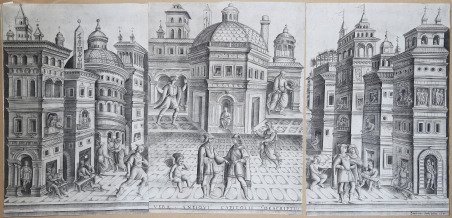
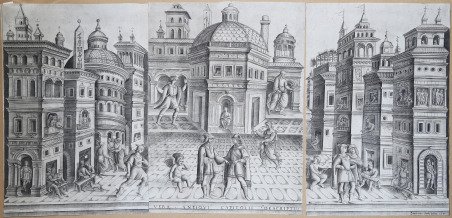
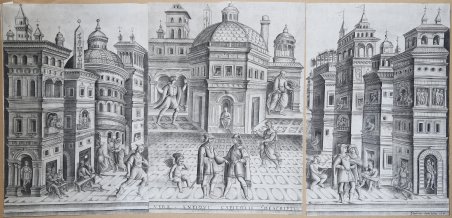
Straordinaria ricostruzione fantastica del Campidoglio, stampata su tre lastre ed edita per la prima volta dal Salamanca circa nel 1550. L’esemplare che qui presentiamo reca l’indirizzo degli eredi di Claude Duchet (Duchetti) e la data 1591. Iscritto in basso al centro: «VERA ANTIQVI CAPITOLII DESCRIPTIO» [Fedele descrizione dell’antico Campidoglio]. Iscritto in basso al centro: «Apud eredes Claudij duchetij, 1591». In basso a sinistra abrasione di «Antonio Salamanca Excudit», a destra abrasione di «VERA ANTIQVI CAPITOLII DESCRIPTIO» . La composizione somiglia ai disegni modenesi del Marcanova, soprattutto nella ricostruzione del Campidoglio e nella raffigurazione dei palazzi di Cicerone e Crasso. Tuttavia, i particolari dell’incisione dimostrano una conoscenza più matura dell’architettura antica. La rappresentazione del Campidoglio si ispira alle ricostruzioni ideali dell’antica Roma dei disegni del Marcanova, e risente delle decorazioni sceniche allestite per gli spettacoli teatrali, molto frequenti nel Rinascimento: “L’influenza che hanno avuto sugli artisti del periodo seguente è rimasta abbastanza limitata. Ma questo in gran parte dipende dal fatto che il codice Marcanova appena terminato trovò posto nella biblioteca di un convento, nella quale, appunto per la sua preziosità, rimase accessibile a pochi studiosi. Nondimeno, ricostruzioni ideali dell’antica Roma nello stile dei disegni marcanoviani si trovano anche nei tempi seguenti, fino alla metà del Cinquecento” (C. Hülsen). La prima edizione di queste tre stampe fu incisa per i tipi di Antonio Salamanca (1550 ca.), e il soggetto ebbe un discreto successo, come dimostra la riedizione degli Eredi di Claude Duchet del 1591. L’incisione edita per i tipi eredi Duchet nasconde in realtà il nome di Giacomo Gherardi, cognato di Claude Duchet, da cui ereditò la bottega con la condizione di firmare le lastre Eredes Claudij Duchetij, come accade appunto nel nostro caso. L’opera appartiene allo ' Speculum Romanae Magnificentiae, la prima iconografia della Roma antica. ' Lo ' Speculum ' ebbe origine nelle attività editoriali di Antonio Salamanca e Antonio Lafreri (Lafrery). Durante la loro carriera editoriale romana, i due editori - che hanno lavorato insieme tra il 1553 e il 1563 - hanno avviato la produzione di stampe di architettura, statuaria e vedutistica della città legate alla Roma antica e moderna. Le stampe potevano essere acquistate individualmente da turisti e collezionisti, ma venivano anche acquistate in gruppi più grandi che erano spesso legati insieme in un album. Nel 1573, Lafreri commissionò a questo scopo un frontespizio, dove compare per la prima volta il titolo Speculum Romanae Magnificentiae. Alla morte di Lafreri, due terzi delle lastre di rame esistenti andarono alla famiglia Duchetti (Claudio e Stefano), mentre un altro terzo fu distribuito tra diversi editori. Claudio Duchetti continuò l’attività editoriale, implementando le lastre dello Speculum con copie di quelle “perdute” nella divisione ereditaria, che fece incidere al milanese Amborgio Brambilla. Alla morte di Claudio (1585) le lastre furono cedute – dopo un breve periodo di pubblicazione degli eredi, in particolare nella figura di Giacomo Gherardi - a Giovanni Orlandi, che nel 1614 vendette la sua tipografia al fiammingo Hendrick van Schoel. Stefano Duchetti, al contrario, cedette le proprie matrici all’editore Paolo Graziani, che si associò con Pietro de Nobili; il fondo confluì nella tipografia De Rossi passando per le mani di editori come Marcello Clodio, Claudio Arbotti e Giovan Battista de Cavalleris. Il restante terzo di matrici della divisione Lafreri fu suddiviso e scisso tra diversi editori, in parte anche francesi: curioso vedere come alcune tavole vengano ristampate a Parigi da Francois Jollain alla metà del XVII secolo. Diverso percorso ebbero alcune lastre stampate da Antonio Salamanca nel suo primo periodo; attraverso . Extraordinary imaginary view of the Camidoglio, realized on three sheets and printed for the first time by Salamanca in 1550. This particular example bears the address of Claude Duchet’s heirs (Duchetti) and the date of 1591. The composition resembles Marcanova's Modena drawings, especially in the reconstruction of the Capitol and the depiction of the palaces of Cicero and Crassus. However, the details of the engraving demonstrate a more mature knowledge of ancient architecture. The depiction of the Capitol is inspired by the ideal reconstructions of ancient Rome in Marcanova's drawings, and is influenced by the stage decorations set up for theatrical performances, which were very common in the Renaissance: "The influence they had on the artists of the following period remained quite limited. But this largely depends on the fact that the newly finished Marcanova codex found its place in the library of a convent, in which, precisely because of its preciousness, it remained accessible to few scholars. Nevertheless, ideal reconstructions of ancient Rome in the style of the Marcanova drawings are also found in later times, up to the mid-sixteenth century" (C. Hülsen). The first edition of these three prints was engraved for the types of Antonio Salamanca (c. 1550), and the subject was quite successful, as evidenced by the 1591 reissue of Claude Duchet's Heirs. The engraving published for the Duchet heirs types actually conceals the name of Giacomo Gherardi, Claude Duchet's brother-in-law, from whom he inherited the workshop with the condition that he sign the plates Eredes Claudij Duchetij, as happens precisely in our case. The work belongs to the Speculum Romanae Magnificentiae, the earliest iconography of ancient Rome. ' The Speculum originated in the publishing activities of Antonio Salamanca and Antonio Lafreri (Lafrery). During their Roman publishing careers, the two editors-who worked together between 1553 and 1563-started the production of prints of architecture, statuary, and city views related to ancient and modern Rome. The prints could be purchased individually by tourists and collectors, but they were also purchased in larger groups that were often bound together in an album. In 1573, Lafreri commissioned a frontispiece for this purpose, where the title Speculum Romanae Magnificentiae appears for the first time. Upon Lafreri's death, two-thirds of the existing copperplates went to the Duchetti family (Claudio and Stefano), while another third was distributed among several publishers. Claudio Duchetti continued the publishing activity, implementing the Speculum plates with copies of those "lost" in the hereditary division, which he had engraved by the Milanese Amborgio Brambilla. Upon Claudio's death (1585) the plates were sold - after a brief period of publication by the heirs, particularly in the figure of Giacomo Gherardi - to Giovanni Orlandi, who in 1614 sold his printing house to the Flemish publisher Hendrick van Schoel. Stefano Duchetti, on the other hand, sold his own plates to the publisher Paolo Graziani, who partnered with Pietro de Nobili; the stock flowed into the De Rossi typography passing through the hands of publishers such as Marcello Clodio, Claudio Arbotti and Giovan Battista de Cavalleris. The remaining third of plates in the Lafreri division was divided and split among different publishers, some of them French: curious to see how some plates were reprinted in Paris by Francois Jollain in the mid-17th century. Different way had some plates printed by Antonio Salamanca in his early period; through his son Francesco, they goes to Nicolas van Aelst's. Other editors who contributed to the Speculum were the brothers Michele and Francesco Tramezzino (authors of numerous plates that flowed in part to the Lafreri printing house), Tommaso Barlacchi, and Mario Cartaro, who was the executor of Lafreri's will, and printed some derivative plates. All the best engravers of the time - such as Nicola Beat. Cfr.