Connubia florum latino carmine demonstrata Auctore D. Mac=Encroe, M.D. cum interpretatione Gallica D*******
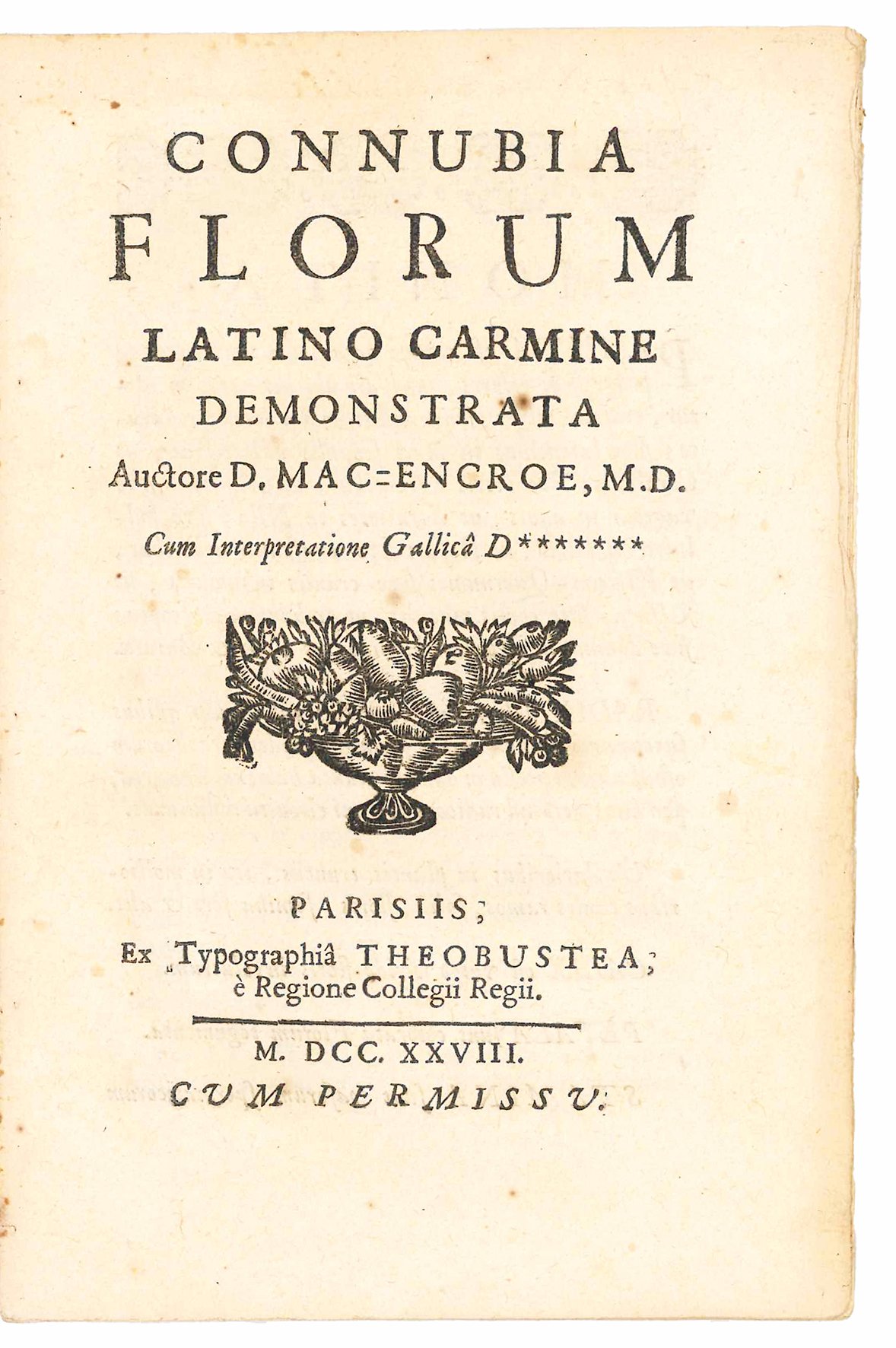
Connubia florum latino carmine demonstrata Auctore D. Mac=Encroe, M.D. cum interpretatione Gallica D*******
Payment methods
- PayPal
- Credit card
- Bank transfer
- Pubblica amministrazione
- Carta del Docente
Details
- Year of publication
- 1728
- Place of printing
- Paris
- Author
- LA CROIX, Demetrius de (fl. 1709-1728)
- Publishers
- Claude Louis Thiboust
- Keyword
- settecento
- State of preservation
- Good
- Languages
- Italian
- Binding
- Hardcover
- Condition
- Used
Description
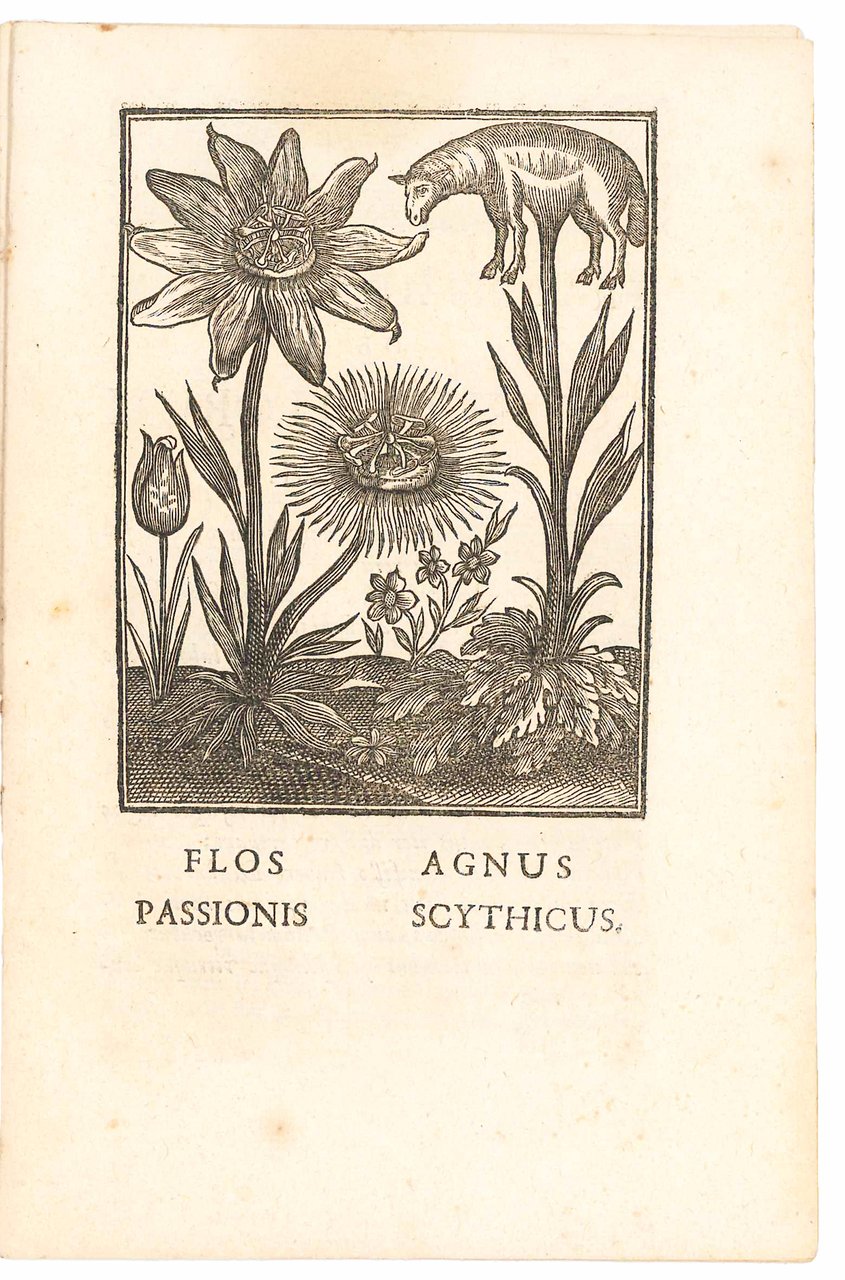
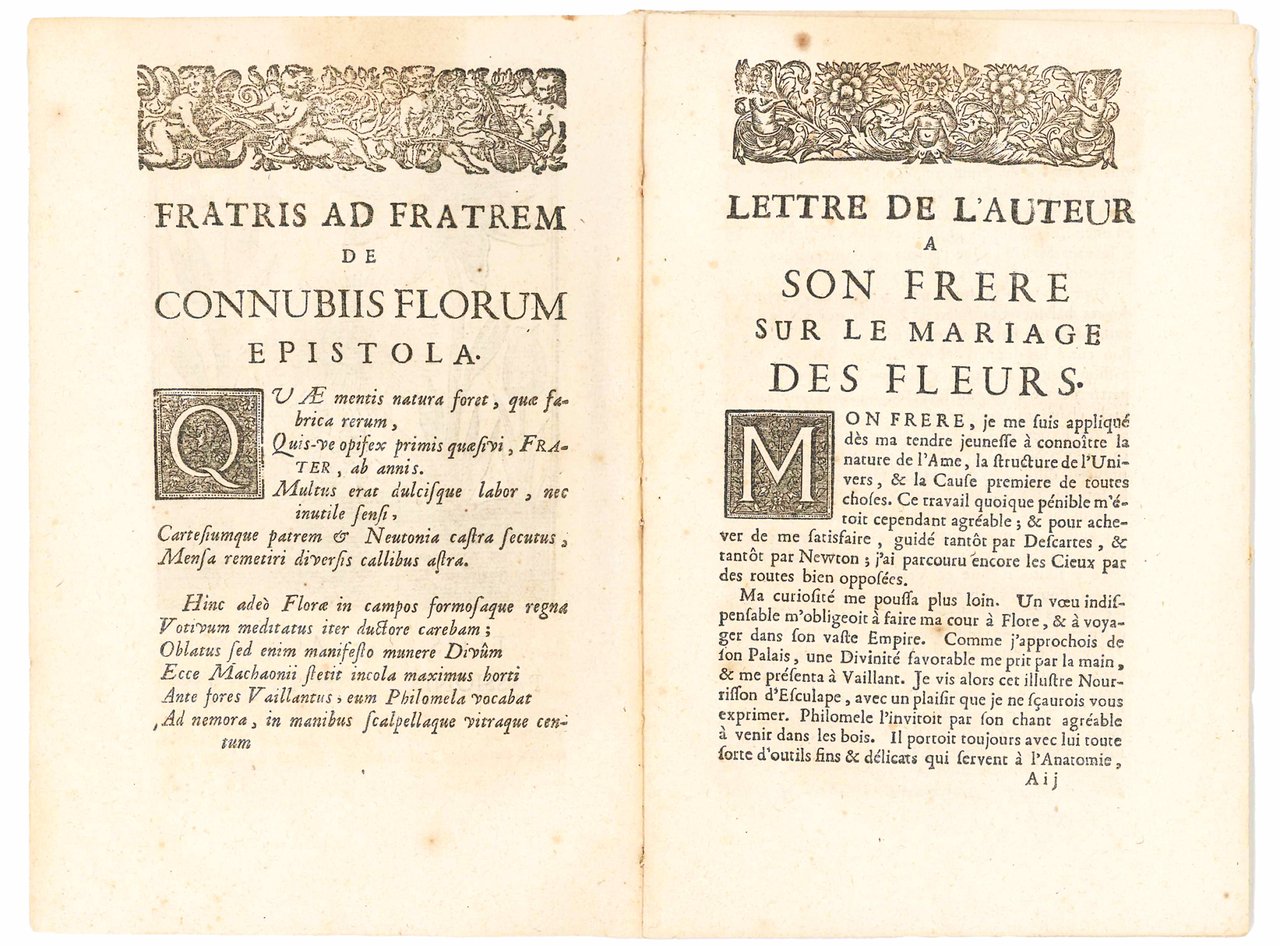
8vo (193x127 mm). VII, [1 blank], 39, [1] pp. Woodcut vignette on the title page and woodcut full-page illustration on p. [1] depicting passion flowers and the Scythian Lamb. Text in Latin and French. Later wrappers. Small pale stain to the upper margin, a good copy.
Rare first separate, greatly enlarged, and bilingual edition - in the variant with the Gaelic name (D. MacEncroe) of the author on the title page (there are copies bearing the French version of his name, D. de la Croix, instead) - of this Latin poem on the sex of flowers, first published as the preface to Sebastian Vaillant's Botanicon Parisiense in 1727.
A new edition was published in 1749 by the Abbé d'Olivet, in volume one of “Poemata didascalica,” under the name of Patrice Trant. However, according to Barbier and Brunet, Trant was only the author of the French translation. A third edition, with a commentary by Richard Clayton, was published in Bath in 1791. A French-only edition with commentary by Antoine-Alexandre Barbier appeared in Paris in 1798, while a Portuguese version of the poem (O consorcio das flores) by Manuel Maria de Barbosa du Bocage was published Lisbon in 1801 and in Rio de Janeiro in 1811.
The Hunt Botanical Library Catalogue considers this poem as “one of the most curious little books in the collection, or even in the demesne of bibliography”.
The Vegetable Lamb of Tartary, depicted in the illustration, is a legendary zoophyte of Central Asia that was once believed to produce sheep as its fruit. It was thought that the sheep were connected to the plant by an umbilical cord and grazed on the surrounding land. Once all the foliage had been consumed, both the plant and the sheep would die. The cotton plant is the underlying inspiration for the legend.
Italian Union Catalogue, IT\ICCU\SBTE\000173; OCLC, 17797823; J.-Ch. Brunet, Manuel du libraire et de l'amateur de livres, Paris, 1862, vol. III, col. 732; A.-A. Barbier, Dictionnaire des ouvrages anonymes, Paris, 1879, vol. IV, col. 1200; A. Stevenson, ed., Catalogue of Botanical Books in the Collection of Rachel McMasters Miller Hunt: pt. 2. Printed books 1701-1800, Pittsburgh, 1961, p. 113.
