Dell'arte rappresentativa premeditata, ed all'improviso parti due. Giovevole non solo a chi si diletta di rappresentare; ma a' predicatori, oratori, accademici, e curiosi [...]
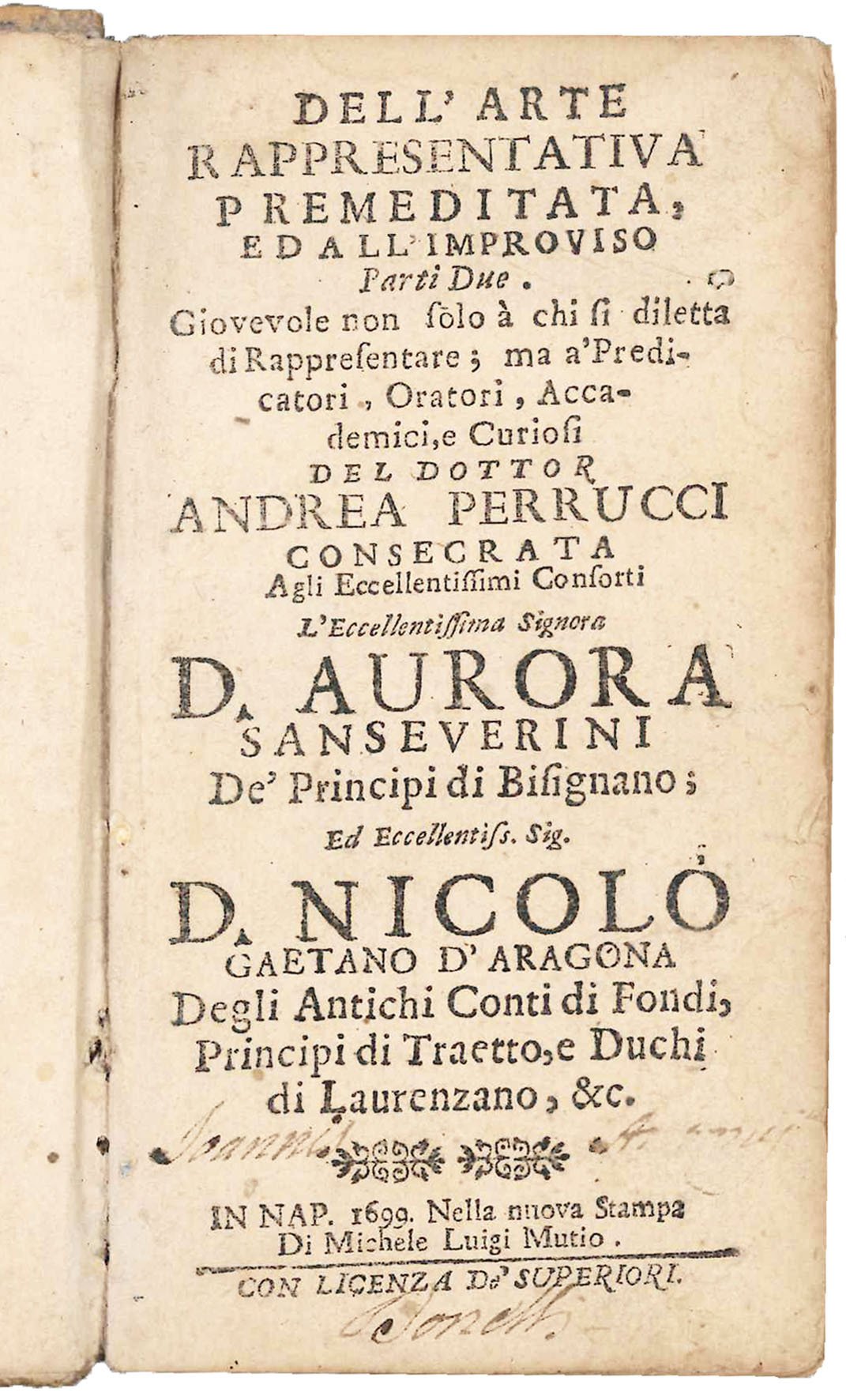
Dell'arte rappresentativa premeditata, ed all'improviso parti due. Giovevole non solo a chi si diletta di rappresentare; ma a' predicatori, oratori, accademici, e curiosi [...]
Payment methods
- PayPal
- Credit card
- Bank transfer
- Pubblica amministrazione
- Carta del Docente
Details
- Year of publication
- 1699
- Place of printing
- Napoli
- Author
- PERRUCCI, Andrea (1651-1704)
- Publishers
- Michele Luigi Muzio
- Keyword
- seicento
- State of preservation
- Good
- Languages
- Italian
- Binding
- Hardcover
- Condition
- Used
Description
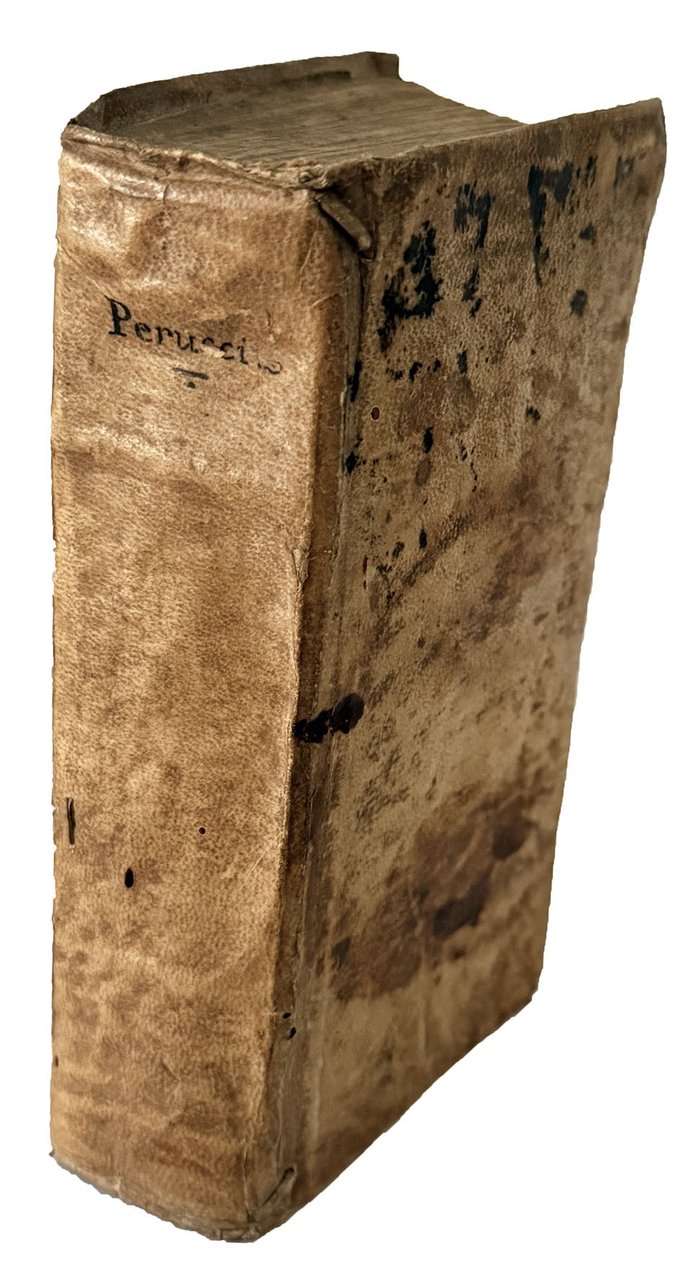
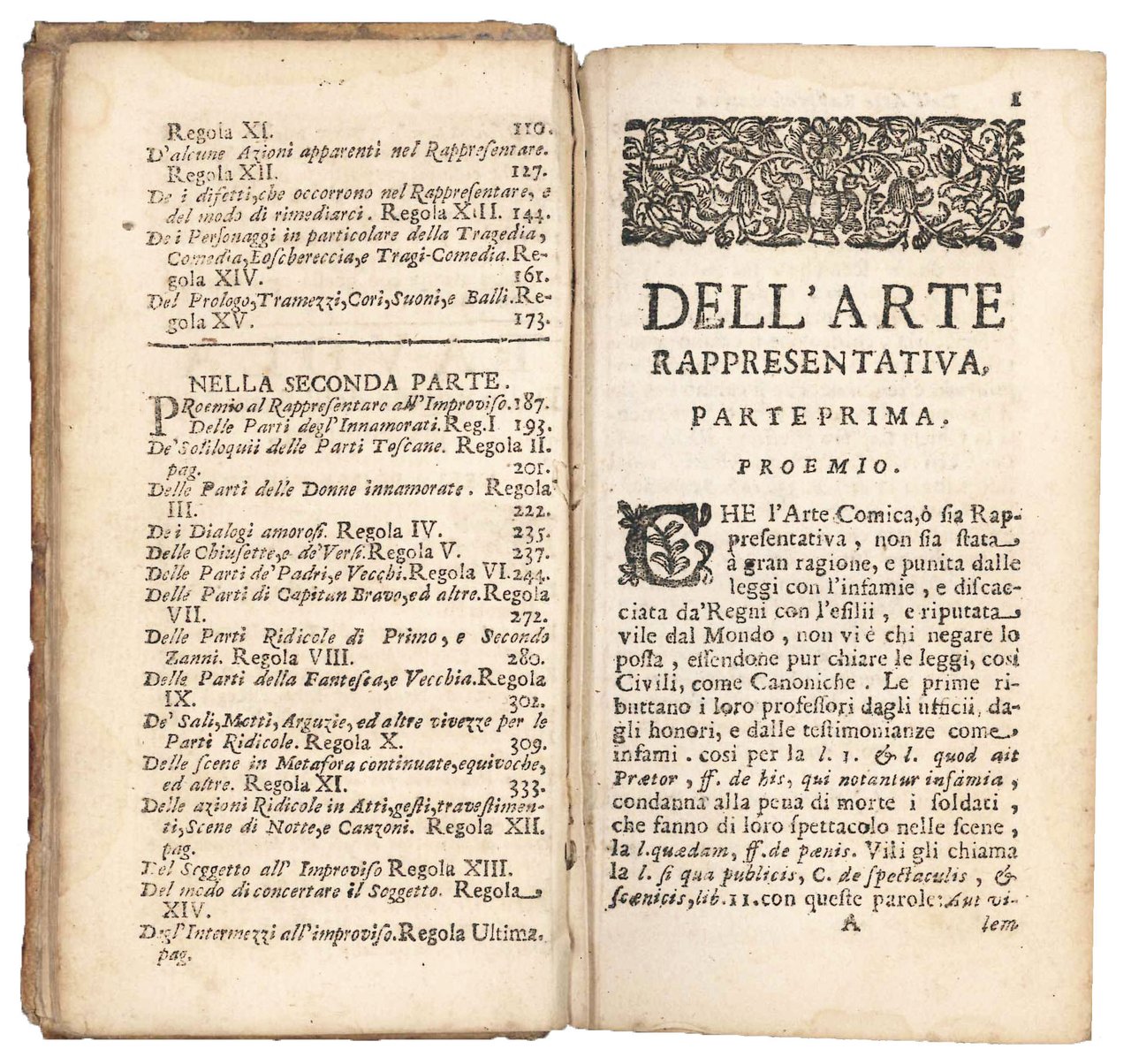
12mo (143x75 mm). [12], 394, [2] pp. Collation: a6 A-Q12 Q[i.e.R]6. To a few surviving copies of this rare book was added an engraved frontispiece, which is not present in this copy. Contemporary stiff vellum, inked title on spine (slightly stained and soiled). On the title page ownership entry “Joannis Antonij Donelli”. Tear repaired to l. B8, worm tracks skillfully repaired on several leaves occasionally affecting the text, light browning, but a good, genuine copy.
Extremely rare first edition. “Andrea Perrucci's Dell'arte rappresentativa premeditata ed all'improviso brings together the two great acting traditions of the early modern period: that of the scripted theatre and that of the commedia dell'arte. The work can be regarded as the culmination of a series of treatises on acting […] by literary men and/or by professional actors and directors of acting companies. Leone de' Sommi was the first, with an unpublished manuscript treatise dating from the 1560s. Next came Angelo Ingegneri (1598), Jules Cesar Boulenger (1603), (1609), and Pier Maria Cecchini (1628). Perrucci (1699) outdoes them all, offering detailed observations on staging, vocal ability and training, requisite acting skills, linguistic differentiation according to social status, and the manner in which distinctive roles should be played […] The evolution of Perrucci's dramatic theories, whether relative to the commedia premeditata or the improvised comedy, cannot be separated from the influence of the Spanish presence, culturally and linguistically, on the Italian peninsula during the sixteenth and seventeenth centuries. The Spanish control of all of southern Italy through the Viceregal court at Naples, and of the rest of the peninsula through dynastic marriages, left its most indelible mark on the evolution of the Italian theatre, on both scripted plays and the commedia dell'arte. On invitation from the Viceroys for both personal enjoyment and as part of the Spanish Crown's propaganda of acculturation, Spanish acting troupes, bringing with them the latest successes of Lope de Vega and his followers, inundated Naples, moving from there to ambassadorial courts throughout the peninsula. The recitation of Spanish comedies in public theatres, private homes, and religious collegi garnered captive audiences throughout the seventeenth century and well into the next century. As for dramatists, opera librettists, and the comici dell'arte, the translation or adaptation of Spanish pieces offered immediate financial and professional rewards. Andrea Perrucci was no stranger to this literary phenomenon, having been born (1651) at a time when the imitation of things Spanish was in full flower. Perrucci's presence in Naples coincided with the reign of Philip IV (1621-1665), fervent supporter of Spain's theatre at home and abroad, and that of Charles II (1665-1700), whose successive Viceroys continued to promote Spanish culture, the theatre being its most prominent medium. Andrea Perrucci undoubtedly had contact with Spanish actors and with Italian dramatists, librettists, and players (comici) who had adapted Spanish works for the Italian stage. Unlike many of his peers, Perrucci did not write in Spanish. But he was familiar enough with that language to read in the original Lope de Vega's Arte nuevo de hacer comedias en este tiempo, published roughly one hundred years earlier, its earliest states dating from around 1605. Perrucci's multiple allusions to that text in his treatise speak to the continuing influence of the Spaniard's dramaturgy in Italian acting circles. Lope de Vega's twenty-page tract, in verse, offered Perrucci concrete advice as to the types of plots that are most enjoyable; the preeminent need to please the public even though the classic rules of the art be compromised; the dramatic intrigue of gender-reversing disguises, given that men and women were routinely cast in their own genders at that time; the need to maintain decorum in speech and manner according
