I cinque libri de le antichità de Beroso sacerdote Caldeo. Con lo commento di Giovanni Annio di Viterbo teologo eccellentissmo [sic]. Il numero de gli altri autori che trattano de la antichità si legge ne la seguente pagina. Tradotti hora pur in italiano per Pietro Lauro modonese. (Colophon: In Vinegia, per Pietro, e Zuanmaria fratelli de i Nicolini da Sabio: Ad instantia da Baldessar de Costantini, à l'insegna di San Georgio)
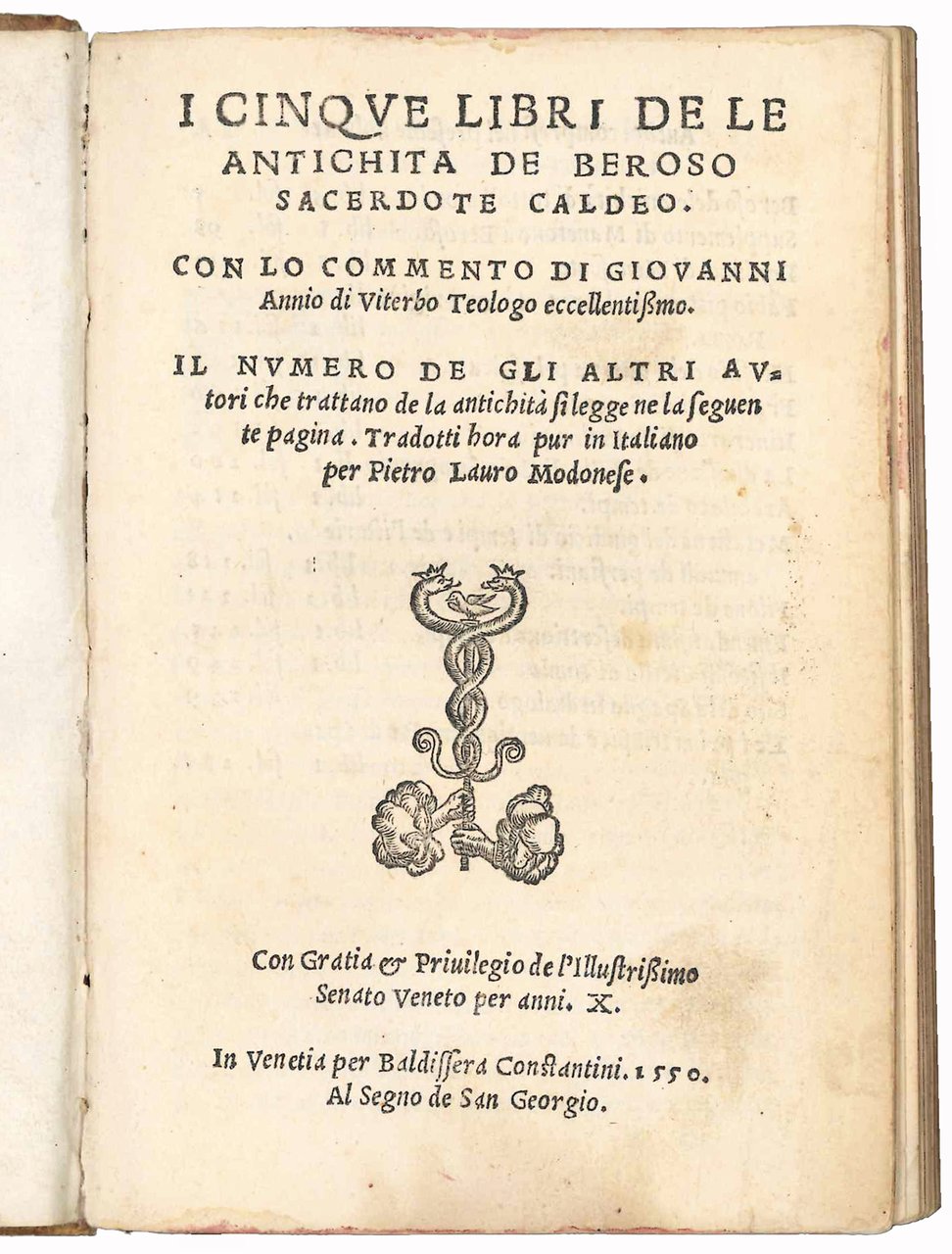
I cinque libri de le antichità de Beroso sacerdote Caldeo. Con lo commento di Giovanni Annio di Viterbo teologo eccellentissmo [sic]. Il numero de gli altri autori che trattano de la antichità si legge ne la seguente pagina. Tradotti hora pur in italiano per Pietro Lauro modonese. (Colophon: In Vinegia, per Pietro, e Zuanmaria fratelli de i Nicolini da Sabio: Ad instantia da Baldessar de Costantini, à l'insegna di San Georgio)
Payment methods
- PayPal
- Credit card
- Bank transfer
- Pubblica amministrazione
- Carta del Docente
Details
- Year of publication
- 1550
- Place of printing
- Venezia
- Author
- NANNI, Giovanni (Joannes Annius de Viterbo, 1437-1502)-LAURO,
- Publishers
- [Pietro & Giovanni Maria Nicolini da Sabbio for] Baldassar
- Keyword
- Quattro-Cinquecento
- State of preservation
- Good
- Languages
- Italian
- Binding
- Hardcover
- Condition
- Used
Description
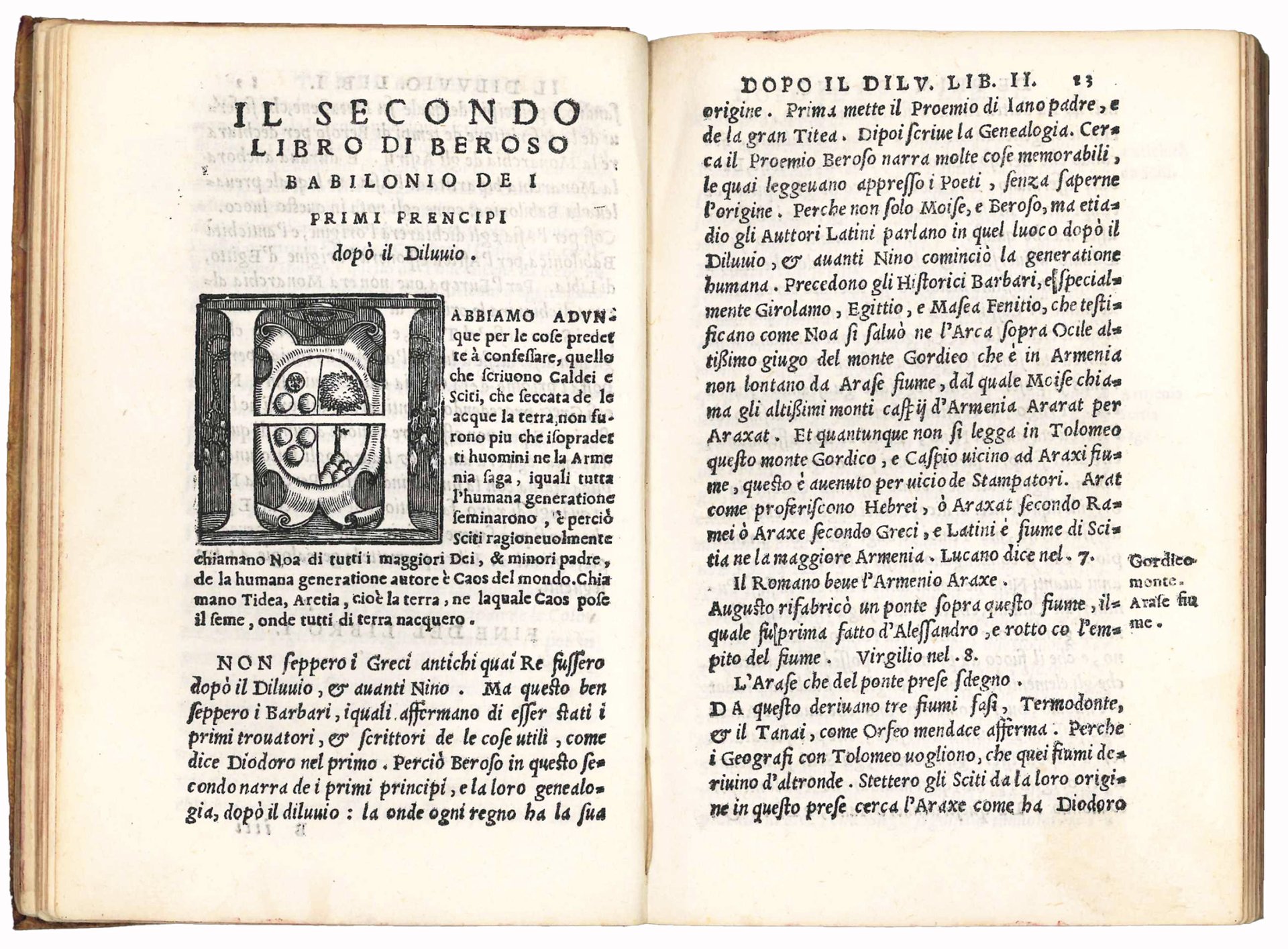
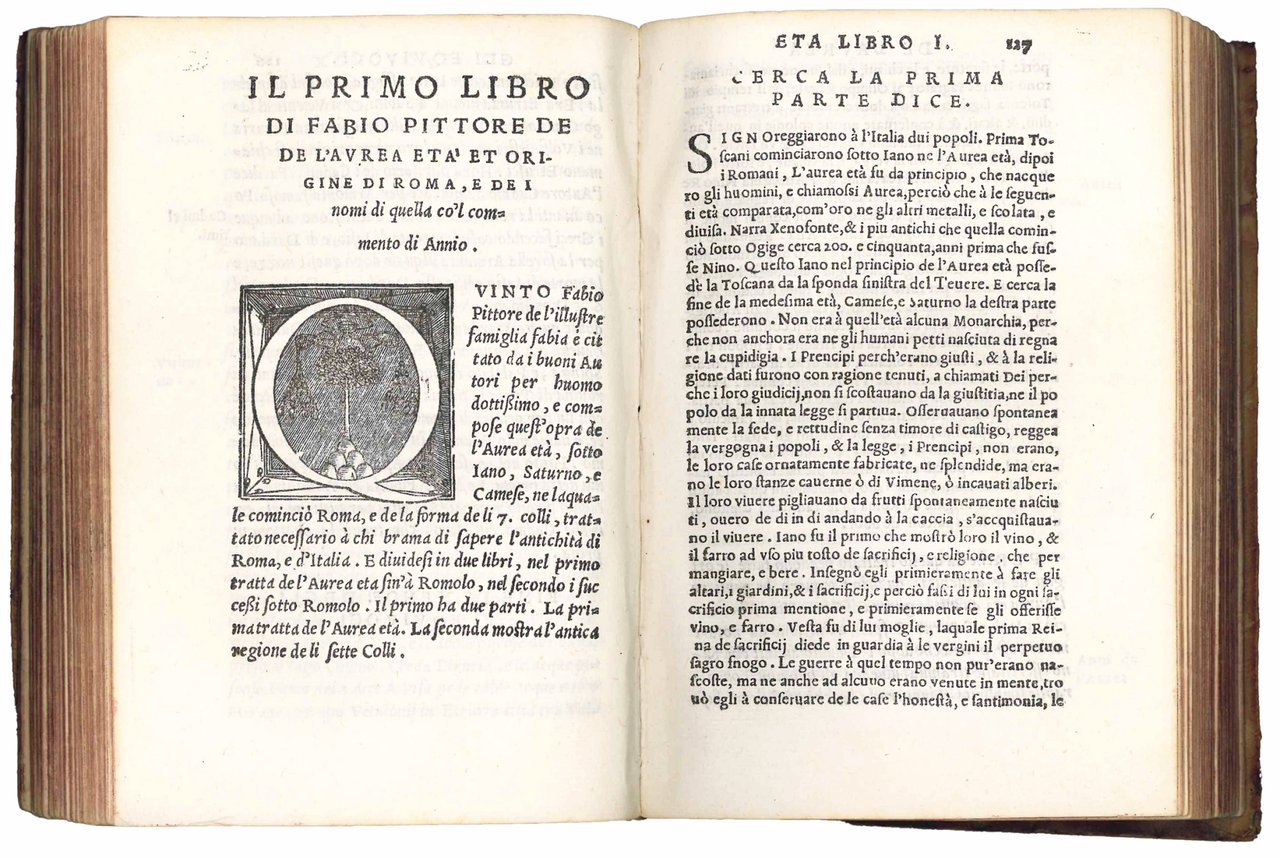
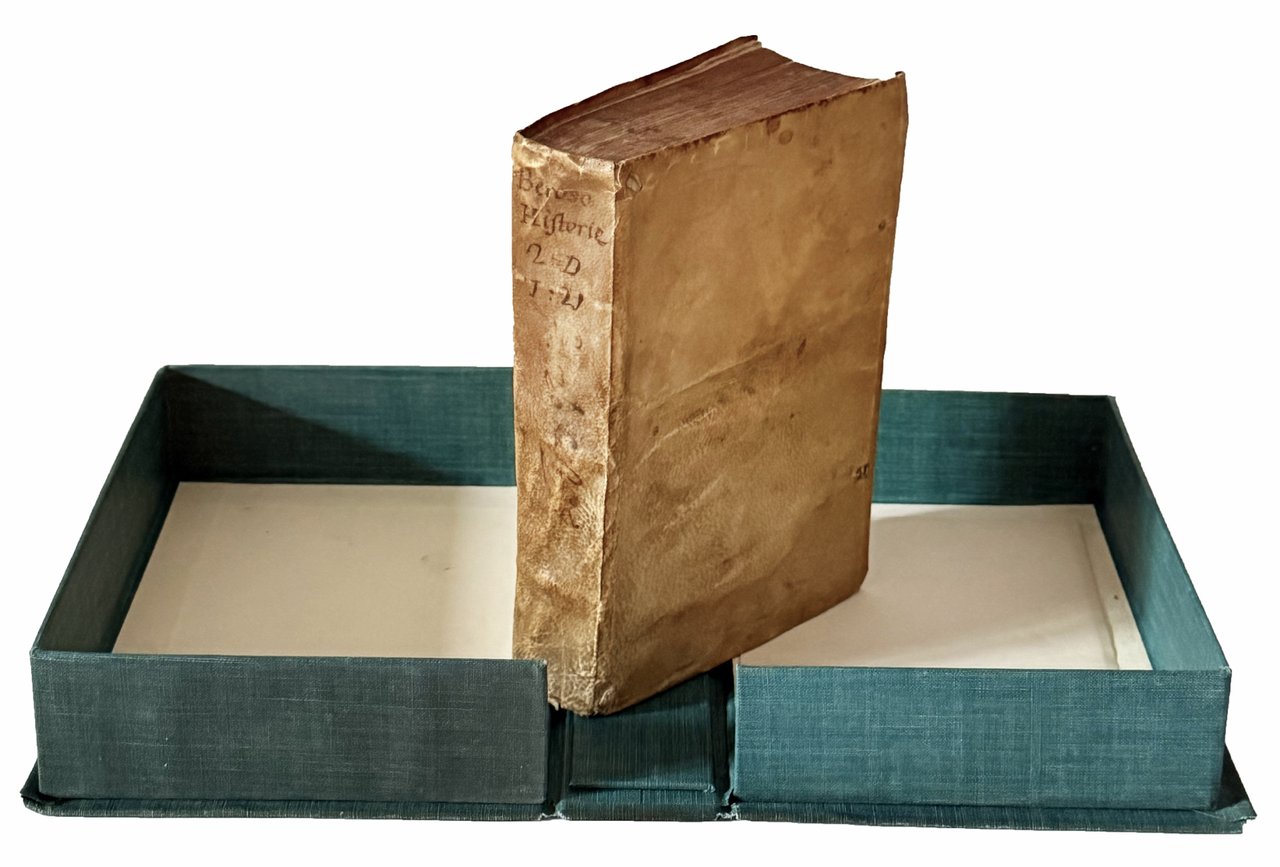
8vo (151x92 mm). [10], 295, [1] leaves. Collation: aa10 A-OO8. Printer's device on the title page. Colophon at l. OO8r. Roman and italic type. Woodcut decorative and historiated initials. Contemporary flexible vellum, inked title on spine, pale red edges (traces of ties, spine slightly darkened). Small loss of paper to the bottom margin of l. Aa10 not affecting the text, small worm track to the last two leaves affecting a few letters, light marginal stain at the beginning of the volume, all in all a very good, genuine copy.
First edition in Italian of this collection of spurious fragments supposedly written by Myrsilus Lesbius, Cato, Archilochus, Metasthenes, Xenophon (De aequivocis), Berossus, Manetho and other Greek and Roman authors. However, they were actually fabricated by the Dominican Annius of Viterbo and first published in Rome by Silber in 1498 under the title Commentaria super opera diversorum auctorum de antiquitatibus loquentium confecta (reprinted in the same year in Venice by Vitali).
Annius allegedly discovered a series of eleven previously lost ancient texts written by a Babylonian, a Jew, a Christian, a Roman, an Egyptian, and others, around which he wrote vast commentaries. In fact, he forged them all, primarily to demonstrate that the ancient Egyptian god Osiris ultimately settled in Viterbo, Annius's own hometown, which then became the epicentre of all human culture. He also planted fake hieroglyphs to prove that the Italians have the oldest lineage of all, while the Greeks, who thought they had invented everything, were actually the latest to contribute to human civilisation. According to Annius, these newly rediscovered texts offered proof that Noah himself had colonised Italy precisely 108 years after the biblical flood. The empire he created went on to rule the world through a venerable priesthood stretching from the ancient Etruscans through the classical Roman era to the Renaissance papacy.
Nanni claimed to have found some of his ancient scripts, which revealed the origins of Italy, in Mantua, a city founded by the Etruscans, while Berosus' Antiquitates were given to him in Genoa by some Armenian brothers: Armenia was, in fact, the nation that traditionally preserved the memories of Noah, who disembarked from the Ark on Mount Ararat.
“The most acknowledged work of the Dominican friar Giovanni Nanni, better known by his pseudonym Annius of Viterbo, is surely his large-scale forgery of antique texts attributed to eleven ancient authors, commonly referred to as the Antiquitates by both modern critics and their Renaissance owners. Yet, the folio format incunable printed in Rome between July and August 1498 does not bear any frontispiece with such a title. Thanks to its two colophons we know that it was titled Commentaria fratris Ioannis Annii Viterbensis ordinis predicatorum Theologiae professoris super opera diversorum auctorum de Antiquitatibus loquentium, or alternatively, as it is named in the dedicatory epistle to the Catholic Monarchs of Spain Ferdinand and Isabel, the De commentariis Antiquitatum. Either way, the main focus does not seem to be on the opera diversorum auctorum, the antiquities themselves, but on the commentaries and their author, Annius of Viterbo. In fact, it is the coordinative action of his erudite commentary that bestowed the meaning he desired upon his concocted auctores: each page being an intricate tangle of forty-three lines of quoted authorities and complex linguistic and historical analysis of ancient texts and archaeological findings, all printed in a roman typeface that encircled the main gothic rotunda of the transcribed sources. As a result, with this combination of scholarly glosses and pseudo-antique materials Annius was able to demonstrate the most illustrious antiquity of his town, Viterbo, the Etruscan origin of civilisation as well as of the Papacy, the Noahic genealogy of most of the European provinces of Annius' time, and the existence of giants after the un
