I Fasti di Ovidio tratti alla lingua volgare per Vincenzo Cartari Regiano
I Fasti di Ovidio tratti alla lingua volgare per Vincenzo Cartari Regiano
Payment methods
- PayPal
- Credit card
- Bank transfer
- Pubblica amministrazione
- Carta del Docente
Details
- Year of publication
- 1551 (aprile)
- Place of printing
- Venezia
- Author
- OVIDIUS NASO, Publius (43 BC-ca. 17)-CARTARI, Vincenzo, tr. (b
- Publishers
- Francesco Marcolini
- Keyword
- Quattro-Cinquecento
- State of preservation
- Good
- Languages
- Italian
- Binding
- Hardcover
- Condition
- Used
Description
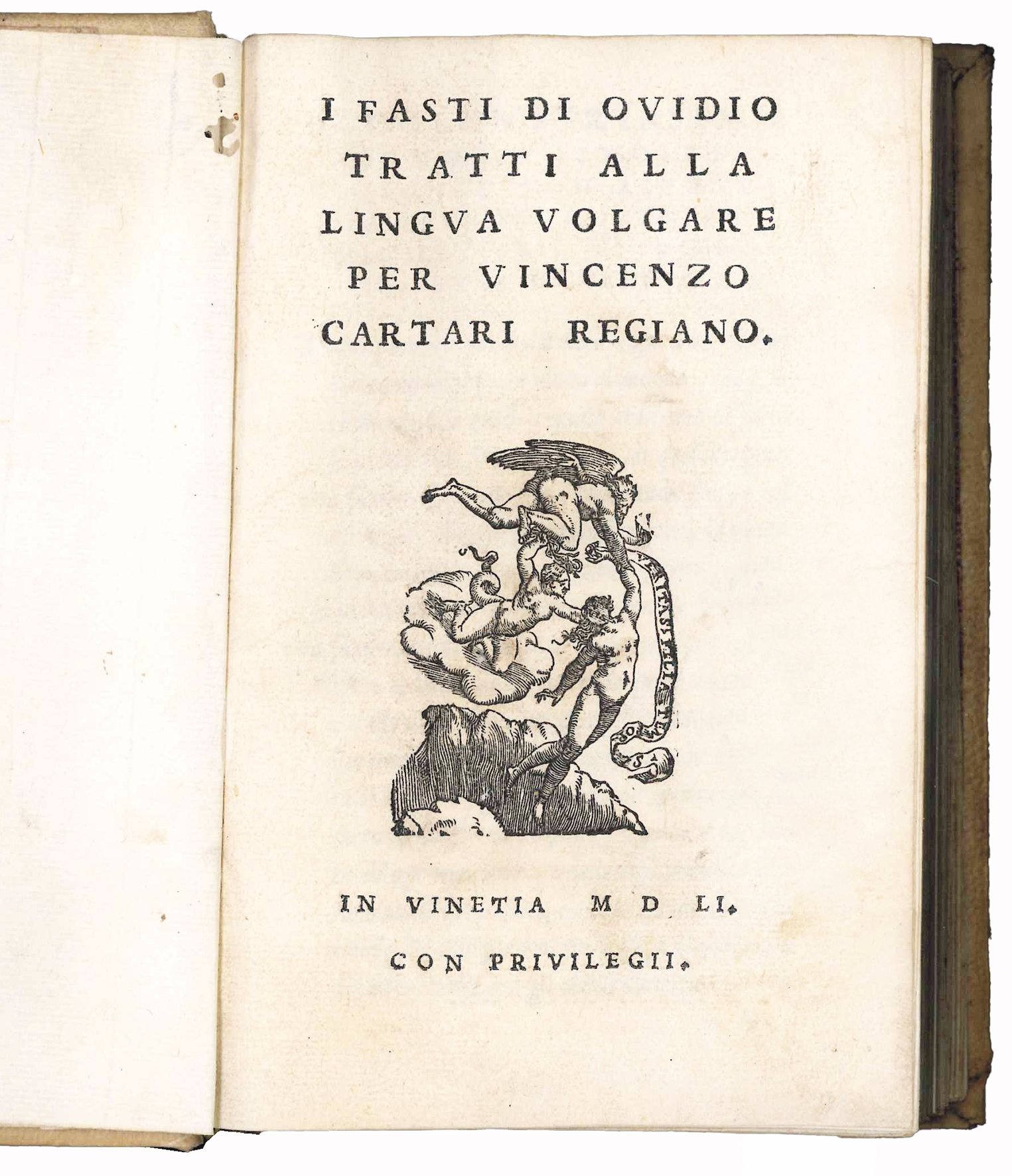
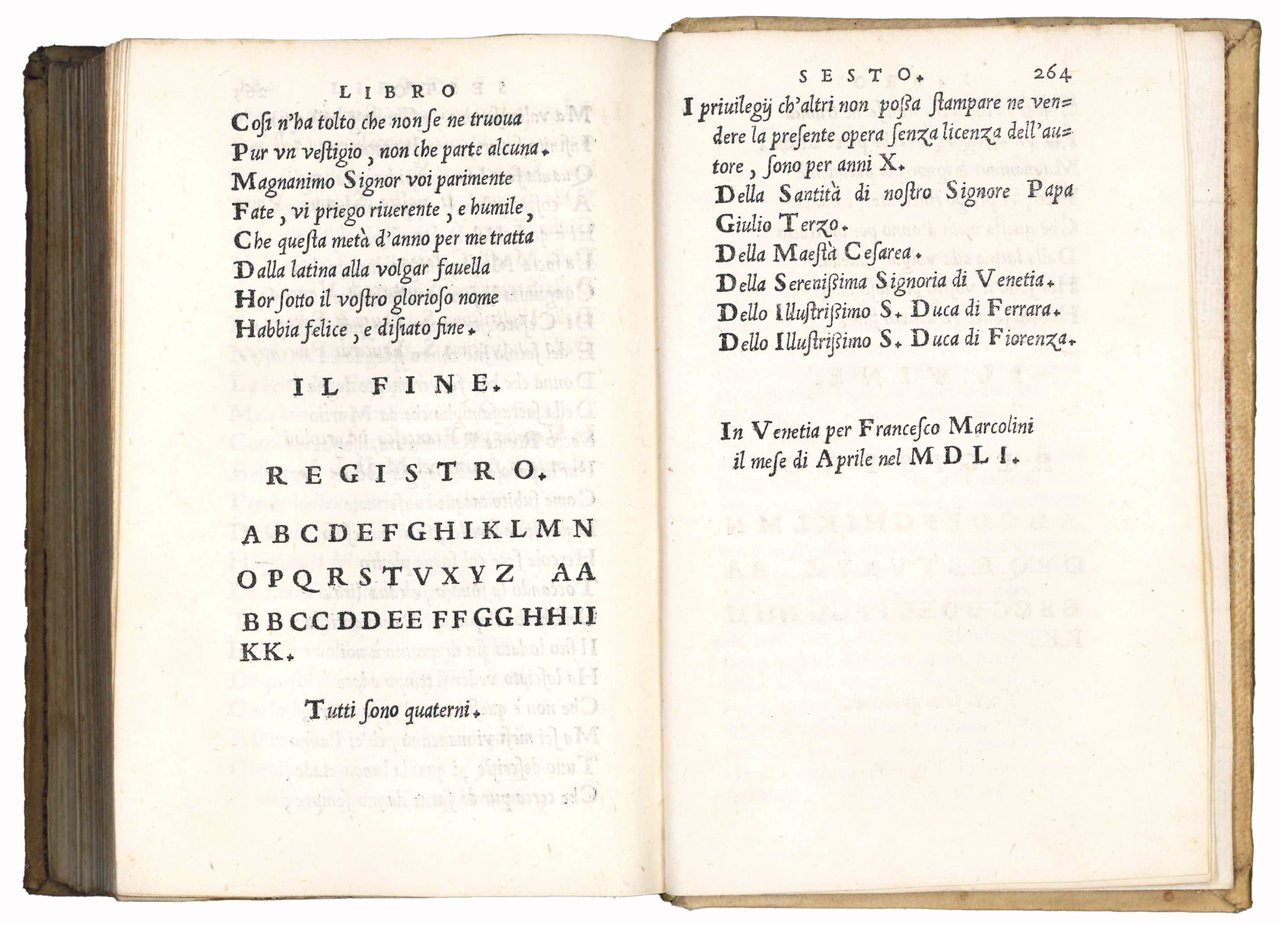
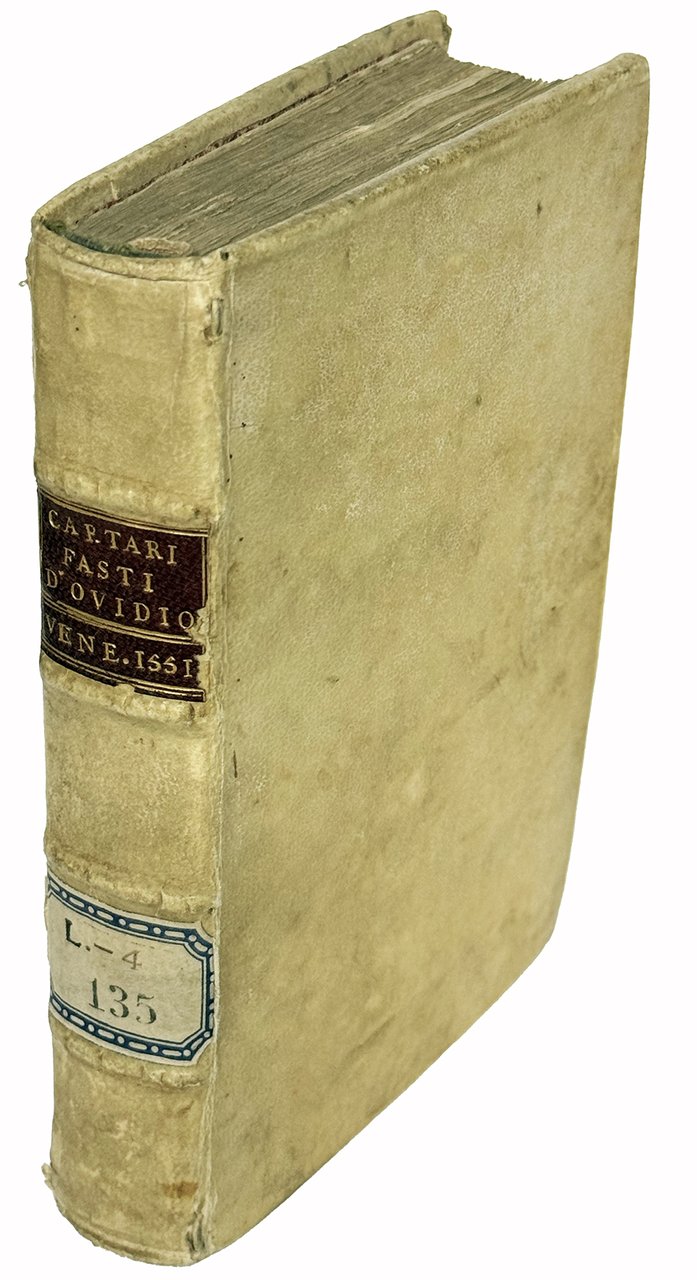
8vo (163x105 mm). 264, [2] leaves. Collation: A-KK8 LL2. Printer's device on the title page. Colophon at l. KK8r. Errata at l. LL1. Leaf LL2 is a blank. Roman and italic types. 18th-century stiff vellum, spine with four raised bands and morocco lettering piece, marbled endleaves. Label with manuscript shelf mark on the spine, bookplate and stamp of a private collection on the front pastedown and title page. Some occasional pale staining, a very good copy.
First edition of the first translation into any modern language of Ovid's Fasti, a six-book Latin poem written by in AD 8 and also known as The Book of Days or On the Roman Calendar.
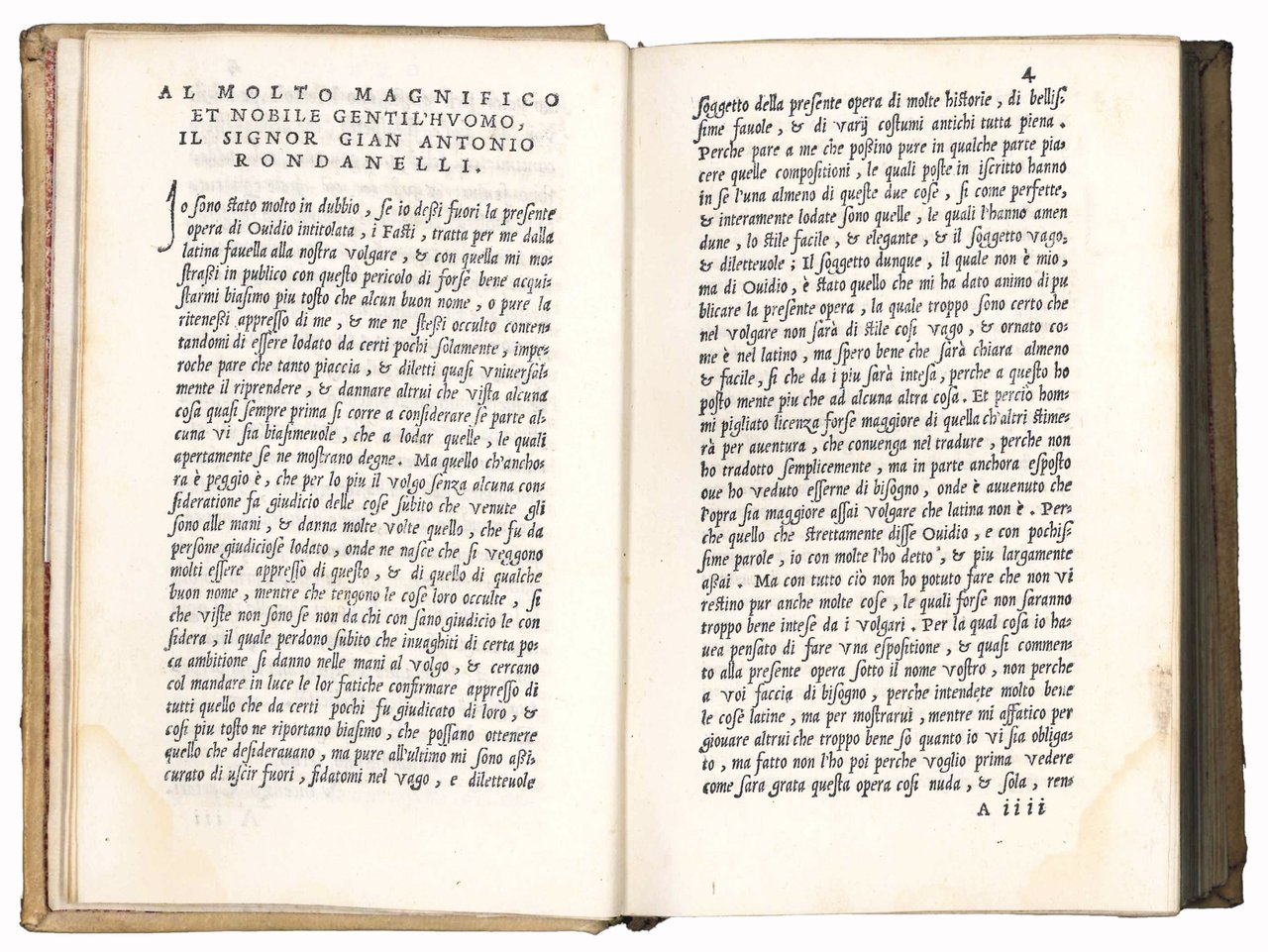
Vincenzo Cartari was born in Reggio Emilia around 1531. As far as we can tell from the scarce information available, his entire life revolved around the Este family, to whom his ancestors had also been loyal servants. In 1551, dedicating his translation of Ovid's Fasti to Alfonso II, the future Duke of Ferrara, Cartari points out that his family's services had been particularly appreciated during the reign of Duke Ercole I (1471-1505). In the same dedication, he also mentions that he was almost alone in the world, and this is all we know about his family life. He certainly belonged to the court of Cardinal Ippolito II d'Este who, as demonstrated by the protection he accorded to Muret, appreciated men of culture. In a letter of unknown date, the humanist Bartolomeo Ricci da Lugo, tutor to the children of Duke Ercole II, congratulates Cartari on his excellent relations with Cardinal Ippolito and conveys the congratulations of other illustrious figures from Ferrara on the cardinal's protection, among whom we note the names of Gian Antonio Rondanelli and Camillo Gualenghi, who also appear in the dedications of Cartari's works, including the present one, which has a second dedication to Rondanelli. Ippolito d'Este took Cartari with him on the delicate diplomatic mission he carried out between 1561 and 1563 at the French court on behalf of Pius IV. The date of his death is unknown: a post quem date is provided by the dedication in the 1571 Venetian edition of the Imagini, his most famous work, which is addressed to Cardinal Luigi d'Este and bears the date September 10, 1569.
Cartari published four works at a young age and within a short period of eleven years, some of which earned him considerable notoriety: I Fasti di Ovidio tratti alla lingua volgare (Venice, 1551); Il Flavio intorno ai Fasti Volgari (Venice, 1553); Le imagini con la spositione dei dei de gli antichi (Venice, 1556); Compendio dell'Historie di Monsignor Paolo Giovio (Venice, 1562).
The version of the Fasti, the first known in a modern language, is more interesting for the methodological approach than for its intrinsic success. It is, in fact, a very laborious translation in free verse of absolutely mediocre quality. However, the translator's main objective was not to produce an Italian text with independent artistic merit, but to provide a faithful interpretation of one of Ovid's least known and least appreciated works. In the second dedication of the edition (the first is to Alfonso II), Cartari tells Rondanelli that he is willing to overdo the Italian rendering in order to achieve his explanatory goal. This is indeed what actually happens, which helps to present Flavius, i.e. the commentary on the Fasti mentioned in the translation itself, in a more favourable light.
However, Cartari's name is mainly associated with the Imagini, a treatise on the iconography of classical deities, which enjoyed exceptional success for two centuries, resulting in around twenty-five editions, a good half of which were in Latin, English, French, and German. (cf. M. Palma, Cartari, Vincenzo, in: “Dizionario Biografico degli Italiani”, vol. 20, Rome, 1977, s.v.).
Edit 16, CNCE53576; USTC, 845793; F. Federici, Degli scrittori latini e delle italiane versioni delle loro opere, Padua, 1840, p. 81.
