L'ultima cena.
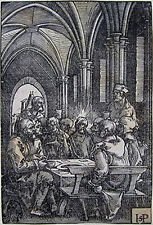
L'ultima cena.
Payment methods
- PayPal
- Credit card
- Bank transfer
- Pubblica amministrazione
- Carta del Docente
Details
- Year of publication
- 1522
- Author
- HANS SEBALD, BEHAM (German, 1500-1550).
- Publishers
- 1522
- Keyword
- Stampe
- State of preservation
- Good
- Binding
- Hardcover
- Condition
- Used
Description
>Xilografia (mm 133x90 compresi i piccoli margini bianchi), firmata in basso a destra con il monogramma H(ans)S(ebald)B(eham) a lettere capitali . Il soggetto rappresenta l'ultima cena in un ambiente a volte. Hans ed il fratello Barthel furono operosissimi incisori. Entrambi appartengono a quel gruppo detto dei Kleinmeister, tedeschi, e in ispecie di Norimberga, le cui opere di piccolo formato, d'ornamento o di figura, ebbero notevole influenza sulle arti minori. Ambedue seguaci del Dürer. Grazie a loro le forme dell'arte italiana penetrarono nel Rinascimento tedesco. I motivi ornamentali delle loro incisioni si compongono di grottesche e di volute, di mezze figure, di figure d'uomini e bambini, cui specialmente Barthel riesce a dare mosse e atteggiamenti vivaci. Esemplare ben inchiostrato con piccolo restauro all'angolo (bianco) inferiore destro.
This superb original woodcut is entitled ''The Last Supper'', from Passion. Sebald Beham (1500-1550) was a German painter and printmaker, especially noted for his engravings. Born in Nuremberg, he spent the later part of his career in Frankfurt. He was one of the most important of the ''Little Masters'', the group of German artists making prints in the generation after Dürer. His early work was done under the shadow of Dürer, who was still working in Nuremberg, and one early woodcut ''Head of Christ'', to which the ''AD'' monogram was added in the second state (though probably not by Beham), was long misattributed to Dürer by Adam Bartsch and others. He also borrowed from his brother Barthel's rather more original works. In his later work he boldly re-interpreted many of Dürer's most famous prints in works such as his Melancholia of 1539, exploiting the difference in scale between his work and the original. His name is often given as Hans Sebald Beham, although there is no documentary evidence that he ever used this additional forename Hollstein, German, III, 180. Thieme-Becker, Künstler-Lexikon, III, Lipsia 1909
