La Vie de Pere Paul. Traduitte de l'Italien par F[rancois de] G[reverol] C[onseiller] A[u] P[arlement] D[e] B[ordeaux]. IN CONTEMPORARY BINDING
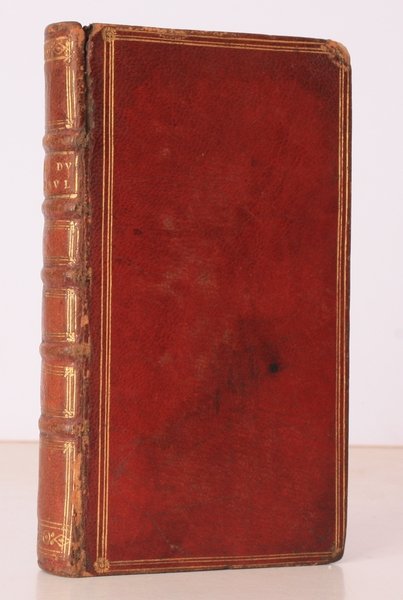
La Vie de Pere Paul. Traduitte de l'Italien par F[rancois de] G[reverol] C[onseiller] A[u] P[arlement] D[e] B[ordeaux]. IN CONTEMPORARY BINDING
Payment methods
- PayPal
- Credit card
- Bank transfer
- Pubblica amministrazione
- Carta del Docente
Details
- Year of publication
- 1663
- Author
- Micanzio] [Fulgenzio
- Publishers
- Jean de Ravenstein, Amsterdam
- Keyword
- theology, sarpi, micanzio, council of trent, elzevier, fine bindings, bindings, fulgenzio micanzio, theology, la, vie, de, pere, paul
- Languages
- English
Description
16mo., on laid paper, title and preliminaries very lightly age-soiled; most attractively bound in seventeenth century red full morocco, sides with triple frame border stopped at corners by rosettes all in gilt, back with five raised bands, second compartment framed and lettered in gilt, all other compartments framed in gilt, all edges gilt, marbled endpapers, one corner lightly bruised, joints very lightly rubbed, short split in upper joint (but binding entirely sound), a very good, clean copy of a scarce work in wholly unrestored period binding. Scarce life of Paolo Sarpi by his disciple Fulgenzio Micanzio (1570-1654). Sarpi (1552-1623), Venetian scholar, church reformer and patriot, was the author of several works, of which the most important is his 'Istoria del Concilio Tridentio', first published in Italian (London, 1619) with an English translation by Brent in the following year and a French edition by Elzevier in 1661. It was his approach to treat ecclesiastical history in the manner of politics; 'a kind of Anglican picture of the debates and decisions' (Hay). His contempt for the Curia made him popular with Protestants; Milton refers to him as 'the great unmasker'. Prudently, Sarpi never acknowledged his authorship of the work, despite the efforts of Louis II to extract his admission. Willems, p.217, n.876.
