Mémoires, pour servir à l'histoire d'un genre de polypes d'eau douce, à bras en forme de cornes
Mémoires, pour servir à l'histoire d'un genre de polypes d'eau douce, à bras en forme de cornes | Rare and modern books | TREMBLEY, Abraham (1710-1784)



Mémoires, pour servir à l'histoire d'un genre de polypes d'eau douce, à bras en forme de cornes
Mémoires, pour servir à l'histoire d'un genre de polypes d'eau douce, à bras en forme de cornes | Rare and modern books | TREMBLEY, Abraham (1710-1784)
Payment methods
- PayPal
- Credit card
- Bank transfer
- Pubblica amministrazione
- Carta del Docente
Details
- Year of publication
- 1744
- Place of printing
- Leiden
- Author
- TREMBLEY, Abraham (1710-1784)
- Publishers
- Johannes & Hermanus Verbeek
- Keyword
- settecento
- State of preservation
- Good
- Languages
- Italian
- Binding
- Hardcover
- Condition
- Used
Description
“ONE OF THE FOUNDERS OF EXPERIMENTAL BIOLOGY” (OSLER, 4119)
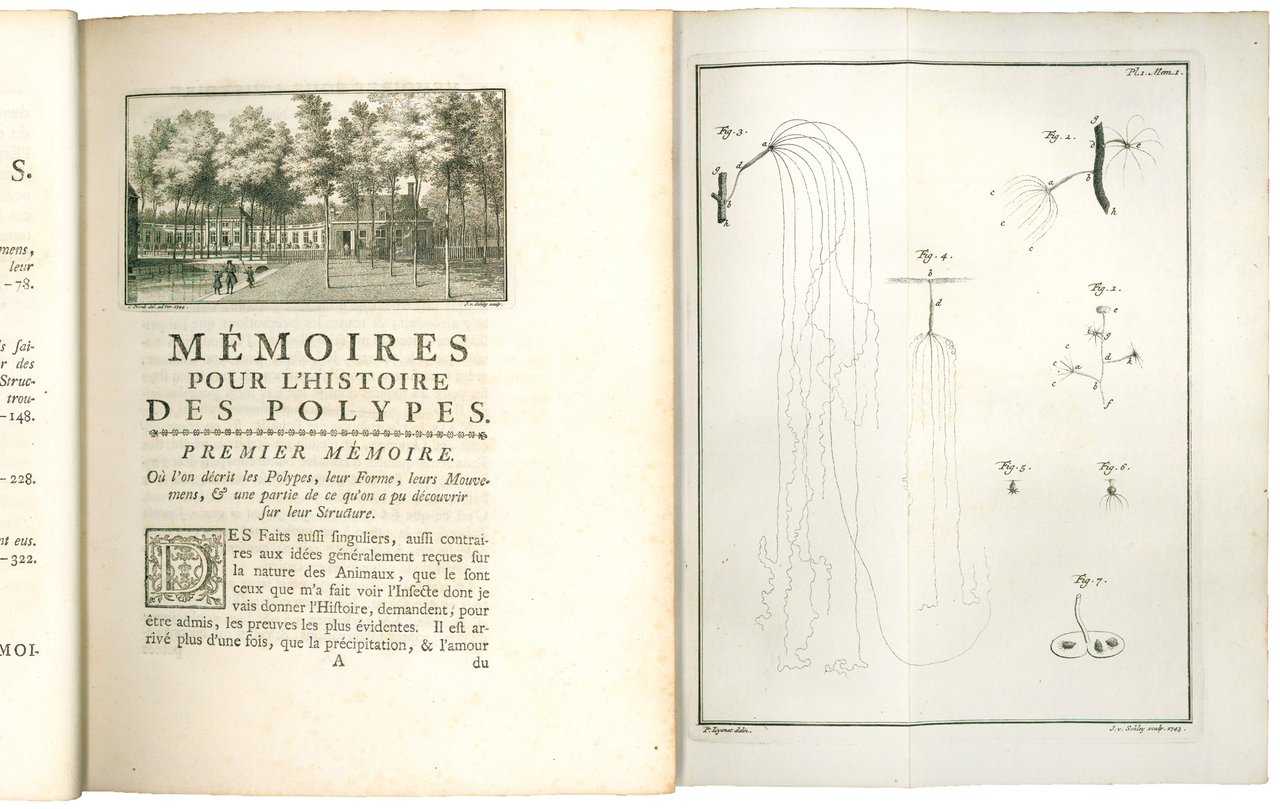
4to (250x200 mm). XV, [1], 324, [2] pp. and 13 folding plates engraved by Jacob van der Schley after Pierre Lyonet. Collation: *-**4, A-I4 K4(-4) L-Ss4. Four nicely illustrated headpieces engraved by Van der Schley after C. Pronk. Four engraved decorative tailpieces. Contemporary calf, richly gilt spine with lettering piece, red edges (worn and rubbed). On the front pastedown bookplate of William Constable. Occasionally slightly browned, title page a bit stained in the margin, overall a good copy.
First edition (a two-volume octavo edition appeared in Paris in the same year) of this work on the hydra, in which Trembley for the first time observes in it asexual reproduction, regeneration, and photosensitivity in an animal without eyes. “Trembley was one of the pioneers of experimental morphology. The above work records how he cut hydras into several pieces, producing new individuals, and how, by cutting up the latter, he obtained a third generation. His experiments were of great importance in the study of the regeneration of lost parts, he was the first to make permanent grafts and to witness cell division” (Garrison-Morton).
Nissen, 4163; Garrison-Morton, 307; Blake 458; Norman, 2094; Waller, 1107.