Prodromus ad institutiones philosophicas sive elementa matheseos institutionibus philosophicis, certe physicis praemittenda opus ad usum Mexicanae juventutis regali, ac pontificiae Mexicanorum Academiae dicatum ab Andre a de Guevara et Basoazabal ejusdem olim Academiae alumno
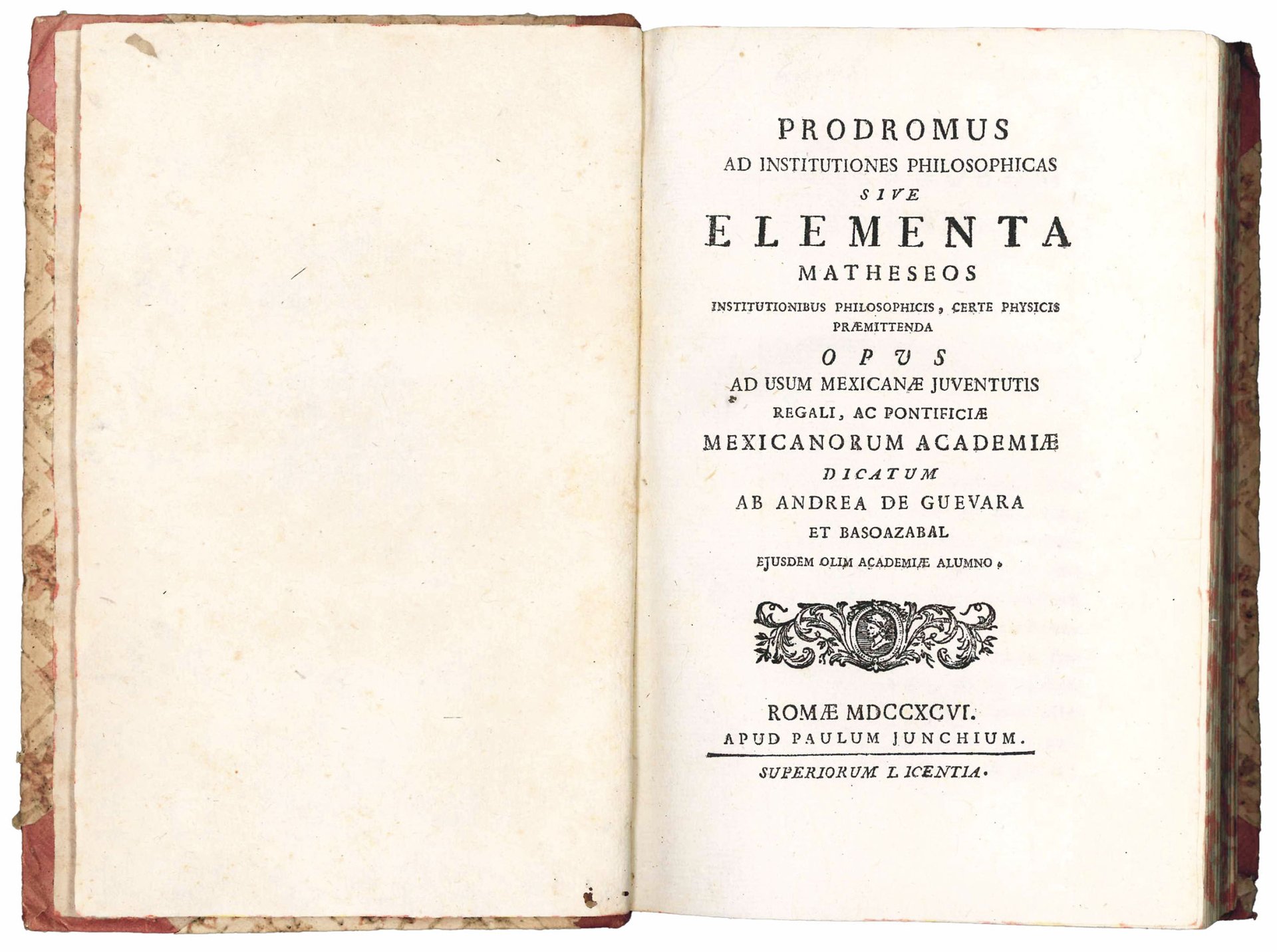
Prodromus ad institutiones philosophicas sive elementa matheseos institutionibus philosophicis, certe physicis praemittenda opus ad usum Mexicanae juventutis regali, ac pontificiae Mexicanorum Academiae dicatum ab Andre a de Guevara et Basoazabal ejusdem olim Academiae alumno
Payment methods
- PayPal
- Credit card
- Bank transfer
- Pubblica amministrazione
- Carta del Docente
Details
- Year of publication
- 1796
- Place of printing
- Roma
- Author
- GUEVARA Y BASOAZABAL, Andrés de (S.J., 1748-1801)
- Publishers
- Paolo Giuchi
- Keyword
- settecento
- State of preservation
- Good
- Languages
- Italian
- Binding
- Hardcover
- Condition
- Used
Description
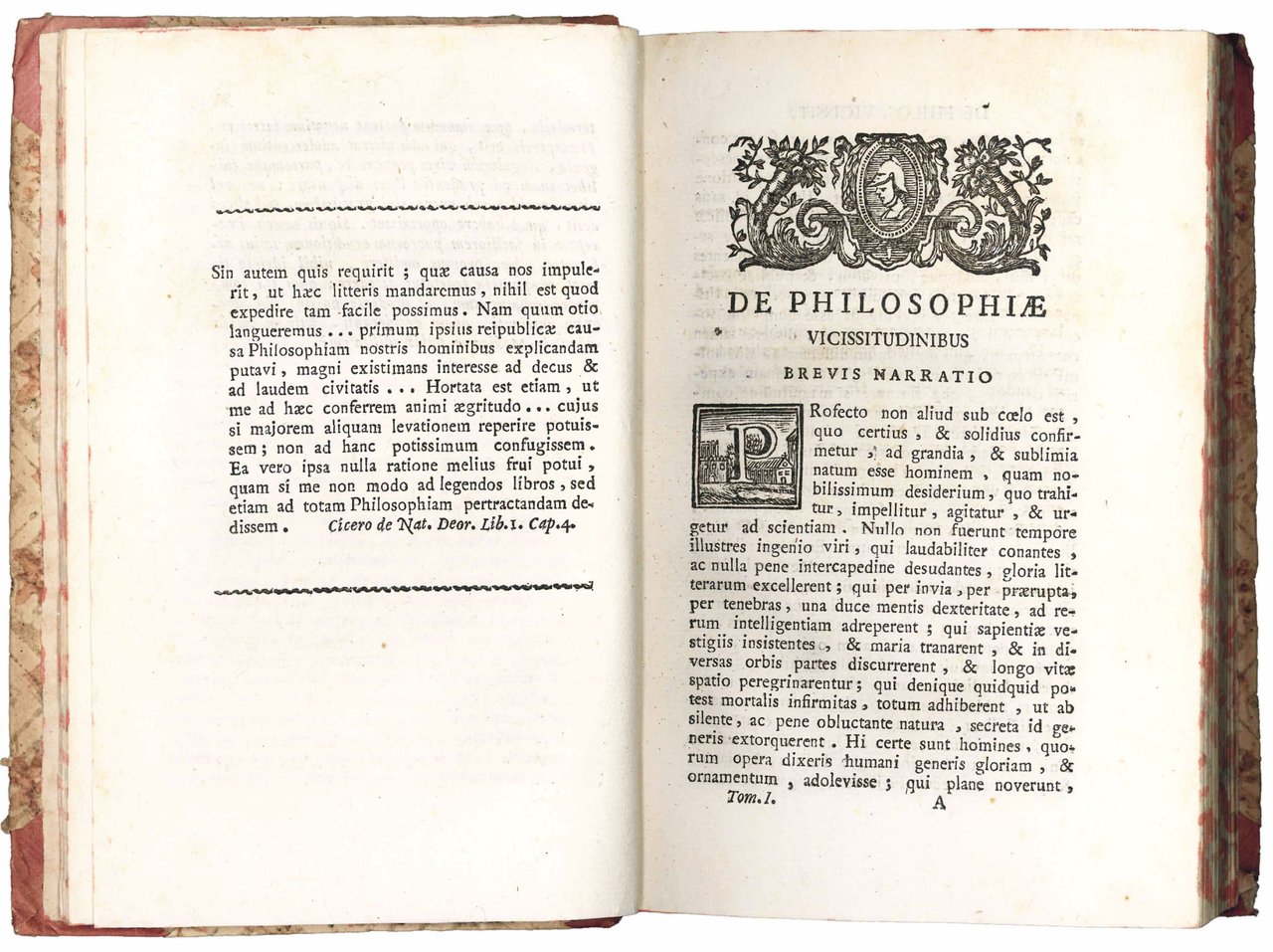
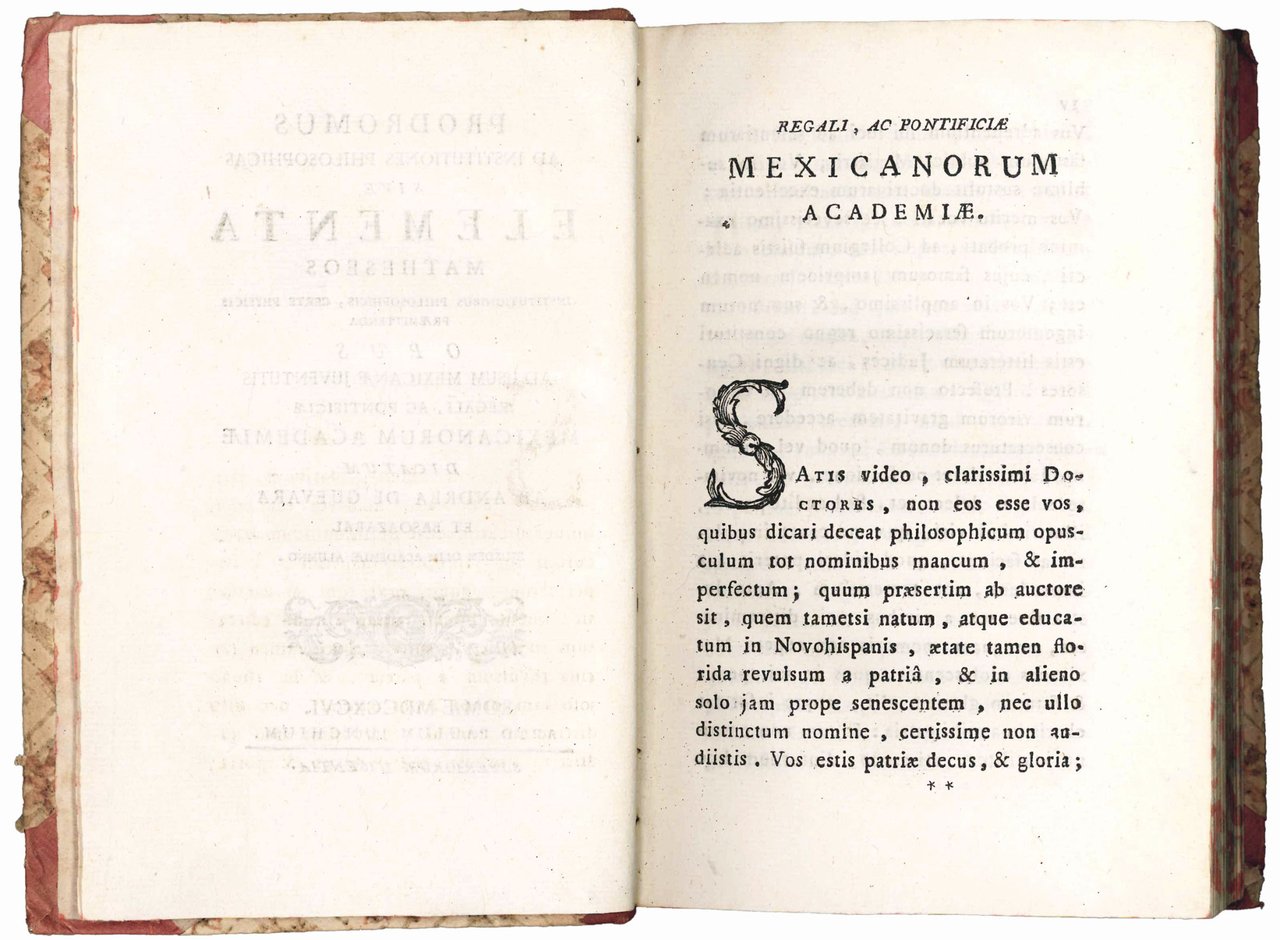
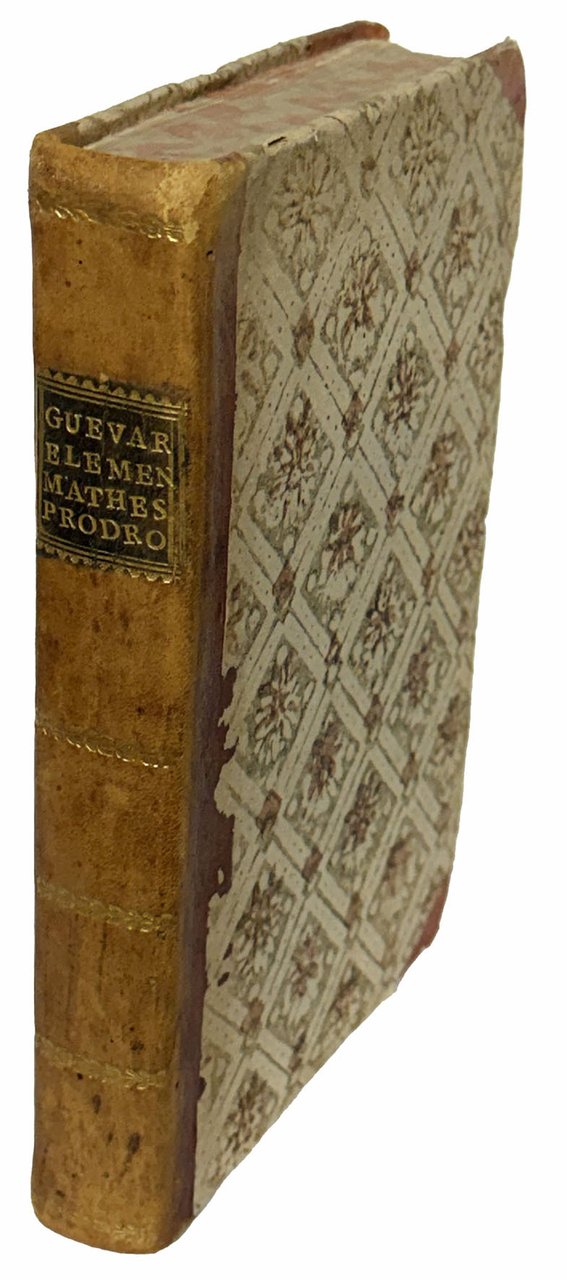
8vo (190x123 mm). XV, [1], 294, [2 blank] pp. and II engraved folding plates. Woodcut ornament on the title page. Contemporary half vellum, gilt spine with morocco lettering piece, panels covered by colored paper, marbled edges (slightly worn and rubbed). On the front pastedown bookplate of the Florentine mathematician and physicist Enrico Giusti (1940-2024). Some quires slightly browned, otherwise a good, genuine copy.
Rare first edition of this publication of which two other issues are known, one bearing a different title and having three plates signed by Antonio Gregori. In the approbation and in the signature of the quires the book is designated as “tomus primus”, as it was meant to be the introductory volume to Guevara y Basoazabal's major work, the Institutionum elementarium philosophiae ad usum studiosae juventutis, which he published in three volumes in Rome between 1796 and 1798. The Prodromus, which opens with a dedication to the professors of the University of Mexico, here defined as “Regalis ac Pontificia Mexicanorum Academia”, contains a short history of philosophy (De Philosophiae vicissitudinibus brevis narratio), followed by a treatise on mathematics, geometry, and trigonometry.
Born in Guanajuato (Mexico) in 1748, Guevara y Basoazabal studied at the Jesuit college in Guanajuato, and at those of San Pedro y San Pablo and San Ildefonso in Mexico. He joined the Society of Jesus in Tepotzotlán in 1764 and was exiled to Italy in 1767. He continued his training in Italy and was ordained a priest in 1771. When the Society was suppressed in 1773, he moved to Rome, probably after 1788. From Rome, in 1789, he sent his Pasatiempos o entretenimientos familiares de cosmología (‘Pastimes or Familiar Entertainment in Cosmology') to Francisco de Azpilcueta, councilman of Guanajuato. He then published in Rome between 1796 and 1798 his major work, the Institutionum elementarium philosophiae ad usum studiosae juventutis, of which he sent a manuscript copy to Mexico with a dedication to the College of San Ildefonso. The Institutionum elementarium philosophiae, whose volumes are dedicated to logics, methaphysics, physics and natural sciences, were reprinted in Venice in 1800 and 1819, and at least nine times in Spain: two in Valencia (1824, 1825), six in Madrid (1824-1827, 1829, 1833) and one in Barcelona (1845); also, no fewer than five epitomes, summaries, or partial translations are known. Guevara y Basoazabal died in Piacenza (Italy) in 1801 (cf. J.-I. Saranyana & C.-J. Alejos Grau, eds., Teología en América Latina, Madrid, 2005, vol. II/1, pp. 581-582; M. Beuchot, Lógica y Metafísica en la Nueva España, México D.F., 2006, p. 141 ff.).
Italian Union Catalogue, IT\ICCU\BVEE\091697.
