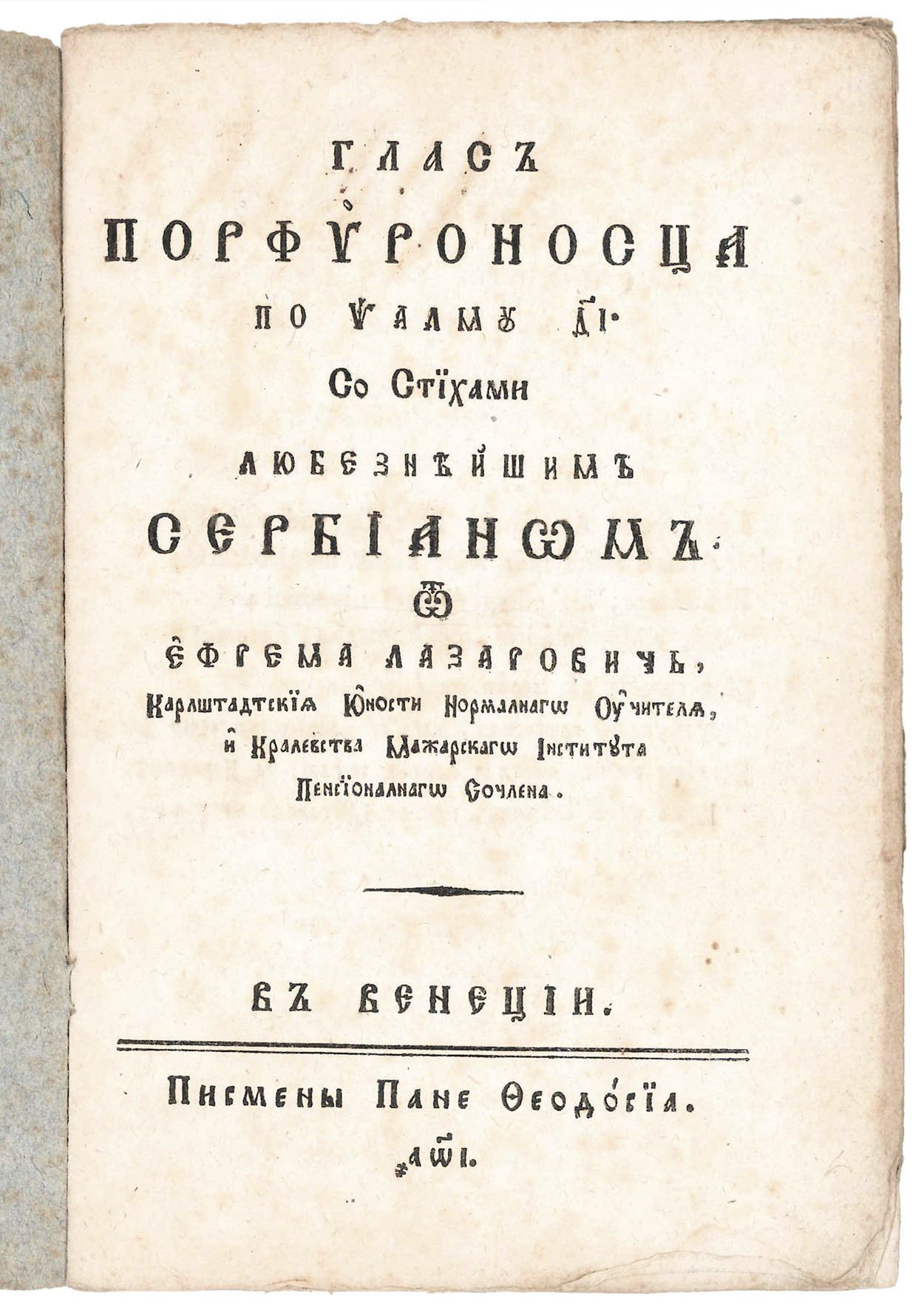
Гласъ Порфуроносца (‘The Voice of the Porphyry Bearer')
Гласъ Порфуроносца (‘The Voice of the Porphyry Bearer')
Payment methods
- PayPal
- Credit card
- Bank transfer
- Pubblica amministrazione
- Carta del Docente
Details
- Year of publication
- 1810
- Place of printing
- Venezia
- Author
- LAZAROVIĆ, Ephrem (fl. 18th-19th cent.)
- Publishers
- Pano Teodosio
- Keyword
- Ottocento e Novecento
- State of preservation
- Good
- Languages
- Italian
- Binding
- Hardcover
- Condition
- Used
Description
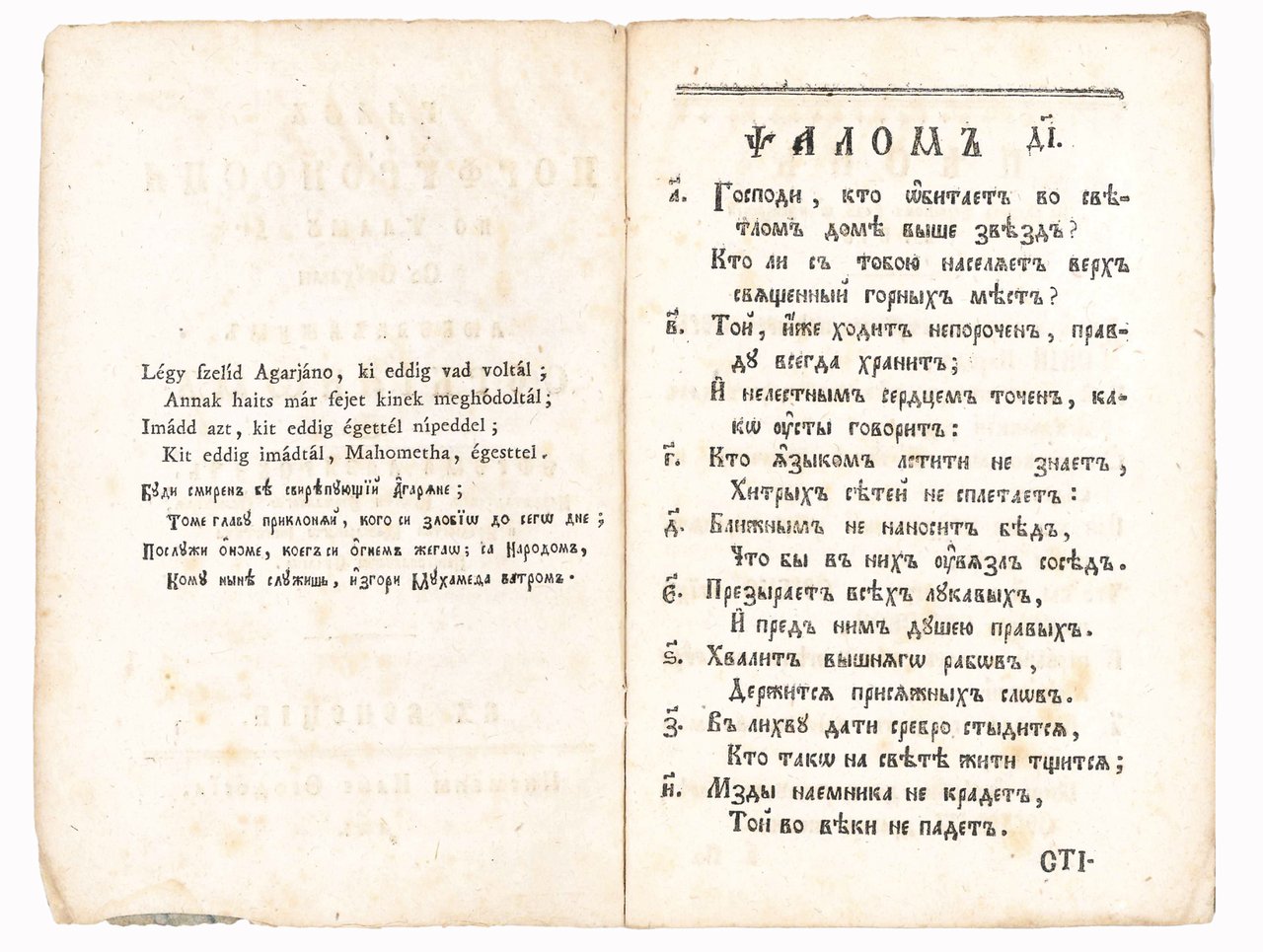
SERBIAN RELIGIOUS POEM PRINTED IN VENICE
8vo (188x122 mm). 13, [3 blank] pp. Contemporary blue wrappers. Some light foxing, but a very good copy.
Extremely rare first edition of this Serbian religious poem printed in Venice in 1810.
The author, Ephrem Lazarović, was a Serbian school teacher in the early 19th century. He taught in Divoš, Syrmia County, from 1807 onwards. Subsequently, he took up a teaching position in Karlstadt, where he remained until his death. He eventually passed away in Divoš (cf. P.J. Safarik, Geschichte des Serbischen Schriftthums, J. Jirecek ed., Prague, 1865, p. 335, no. 162).
In the mid-18th century, the need for a Cyrillic printing press had become particularly urgent among the Serbs of Hungary. The latest attempt by Metropolitan Pavle Nenadović to open a printing press in Sremski Karlovci had failed due to the lack of socio-economic conditions favorable to the launch of such an enterprise. On the other side of the Adriatic, in the more tolerant Venice, times were rapidly changing: it was then that, with the support of the government of the Republic, the printer of Greek origin Demetrio Teodosio (Demetrios Theodosios) succeeded where the Metropolitan of Sremski Karlovci had failed. The history of Serbian books in the lagoon city, which began in the 16th century with the printing press of Božidar Vuković, thus experienced a new renaissance in the 18th century, when it reached its peak thanks to Teodosio: starting in 1758 and for over half a century, the Teodosio printing house published books in the Glagolitic and Cyrillic (also called “Illyrian”) alphabets, making Venice the hub of book production for Catholic Croats and Orthodox Serbs in the Balkans, despite new printing centers also opening in Vienna and Buda.
Unlike the Viennese court, which sought to prevent the cultural awakening of the Serbian people through imperial censorship, Venice, thanks to a less oppressive censorship system and, above all, to publishers and printers who were very attentive to new cultural interests, had always allowed a freer circulation of ideas. The ‘plan' drawn up by the Venetian authorities together with Teodosio was to open a printing press in Venice (and not in Padua, as hoped for by the pope, who aimed to proselytize Catholicism among the Serbs) and place it, at least formally, under the direction of a private individual (and not the government); a workshop capable of producing books in the Cyrillic alphabet for the Serbs of the Habsburg Empire. The books issued by Theodosius were submitted to Venetian authorities, and not to those of the Holy Office, reaffirming Venice's traditional independence in matters of printing. It was probably to avoid ecclesiastical censorship that Teodosio published about twenty titles with Moscow and St. Petersburg as fictitious place of printing. The Cyrillic characters, which had become impossible to find in 18th-century Venice, were imported from Russia at great expense, as the printer points out on several occasions in his letters to the authorities, while the Glagolitic characters were imported from Rome.
From the outset, the Teodosio printing house published a considerable number of sacred and liturgical texts intended for various parts of the Slavic world, such as Dalmatia, Bosnia, Serbia, Bulgaria, Transylvania, Moldavia, and even Muscovy. In addition to these, there were also texts of a more secular nature, published in the various Slavic languages of the Balkans. 1764 was not only a particularly productive year for Teodosio, but also marked the arrival in Venice of Zaharija Orfelin, undoubtedly the greatest Serbian intellectual of the time, who became Teodosios' collaborator and published many of his works with him. In 1768, Orfelin was also responsible for the publication by the Teodosio printing house of the first Serbian periodical, entitled Slaveno-serbski Magazin. Teodosio died in 1782 and the business was continued by his nephew Pano (Panos), who continued to print boo
