Allegoria del Bene e del Male (Le Virtù allo specchio)
Allegoria del Bene e del Male (Le Virtù allo specchio) | Prints | SAENREDAM Jaen P.
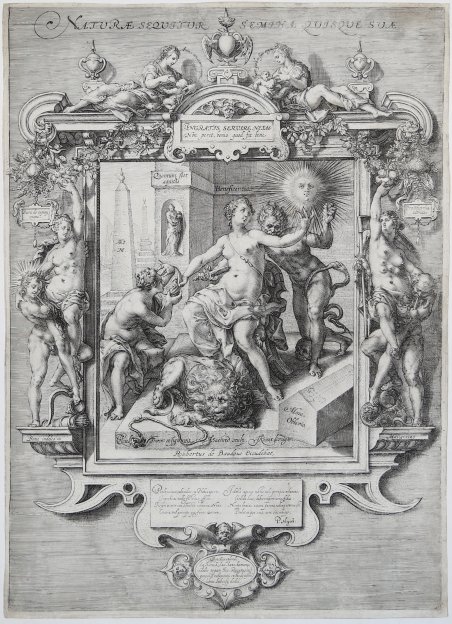
Allegoria del Bene e del Male (Le Virtù allo specchio)
Allegoria del Bene e del Male (Le Virtù allo specchio) | Prints | SAENREDAM Jaen P.
Payment methods
- PayPal
- Credit card
- Bank transfer
- Pubblica amministrazione
- Carta del Docente
Details
- Year of publication
- 1600
- Size
- 528 X 375
- Engravers
- SAENREDAM Jaen P.
Description
Bulino, 1600 circa, firmato in lastra in basso al centro. Da un disegno di Cornelis Ketel. Esemplare del terzo stato di quattro, prima che l'indirizzo di Laurentius. Bellissima prova, stampata su carta vergata coeva, rifilata al rame o con piccoli margini, due lievi pieghe di carta orizzontali, per il resto in ottimo stato di conservazione.Questo superba e monumentale opera, ricca di dettagli allegorici, già suscitò molto interesse negli artisti contemporanei di Saenredam, confermando la sua posizione come una delle più importanti personalità artistiche nella cerchia di Goltius. Nella sua biografia di Cornelis Ketel, per esempio, Carel van Mander ha dedicato una descrizione completa di questa stampa, riferendosi ad essa come "Deughtspiegel", lo specchio della Virtù.Il titolo latino impresso nella stampa - Naturae seguitur semina quisque suae -può essere tradotto come: "Ognuno segue il seme della propria natura". Un'interpretazione dettagliata di questa immagine, accademicamente e iconograficamente complessa, sarebbe troppo ambiziosa nel contesto di una breve voce di catalogo, ma è comunque possibile affrontare il tema di fondo dell'immagine.Una personificazione della Beneficentia è posta al centro della composizione, affiancato dalla Gratitudine e dalla Ingratitudine. Le iscrizioni che accompagnano forniscono ulteriori indizi per il programma iconografico qui rappresentato: due serpenti, che si mordono con rabbia uno con l'altro, sono avvolti attorno alla gamba destra della personificazione maschile dell’Ingratitudine, mentre il ginocchio sinistro poggia su un teschio. In primo piano a destra si trova una bara con la scritta - Mors.Oblivio -. L'immagine suggerisce che dimenticare è un atto di gentilezza non meno terribile della morte. La figura femminile in ginocchio sulla sinistra rappresenta uno scenario opposto. Lei è pienamente consapevole della gentilezza che le è mostrata, come conferma l'obelisco dietro di lei dove si legge - Aet (Ernis) M (emoria) -. Il leone dall’aspetto docile posto ai piedi della figura simboleggiante la Beneficentia, che ha fatto amicizia con un piccolo cane, sono ulteriori caratteristiche di gratitudine. La scena principale si trova racchiusa in una cornice allegorica riccamente decorata. Sulla destra della cornice si trovano Diana e Efeso, visto dare alla luce un bambino, identificato come Malignitas secondo l'iscrizione. A sinistra, Apollo assiste una giovane donna che mette al mondo un neonato innocente, che viene identificato con l’iscrizione Bona indolis.Bell’esemplare di questo capolavoro di Saenredam. Engraving, circa 1600, signed at lower center. After Cornelis Ketel. Example of the third state of four, before the address of Laurentius. A fine impression, printed on contemporary laid paper, trimmed to the platemark or with small margins, 2 small horizontal paper folds, otherwise in good condition.This superb monumental print, rich in allegoric detail, already impressed Saenredam’s contemporaries, confirming his position as one of the most outstanding artistic personalities in Goltius’s circle. In his biography of Cornelis Ketel, for instance, Carel van Mander dedicated a full description to this print, referring to it as the “Deughtspiegel” (Mirror of Virtue).The Latin title lettered in the print Naturae seguitur semina quisque suae can be translated as: “Everyone follows the seed of his own nature”. A detailed interpretation of this academic and iconographically complex image would be too ambitious in the context of a brief catalogue entry, but it is nonetheless possible to address the underlying theme of the image.A personification of Beneficentia /Charity) can be seen at the center of the composition, flanked by Gratitude and Ingratitude. The accompanying inscriptions provide further clues to the iconographic program represented here, Two snakes, angrily biting each other, are wound around the right leg of the male personification of Ingratitude, while the left knee rests on a skull. In the right foreground lies a coffin with the inscription - Mors.Oblivio - . The imagery suggests that forgetting an act of kindness is no less terrible than death. The female figure see piously kneeling on the left points to an opposite scenario. She is fully aware of the kindness shown to her as confirmed by the obelisk behind her that is inscribed - Aet(ernis) M(emoria) - . The good natured lion at the feet of the Beneficentia, who has made friends with a small dog, as well as a mouse, that is shown balancing on a rope, to which the king of the animals is bound, are further attributes of gratitude. The main scene is set in a richly decorated allegorical frame. On the right is the many breasted Diana and Ephesos, seen giving birth to a child, identified as – Malignitas – (Evil Nature) according to the inscription. On the left, Apollo assists a young woman as she gives birth to – Bona indoles – (Good Nature) and breathes life into the innocent newborn. Lettered with the title above. Surmounting the mirror a cartouche with "INGRATIS SERVIRE NEFAS / Non perit, bonis quod fit bene". Below in a cartouche two columns of text by P.Hogerbeets. Below the central image "CKetel Inven. et figurivit I Saenred. sculp. JRazet divulgavit.".A related drawing by Ketel in the Rijksmuseum, Amsterdam (see K.G. Boon, 'Netherlandish drawings of the fifteenth and sixteenth centuries', The Hague 1978, no. 328). See also H. van Os, J. P. Filedt Kok, G.Luijten and F.Scholten, 'Netherlandish Art in the Rijksmuseum 1400-1600', Amsterdam 2000, pp. 205-206. The print is known in editions with letterpress explanation in German and in Dutch/French. Cfr. Bartsch 106, Hollstein 114 III (of IV). Dimensioni 528 x 375.