Bella è costei, ma con quel volto, orrore.
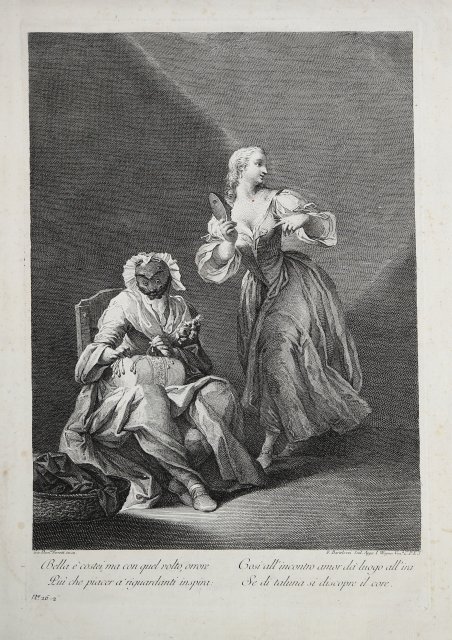
Bella è costei, ma con quel volto, orrore.
Payment methods
- PayPal
- Credit card
- Bank transfer
- Pubblica amministrazione
- Carta del Docente
Details
- Year of publication
- 1760
- Size
- 280 X 420
- Engravers
- BARTOLOZZI Francesco
Description
Arlecchino travestito da donna, seduto su una sedia a sinistra, che lavora a un merletto; a destra, una giovane donna in piedi, con la testa di profilo a destra, che tiene una maschera nella mano destra. Stampa da un dipinto di Giovanni Domenico Ferretti raffigurante Colombina che svela l'identità di Arlecchino. La stampa è la seconda di una serie di quattro intitolata "Le quattro arlecchinate" e fu pubblicata a Venezia da Joseph Wagner. Acquaforte e bulino, con i nomi degli artisti sotto l'immagine: "Gio. Domco. Ferretti inven. / F. Bartolozzi Scul. Appo I. Wagner Vena. C. P. E. S.", quattro righe di versi italiani che iniziano: "Invano si nasconde [.]" che termina: "[.] al viso ogni Buffone"; numerata in basso a sinistra: "N. 26-4". Magnifica impressione, stampata su carta vergata coeva, con margini, ottimo stato di conservazione. Francesco Bartolozzi, figlio di un orafo fiorentino, conosce l'incisore tedesco Joseph Wagner presso la cui bottega, la più importante di Venezia, dove si trasferisce nell'agosto del 1748. Nella città lagunare Bartolozzi rimane per sedici anni, partecipando alla vita artistica ed entrando in contatto i maggiori editori e stampatori, oltreché con uomini di cultura. Alterna opere proprie a traduzioni da altri artisti in collaborazione con Wagner, come la serie dedicata al Guercino alla quale si dedica quasi esclusivamente fra il 1761 ed il 1765. Sono questi gli anni in cui Bartolozzi diviene titolare di una propria bottega. Si trasferisce quindi in Inghilterra, dove si ferma per circa quarant'anni, e dove si dedica prevalentemente all'attività di traduzione, alternando con eguale successo l'interpretazione delle opere dei pittori celebri del passato e quella dei contemporanei. Oltre ai disegni del Guercino della collezione reale l'artista riproduce disegni dai Carracci, Pietro da Cortona, Guido Reni, Carlo Maratta e dell’amico Giovan Battista Cipriani. Bibliografia Calabi & De Vesme 1928 / Francesco Bartolozzi. Catalogue des estampes et notice biographique d'après les manuscrits de A. De Vesme entièrement réformés et complétés d'une étude critique par A. Calabi (1339.III). ' Harlequin dressing up as a woman, seated on a chair to left, working on lace; to right, a young woman standing, head in profile to right, holding a mask in her right hand. Print from a painting by Giovanni Domenico Ferretti depicting Columbine unveiling Harlequin's identity. The print is the second in a series of four entitled 'Le quattro arlecchinate', or Harlequinades and was published in Venice by Joseph Wagner. Etching with engraving, lettered below image with artists' names: "Gio. Domco. Ferretti inven. / F. Bartolozzi Scul. Appo I. Wagner Vena. C. P. E. S.", four-line of Italian verse beginning: "Invano si nasconde [.]" ending: "[.] al viso ogni Buffone", numbered at bottom left: "No. 26-2". A fine impression, printed on contemporary laid paper, with margins, very good condition. Francesco Bartolozzi, the son of a Florentine goldsmith, met German engraver Joseph Wagner at whose workshop, the most important in Venice, where he moved in August 1748. In the lagoon city Bartolozzi remained for sixteen years, participating in artistic life and coming into contact with major publishers and printers, as well as men of culture. He alternated between his own works and translations by other artists in collaboration with Wagner, such as the series devoted to Guercino to which he devoted himself almost exclusively between 1761 and 1765. These are the years when Bartolozzi becomes the owner of his own workshop. He then moved to England, where he stayed for about forty years, and where he devoted himself mainly to the activity of translation, alternating with equal success between interpreting the works of famous painters of the past and those of his contemporaries. In addition to drawings by Guercino in the royal collection, the artist reproduced drawings by the Carracci, Pietro da Cortona, Guido Reni, Carlo Maratta, and his friend Giovan Battista Cipriani. Bibliografia Calabi & De Vesme 1928 / Francesco Bartolozzi. Catalogue des estampes et notice biographique d'après les manuscrits de A. De Vesme entièrement réformés et complétés d'une étude critique par A. Calabi (1339.III). Cfr.
