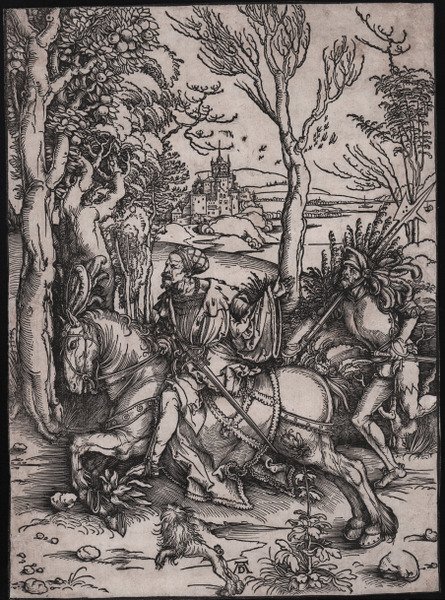
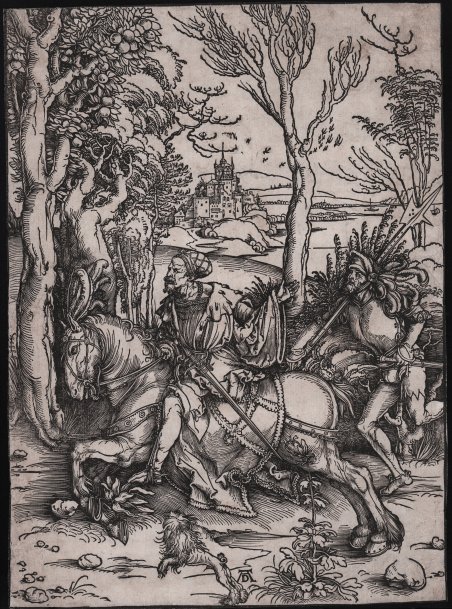
Xilografia, circa 1496, firmata in tavola in basso al centro con il monogramma AD. Bellissima prova, della quarte variante descritta da Meder, impressa su carta vergata coeva con filigrana “cerchio con croce su tre monti” (Meder 157, Briquet 1242), rifilata alla linea marginale, interventi di restauro visibili al verso agli angoli inferiore e superiore sinistr e lungo il margine sinistro, nel complesso in buono stato di conservazione. Realizzata intorno al 1496, la xilografia Il cavaliere e il lanzichenecco di Albrecht Dürer è uno squisito esempio di una delle prime opere del maestro a rilievo. Albrecht Dürer è stato il principale artista del Rinascimento tedesco. Già nel 1490, quando aveva vent'anni, elevò da solo l'arte della xilografia a un'arte raffinata. ' Egli diede il suo influente contributo allo sviluppo della stampa introducendo nuovi standard di complessità nelle tecniche di stampa, nella composizione e nei soggetti (Hults 1996, p. 12). La xilografia Il cavaliere e il lanzichenecco è un esempio della brillantezza estetica del lavoro di Dürer, ed appartiene alla prima fase della sua carriera. Una brillantezza fatta di linee sottili e dettagli, che ha avuto profonde conseguenze sulla storia dell'arte (Panofsky 1945, p. 47-48). La rete incredibilmente intricata di linee presenta la forma, la luce e lo spazio con un senso di movimento leggero, pari ai più alti risultati dell'arte del disegnatore. L'immagine sembra intenzionalmente aperta; non è mai stata collegata in modo convincente ad alcun testo o leggenda. Piuttosto, evoca ipotetiche figure che si potrebbero incontrare su una strada al di là delle mura protettive di una città. Il cavallo balza in avanti con entrambe le zampe anteriori ben sollevate da terra; stringe il morso e ha un'espressione di fuoco. Il cavaliere, altrettanto intenzionato, incita il compagno con un gesto del braccio. Attraversano una strada tortuosa in una valle fluviale costellata di città fortificate, monasteri o castelli. Natura e civiltà sono in equilibrio. È autunno: l'albero più a sinistra è carico di frutti e alcuni altri hanno già perso le foglie. Bibliografia Meder 1932, Dürer Katalog (265 d/d); Bartsch, Le Peintre graveur (VII.145.131); Dodgson 1903, 1911, Catalogue of Early German and Flemish Woodcuts in the BM, (I.271.6); Schoch 2001-04; Albrecht Dürer, das druckgraphische Werk (II.106.1); Strauss, The woodcut and woodblocks of Albrecht Durer, n. 34. In the foreground, a bearded nobleman riding from right to left, followed by a man-of-arms on foot, in the background a Gothic castle. Woodcut, circa 1496, signed on the block at lower center. Created c. 1496, Albrecht Dürer’s woodcut The Knight and the lansquenet is an exquisite example of one of the master printmaker’s early works in the relief printing medium. Albrecht Dürer was the leading artist of the German renaissance. Already in the 1490s, while he was in his twenties, he single-handedly elevated the craft of woodcut to a fine art. This vigorous, charming woodcut image of a knight on horseback and a foot soldier belongs to this phase of his career. The unbelievably intricate network of lines presents form, light, and space with a lithe sense of movement equal to the highest achievements of the draftsman’s art. He made his influential contribution to the development of printmaking by introducing new standards of complexity in printmaking techniques, composition and subject matter (Hults 1996, p. 12). The Knight and the lansquenet woodcut is an example of the aesthetic brilliance of Dürer’s work. A brilliance comprised by fine lines and detailing, that had profound consequences on the history of art (Panofsky 1945, p. 47 – 48). The image seems intentionally open-ended; it has never been convincingly linked to any text or legend. Rather it conjures up colorful figures that one might have encountered on a road beyond the protective walls of a city. The horse leaps forward with both forelegs well off the ground. It clenches the bit and has a fiery expression. The equally intent rider urges on his companion with a wave of his arm. They traverse a winding road in a river valley dotted with fortified towns, monasteries, or castles. Nature and civilization are in balance. It is autumn: the leftmost is heavy with fruit, and some of the others have already lost their leaves. The hurried travelers pass us by, but we will remain to enjoy the lovely view. A fine Meder d impression, printed on laid paper with “Cross on Trimount (Meder 157, Briquet 1242) watermark, trimmed to the borderline, restoration work visible on verso at lower and upper left corners and along left margin, overall in good condition. Bibliografia Meder 1932, Dürer Katalog (265 d/d); Bartsch, Le Peintre graveur (VII.145.131); Dodgson 1903, 1911, Catalogue of Early German and Flemish Woodcuts in the BM, (I.271.6); Schoch 2001-04; Albrecht Dürer, das druckgraphische Werk (II.106.1); Strauss, The woodcut and woodblocks of Albrecht Durer, n. 34. Cfr.
 Find out how to use
 Find out how to use