Civitas Acon Sive Ptolomaida
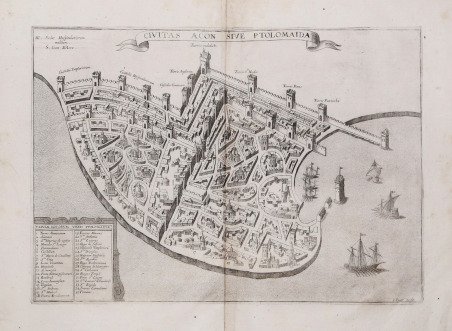
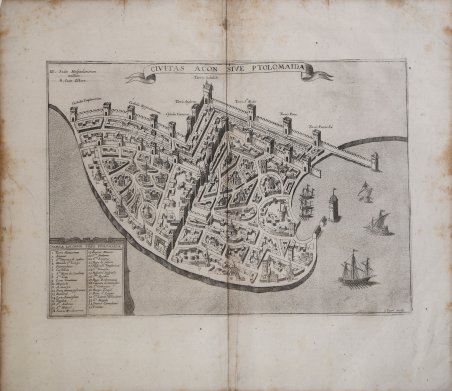
Civitas Acon Sive Ptolomaida
Payment methods
- PayPal
- Credit card
- Bank transfer
- Pubblica amministrazione
- Carta del Docente
Details
- Year of publication
- 1659
- Place of printing
- Parigi
- Size
- 335 X 235
- Engravers
- Boissat Pierre de
Description
Rara pianta di Acri (nota in italiano anche come San Giovanni d'Acri o Tolemaide; in ebraico: ?, 'Akkô; in arabo: ?, ?Akk?) raffigurante la città sotto il controllo dei Cavalieri di San Giovanni. L'opera - incisa da Jean Picart - è pubblicata nel "Histoire des Chevaliers de l’Orde de S. Jean de Hierusalem, contenant leur admirable Institution & Police…" [Paris, Jacques d’Allin, MDCLIX] di Pierre de Boissat, traduzione francese della storia di Malta di Giacomo Bosio (1544-1627).San Giovanni d'Acri è una delle città più antiche città del mondo, che risale alla storia del faraone Thutmose III (1504-1450 a.C.). A suo tempo era uno dei maggiori porti del Medio Oriente, al pari di Alessandria e Costantinopoli. La città entrò a far parte dell'impero di Alessandro Magno dopo la sua conquista del 332 a.C. In seguito fu conquistata dal re egiziano Tolomeo II, che la ribattezzò Tolomeo nel II secolo a.C. Il nome fiorì fino alla conquista della città da parte dei musulmani nel VII secolo d.C. Nel 1104 la città fu conquistata dai Cavalieri di Malta e fu ribattezzata San Giovanni d'Acri. Nel 1291 i Mamelucchi invasero e distrussero la città, uccidendo tutti i crociati rimasti, ponendo fine alla sua antica storia.Acquaforte, ampi margini, piccoli strappetti al margine superiore, per il resto in ottimo stato di conservazione. Rare plan of Acre - engraved by Jean Picart - intended to illustrate a period when the town was under the control of the Knights of St. John. Shows extensive fortifcations, town plan, buildings and a key identifying significant landmarks.The work is published in the "Histoire des Chevaliers de l'Orde de S. Jean de Hierusalem, contenant leur admirable Institution & Police.". [Paris, Jacques d'Allin, MDCLIX] by Pierre de Boissat, French translation of the history of Malta by Giacomo Bosio (1544-1627).The book includes a series of plates showing the cities in which the Knights Hospitaller became most active (Jerusalem, Saint John of Acre, Rhodes, Cyprus and Malta). The plates are variations of illustrations already published in contemporary cartographic works and travel accounts.Acre or Akko is one of the oldest continuously inhabited cities in the World. The City dates its history back to Pharaoh Thutmose III (1504-1450 BC). In its time, it was one of the major ports in the Middle East, on a par with Alexandria and Constantinople. The town became a part of the empire of Alexander the Great after his conquest of 332 BC. It was later seized by Egyptian King Ptolemy II, who renamed the city Ptolemais in the 2nd Century BC. The name flourished until the Muslim's conquered the City in the 7th Century AD. In 1104, the town was conquered by the Knights of Malta and the town was renamed St. Jean d'Acre. In 1291, the Mamluks invaded and destroyed the City, killing all the remaining Crusaders, ending its ancient history.Etching, printed on contemporary laid paper, with margins, small tears in the upper edge, otherwise good condition. Cfr.
