Colloquio di Annibale e Scipione
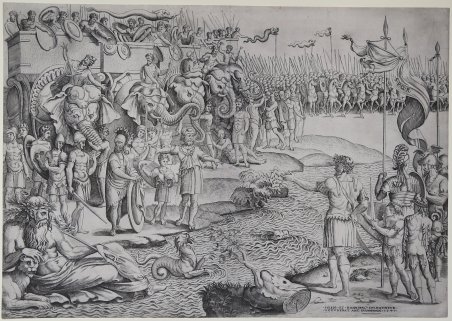
Colloquio di Annibale e Scipione
Payment methods
- PayPal
- Credit card
- Bank transfer
- Pubblica amministrazione
- Carta del Docente
Details
- Year of publication
- 1521
- Size
- 552 X 391
- Engravers
- DENTE detto "Marco da Ravenna" Marco
Description
Bulino, 1521-23 circa, da un soggetto attribuito a Giulio Romano. Esemplare nel primo stato di tre o secondo di quattro, con l’indirizzo di Antonio Salamanca e la data 1541.Magnifica prova, ricca di toni, impressa su carta vergata coeva con filigrana “Balestra nel cerchio con giglio” (Briquet 760, carta databile alla prima metà del XVI secolo), rifilata al rame, in ottimo stato di conservazione. L’incisione raffigura l’incontro tra Annibale e Scipione, prima della battaglia di Zama, durante la seconda Guerra Punica, svoltasi nel 202 a.C, secondo la narrazione fornita da Tito Livio (Storie, XXX 29 e 30. 1-2). Sulle due sponde del fiume, personificato da una divinità incoronata, in basso a sinistra, sono: sulla destra, Scipione, accompagnato da due portabandiera e due ragazzi; sulla sinistra, Annibale, con la sua armata, gli elefanti e la cavalleria. Il soggetto corrisponde alla dodicesima scena degli arazzi del ciclo ' Gesta di Scipione. ' La serie completa di arazzi legata alla figura di Scipione è formata da due gruppi distinti: 13 rappresentazioni delle ' Gesta di Scipione ' hanno per fonte letteraria Tito Livio, e i Trionfi di Scipione – di 9 scene – basati sulla descrizione dello storico Appiano. La serie fu commissionata da Francesco I di Francia, nel luglio del 1532, all’imprenditore Marc Crétif, di Bruxelles. Completata nel 1535, fu distrutta nel 1797 per ordine del direttore della Garde_Meuble, Vilette, perché aveva bisogno dell’oro degli arazzi per pagare i suoi dipendenti. I cartoni dei Trionfi furono realizzati da Giulio Romano, mentre quelli della Gesta erano tradizionalmente attribuiti a Giulio e al Penni. ' Vasari, in riferimento ad un’incisione anonima del Colloquio di Annibale e Scipione scrive che il disegno risale a Giulio. Al Louvre è conservato un disegno che corrisponde, in controparte e nelle linee generali, alla stampa. Un altro bozzetto della scena,conservato a Parigi, reca l’iscrizione “Julio Romano”, ma Bacou l’attribuisce al Penni. Quasi tutti i repertori ascrivono l’invenzione di questa scena a Giulio Romano. La Massari ritiene che il disegno sia stato realizzato intorno al 1521-23, prima della partenza dell’artista per Mantova. La stampa è catalogata dal Bartsch tra le incisioni della scuola di Marcantonio, mentre erroneamente è assegnata dal D’Arco a Giorgio Ghisi. L’attribuzione al Dente, sostenuta in passato da Heinecken, Huber, Zanetti e Passavant, e confermata anche dalla Massari, sulla base delle indubbie affinità stilistiche tra questo foglio e altre opere del ravennate, ci sembra assolutamente plausibile. Il primo stato della stampa, ipotizzato da Massari, non è conosciuto attraverso alcun esemplare. Ex collezione Staatliche graphische Sammlung München(Lugt 1613).Eccezionale esemplare. Engraving, around 1521-23, after a subject attributed to Giulio Romano. Example in the first state of three (or the second of four according Massari), with the address of Antonio Salamanca and the date 1541.Magnificent example, rich in shades, printed on contemporary laid paper with watermark "crossbow in the circle with lily" (760 Briquet, paper dating from the first half of the sixteenth century), trimmed to copper, in excellent condition.The engraving depicts the meeting between Hannibal and Scipio, before the battle of Zama, during the Second Punic War, which took place in 202 BC, according to Tito Livio. (Stories, XXX 29 and 30. 1-2).On both sides of the river, personified by a deity crowned, bottom left, on the right are Scipio, accompanied by two standard-bearer and two boys; on the left, Hannibal, with his army, elephants and cavalry.The subject corresponds to the twelfth scene of the tapestries cycle Gesta of Scipio.In July 1532, François I ordered a gigantic ensemble of twenty-three-panel tapestry depicting the heroic deeds and ultimate triumph of Scipio Africanus. The whole set was completed in April 1535, and comprised two cycles: following an introductory allegory, 12 illustrate the Deeds of Scipio, based on Tito Livio, and largely designed by Giovanni Francesco Penni; and 10 scenes of the Triumphs of Scipio, based on the description of the historian Appiano."Scipio the Great", finely woven and particularly rich in gold threads, was widely admired and copied several times. During the Revolution, the panels were sold and dispersed. In 1797, François I's tapestry was burned along with other tapestries from the Royal Furniture Repository in order to recover the precious metals.The petits patrons, the original drawings, for 15 of the compositions, have survived.The 'petit patron' for this section of the tapestry is preserved in the Louvre, inv. no. 3719. There is a related sketch in the Bibliotheque Nationale, Paris, Réserve B5, attributed earlier to Giulio Romano (Heinecken, Huber, Zanetti e Passavant) but more recently to Giovanni Francesco Penni. On the basis of the differences between the Louvre drawing and the print, Stefania Massari in Rome 1993 supposes the direct model for the engraving was possibly a copy of this, today lost. The inventor of the composition had been debated, but Massari argues for Giulio Romano's authorship. It is documented that the plate was later in the possession of Carlo Losi, therefore Massari lists a hypothetical fourth state with his publisher's address. Massari lists also an hypothetical first state too, before the Salamanca’s address.Ex collection Staatliche graphische Sammlung München(Lugt 1613).Magnificent example. Cfr. Bartsch XV, 30.5; Heinecken, I.648; Huber, III, 102.3; Massari, Giulio Romano pinxit et delineavit, pp. 42-44, n. 38; Oberhuber, Roma e lo stile classico di Raffaello, pp. 208-209; Passavant, VI.72.63. Dimensioni 552x391.
