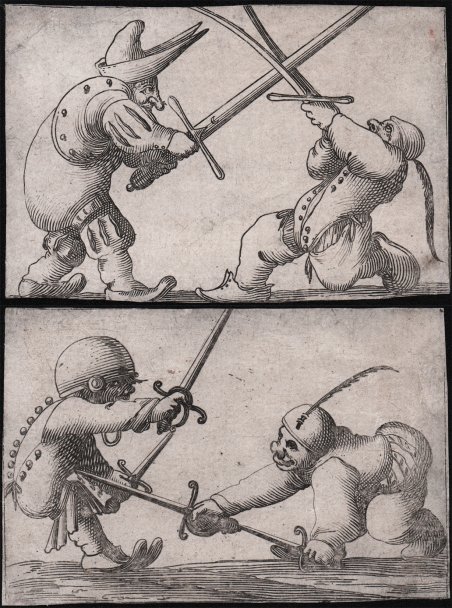
Coppia di rarissime incisioni all’acquaforte, prive di firma ed indicazioni editoriali. Appartengono ad una rarissima suite di 25 incisioni, compreso il frontespizio che reca il titolo Compendio dell'armi de' caramogi, incisa da Francesco Antonio Lucini e pubblicata da Francois Langlois nel 1627. Si tratta di una satira delle macabre giostre che si tenevano nella Firenze del Seicento durante il Carnevale; un’aggiunta “poco nota” al corpus di caricature o grottesche fiorentine che Baldinucci definì “invenzione bizzarrissima”. Questa straordinaria suite di nani che duellano con le armi o con altre armi è una satira del macabro intrattenimento seicentesco che combina costumi bizzarri e violenza grottesca. Come genere indipendente, la caricatura fiorentina diventa più comune all'inizio del Seicento: si pensi alle rappresentazioni di gobbi di artisti come Valerio Spada, Stefano della Bella e Jacques Callot, ai quali Lucini è spesso associato. La serie è descritta solo da F. Viatte in “Master Drawings” vol. XV (1977), dove è riprodotta integralmente, e in un articolo su Baccio del Bianco, in Parody and Festivity in Early Modern Art, del 2012. Viatte parla di un numero significativo di disegni di nani di Stefano della Bella, che potrebbero averla ispirata. “The Compendio dell'armi de' caramogi of 1627 is a rare edition of 25 prints. Without a doubt, Luccini was familiar with the Gobbi series and other dwarf imagery by Callot, under whom he had studied. […] Luccini's combination of bizarre costume, ugly physique and grotesque violence produced an amusing parody of dueling. The prints illustrate dwarfs using a variety of weapons (several operate diverse types of cannons). Many of the images feature pairs of doughy-looking dwarfs battling with swords, knives and lances. The dwarfs wrestle ferociously, often stabbing and slicing the limbs off one another. The contrast between the appearance of the lumpish dwarfs and the brutal nature of the fighting created a paradox; small creatures exhibiting excessive carnality, that would have been highly entertaining for the early modern audience” (cfr. S. Cheng, "Parodies of Life", pp. 132-133). La suite fu pubblicata dal tipografo e incisore occasionale parigino Francois L'Anglois (o Langlois; 1588-1647), detto Chartres. La sua firma “F. L. D. Chartres excud” appare solo nel titolo, poiché nessuna delle altre tavole è firmata. Di conseguenza, potrebbe essere un errore considerare “in Firenze An. MDCXXVII” il luogo di pubblicazione, che sarebbe più probabilmente Parigi, mentre la città toscana sarebbe stata il luogo in cui Lucini inventò i suoi Caramogi. Si dice che Francesco Antonio Lucini (o Luccini) sia stato nella cerchia, forse come discepolo, dell'incisore francese Jacques Callot, prima a Firenze (1616) e poi a Nancy. È famoso per le sue incisioni derivanti da soggetti di Stefano della Bella (1610-1664) e per tutte le carte geografiche del grande atlante Arcano del Mare (1646-1647) di Sir Robert Dudley, un'impresa immensa durata ben dodici anni. Abbiamo individuato solo tre esemplari di questa serie: un esemplare completo si trova alla Bibliothèque Nationale di Parigi; un secondo esemplare, privo di una lastra, si trova alla Biblioteca Civica Bertoliana, a Vicenza; e una terza serie contenente solo dodici lastre al Metropolitan Museum of Art di New York. Minimi restauri perfettamente eseguiti, per il resto in ottimo stato di conservazione. Bibliografia F. Viatte, Allegorical and Burlesque Subjects by Stefano della Bella, Master Drawings, 15 (1977), pp. 347- 365; S. Cheng, Parodies of Life: Baccio del Bianco’s comic drawings of dwarfs, in D. R. Smith “Parody and Festivity in Early Modern Art. Essays on Comedy as Social Vision”, 2012, pp. 127-142. Pair of very rare etchings, unsigned and without printing details. They belong to a very rare suite of 25 engravings, including the frontispiece bearing the title The Compendio dell'armi de' caramogi, engraved by Francesco Antonio Lucini and published by Francois Langlois in 1627. It is a satire of the macabre jousts that were held in seventeenth-century Florence during Carnival; a “little-known” addition to the corpus of Florentine caricatures or grotesques that Baldinucci called “invenzione bizzarrissima”. This extraordinary suite of dwarves dueling with arms or other weapons is a satire of macabre seventeenth-century entertainment that combines bizarre costumes and grotesque violence. As an independent genre, Florentine caricature became more common in the early seventeenth century: think of the representations of hunchbacks by artists such as Valerio Spada, Stefano della Bella, and Jacques Callot, with whom Lucini is often associated. The series is described only by F. Viatte in “Master Drawings” vol. XV (1977), where it is reproduced in full, and in an article on Baccio del Bianco, in Parody and Festivity in Early Modern Art, 2012. Viatte mentions a significant number of dwarf drawings by Stefano della Bella, which may have inspired her. “The Compendio dell'armi de' caramogi of 1627 is a rare edition of 25 prints. Without a doubt, Luccini was familiar with the Gobbi series and other dwarf imagery by Callot, under whom he had studied. […] Luccini's combination of bizarre costume, ugly physique and grotesque violence produced an amusing parody of dueling. The prints illustrate dwarfs using a variety of weapons (several operate diverse types of cannons). Many of the images feature pairs of doughy-looking dwarfs battling with swords, knives and lances. The dwarfs wrestle ferociously, often stabbing and slicing the limbs off one another. The contrast between the appearance of the lumpish dwarfs and the brutal nature of the fighting created a paradox; small creatures exhibiting excessive carnality, that would have been highly entertaining for the early modern audience” (cfr. S. Cheng, "Parodies of Life", pp. 132-133). The suite was published by Parisian printer and occasional engraver Francois L'Anglois (or Langlois; 1588-1647), known as Chartres. His signature “F. L. D. Chartres excud” appears only in the title, as none of the other plates are signed. Consequently, it might be a mistake to consider “in Florence An. MDCXXVII” as the place of publication, which would more likely be Paris, while the Tuscan city would have been the place where Lucini invented his Caramogi. Francesco Antonio Lucini (or Luccini) is said to have been in the circle, perhaps as a disciple, of French engraver Jacques Callot, first in Florence (1616) and then in Nancy. He is famous for his engravings derived from subjects by Stefano della Bella (1610-1664) and for all the maps in Sir Robert Dudley's great atlas Arcano del Mare (1646-1647), an immense undertaking that lasted a full twelve years. We have identified only three set of this series: a complete example is at the Bibliothèque Nationale in Paris; a second specimen, lacking a plate, is at the Biblioteca Civica Bertoliana, in Vicenza, and a third series containing only twelve plates is at the Metropolitan Museum of Art in New York. Minimal restorations perfectly executed, otherwise in excellent condition. Bibliografia F. Viatte, Allegorical and Burlesque Subjects by Stefano della Bella, Master Drawings, 15 (1977), pp. 347- 365; S. Cheng, Parodies of Life: Baccio del Bianco’s comic drawings of dwarfs, in D. R. Smith “Parody and Festivity in Early Modern Art. Essays on Comedy as Social Vision”, 2012, pp. 127-142. Cfr.

 Find out how to use
 Find out how to use