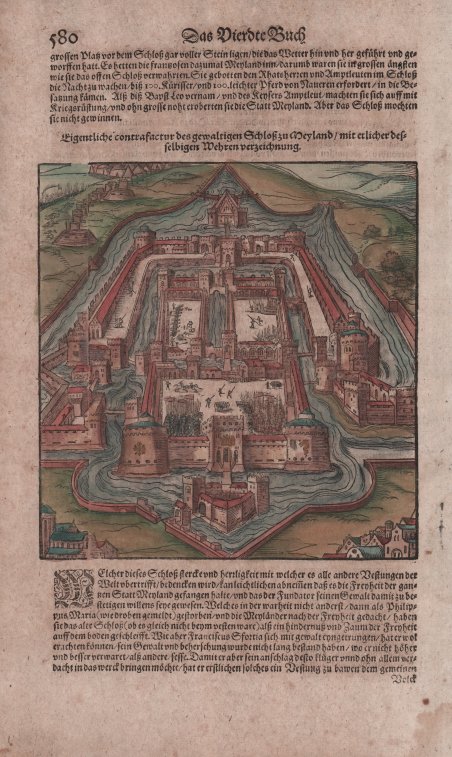
Eigentliche contrafactur des gewaltigen Schloss zu Meyland/mit ettlicher desselbigen Wehren verzeichnung
Eigentliche contrafactur des gewaltigen Schloss zu Meyland/mit ettlicher desselbigen Wehren verzeichnung | Prints | Münster Sebastian
Eigentliche contrafactur des gewaltigen Schloss zu Meyland/mit ettlicher desselbigen Wehren verzeichnung
Eigentliche contrafactur des gewaltigen Schloss zu Meyland/mit ettlicher desselbigen Wehren verzeichnung | Prints | Münster Sebastian
Payment methods
- PayPal
- Credit card
- Bank transfer
- Pubblica amministrazione
- Carta del Docente
Details
- Year of publication
- 1550
- Place of printing
- Basilea
- Size
- 165 X 175
- Engravers
- Münster Sebastian
Description
Questa è una veduta a volo d'uccello del Castello Sforzesco del XVI secolo, la fortificazione di Milano del XV secolo. Fu costruito da Francesco Sforza, duca di Milano; nel corso del tempo fu rinforzato e nel XVI secolo era una delle più grandi fortezze d'Europa. Il castello è visto da sud-est, orientato a nord-ovest. La forma del castello medievale, con le sue mura, il corpo di guardia e i fossati, è riconoscibile. Le armi degli Sforza - l'aquila e il serpente - si possono vedere dipinte sulle torri d'angolo rivolte verso il centro della città. Tavola tratta dalla ' Cosmographiae Universalis, edizione in tedesco, Basilea, seconda metà del XVI secolo.La ' Cosmographiae Universalis ' di Sebastian Münster (1488-1552), stampata per la prima volta Basilea nel 1544 dall’editore Heinrich Petri, venne più volte aggiornata e aumentata di nuove carte geografiche e rappresentazioni urbane nelle sue numerose edizioni che arrivano all’inizio del secolo successivo. Münster aveva lavorato a raccogliere informazioni al fine di ottenere un'opera che non deludesse le aspettative e, dopo un'ulteriore pubblicazione in tedesco abbellita da 910 stampe su legno, giunse nel 1550 all'edizione definitiva in latino, illustrata da 970 silografie. Vi furono poi numerose edizioni in diverse lingue, fra cui latino, francese, italiano, inglese e ceco. Dopo la sua morte di Münster (1552), Heinrich Petri prima, e il figlio Sebastian poi, continuarono la pubblicazione dell’opera. La ' Cosmographia universalis ' fu uno dei libri più popolari e di successo del XVI secolo, e vide ben 24 edizioni in 100 anni: l'ultima edizione tedesca venne pubblicata nel 1628, molto tempo dopo la morte dell'autore. La ' Cosmographia ' conteneva non solo le ultime mappe e vedute di tutte le città più famose, ma anche una serie di notizie enciclopediche di dettagli relative al mondo conosciuto, e sconosciuto. Il particolare successo anche commerciale di quest'opera fu dovuto in parte alle belle incisioni (tra i cui autori si possono citate Hans Holbein il Giovane, Urs Graf, Hans Rudolph Manuel Deutsch, David Kandel). Silografia finemente colorata a mano in buone condizioni. This is a sixteenth century bird's eye view of the Castello Sforzesco (Sforza's Castle), the 15th century fortification of Milan. It was built by Francesco Sforza, the Duke of Milan; over time it was reinforced and by the 16th century it was one of the largest forts in Europe. It now houses several of Milan's museums and art collections, but at the time it was depicted here it was still an active fortress - its yards bristle with pikemen and cavalry, as well as rows of cannon. The castle is viewed from the southeast, oriented to the northwest. The form of the medieval castle, with its walls, guardhouse and moats, is recognizable. Sforza's arms - the eagle and the serpent - can be seen painted on the corner towers facing the center of the city. Plate taken from the ' Cosmographiae Universalis, German edition, Basel, second half of the 16th Century. The ' Cosmographiae Universalis ' of Sebastian Münster (1488-1552), printed for the first time in Basel in 1544 by the publisher Heinrich Petri, was updated several times and increased with new maps and urban representations in its many editions until the beginning of the next century. Münster had worked to collect information in order to obtain a work that did not disappoint expectations and, after a further publication in German embellished with 910 woodblock prints, arrived in 1550 to the final edition in Latin, illustrated by 970 woodcuts. There were then numerous editions in different languages, including Latin, French, Italian, English and Czech. After his death in Münster (1552), Heinrich Petri first, and then his son Sebastian, continued the publication of the work. The ' Cosmographia universalis ' was one of the most popular and successful books of the 16th century, and saw as many as 24 editions in 100 years: the last German edition was published in 1628, long after the author's death. The ' Cosmographia ' contained not only the latest maps and views of all the most famous cities, but also a series of encyclopedic details related to the known, and unknown, world. The particular commercial success of this work was due in part to the beautiful engravings (among whose authors can be mentioned Hans Holbein the Younger, Urs Graf, Hans Rudolph Manuel Deutsch, David Kandel). Woodcut with fine later hand colour, in good condition. Cfr.