Ephermerides Motuum Coelestium Geometriae
Ephermerides Motuum Coelestium Geometriae
Payment methods
- PayPal
- Credit card
- Bank transfer
- Pubblica amministrazione
- Carta del Docente
Details
- Year of publication
- 1742
- Place of printing
- Norimberga
- Size
- 590 X 490
- Engravers
- DOPPELMAIER Gabriel
- Keyword
- Carte Celesti
Description
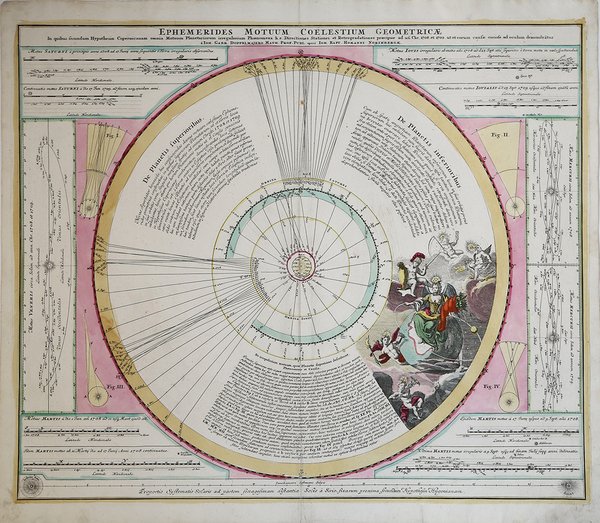
Tavola astronomica raffigurante il moto dei pianeti e la teoria di Hook per il calcolo della distanza tra il Sole e Sirio. Mostra la spiegazione geometrica dei moti irregolari apparenti dei pianeti esterni fino ad allora conosciuti (Marte, Giove e Saturno), seguendo la teoria Copernicana Eliocentrica. Sono descritte le posizioni apparenti dei Pianeti Venere, Mercurio, Marte, Giove e Saturno negli anni 1708 e 1709. Nell'illustrazione è rappresentata l'allegoria del Sistema Solare.Si tratta della carta numero 8 dell’Atlas Coelestis (1742) di Johann Gabriel Doppelmaier che il professore di matematica all’Aegidien Gymnasium di Norimberga, rifacendosi in parte al lavoro di Pardies, redasse intorno al 1720 per conto dell’officina tipografica fondata nella stessa città nel 1702 dal cartografo Johann Baptist Homann.Incisione in rame, coloritura coeva, in ottime condizioni. Copper engraved map of the planetary motion as per observations of 1708 and 1709 by J. G. Doppelmaier. The left hand lunar map, composed by Hevelius, is a considered a foundational map in the science of Selenography – or lunar cartography. This map first appeared in Hevelius' 1647 work Selenographia which laid the groundwork for most subsequent lunar cartographic studies. Here the moon is presented as it can never be seen from Earth, at a greater than 360 degrees and with all visible features given equal weight. In this map Hevelius also establishes the convention of mapping the lunar surface as if illuminated from a single source – in this case morning light. The naming conventions he set forth, which associate lunar features with terrestrial locations such as 'Asia Minor,' 'Persia,' 'Sicilia,' etcetera were popular until the middle of the 18th century when Riccioli's nomenclature took precedence. The Riccioli map, on the right, is more properly known as the Riccioli-Grimaldi map, for fellow Jesuit Francesco Grimaldi with whom Riccioli composed the chart. This map first appeared in Riccioli and Grimaldi's 1651 Almagestum Novum. This was a significant lunar chart and offered an entirely new nomenclature which, for the most part, is still in use today. Curiously, though Riccioli, as a devout Jesuit, composed several treatises denouncing Copernican theory, he chose to name one of the Moon's most notable features after the astronomer – perhaps suggesting that he was a secret Copernicus sympathizer. Other well-known lunar features named by Riccioli include the Sea of Tranquility where Apollo 11 landed and where Neil Armstrong became the first human to set foot on the moon's surface.The upper left and right hand quadrants feature decorative allegorical cartouche work that include images of angelic children looking through a telescope and a representation of the ancient Greek Moon goddess Selene. Additional mini-maps show the moon in various phases of its monthly cycle. Below the map proper extensive Latin text discusses Selenography. Also showing the Hooke's calculation of the distance between the Sun and Sirius. This is map number 8 of the Atlas Coelestis (1742) by Johann Gabriel Doppelmaier that the professor of mathematics at the Aegidien Gymnasium in Nuremberg, referring in part to the work of Pardies, wrote around 1720 on behalf of the printing house founded in the same city in 1702 by cartographer Johann Baptist Homann. Cfr.
