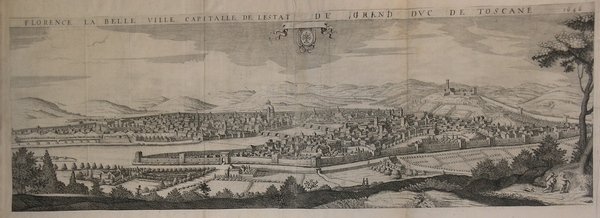
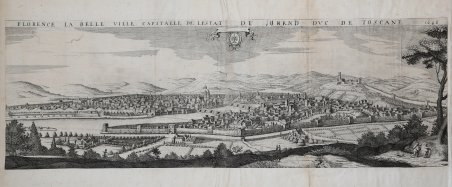
In alto in uno spazio bianco fuori dalla veduta: FLORENCE LA BELLE VILLE CAPITALLE DE LESTAT DU GRAND DUC DE TOSCANE 1646. Il foglio contiene, entro una marginatura singola, una veduta panoramica della città da Bellosguardo, derivata direttamente da quella di Mattheus Merian. In alto, fuori dalla veduta, il titolo. Al centro, sotto un nastro, lo stemma con il giglio fiorentino. Acquaforte e bulino, 1646, incisa da Hugues Picart per il Theatre des Citez, ou Recueil de plusieurs villes, dont les noms suivent par ordre alphabetique; Selon qu'ils sont contenues en ce present volume. Paris, Jean Boisseau, 1648. Jean Boisseau fu "enlumineur du roi pour les cartes géographoques", e venditore di carte marittime con bottega a Parigi, à l'enseigne du Solleil Levant. Viene menzionato per la prima volta negli archivi parigini nel 1631: viene allora descritto come "maestro miniatore", titolo al quale non rinuncerà mai. Poco dopo, nel 1635, divenne "miniatore di carte nautiche". Infine, nel 1636, pubblicò diverse opere di araldica, genealogia e cronologia. Allo stesso tempo, fece incidere alcune carte geografiche. Nel 1641 riedita il Theatre di Jean Leclerc e pubblica la Topographie françoise de Châtillon. L'anno successivo migliora l'atlante di Leclerc, che diventa il suo Théatre des Gaules. Nel 1643 copia l'Atlas Minor di Mercator-Hondius per il suo piccolo Trésor des cartes géographiques. Molto attivo fino al 1648, data di pubblicazione del Théatre des Citéz e della seconda edizione della Topographie. Oltre a queste opere cartografiche realizzò - dal 1642 al 1648 - una raccolta, dal titolo Théâtre des Citez, contenente vedute di città incise in due lastre, molte delle quali copie di quelle dell'Archontolgia Cosmica del 1638, illustrata da Mattheus Merian. Secondo M. Pastoureau, sono noti due soli esemplari della raccolta topografica: uno, appartenente a una collezione privata, contiene cinquantasei vedute. Un altro esemplare, con solo quarantuno vedute e senza frontespizio si trova a Parigi, Bibliothéque Institut d'art et d'archeologie (Fondation Jacques Doucet). Boisseau scompare poi senza lasciare eredi. Louis Boissevin recupera parte della sua collezione e dà una riedizione del Trésor nel 1653 e della Topographie nel 1655. Della veduta di Firenze esistono vari stati: uno completo con l'anno di edizione e le parole sul nastro; un altro dove l'anno è stato eraso; un altro ancora dove il nastro è vuoto. Esemplare nel primo stato di tre, avanti la legenda alfanumerica in basso. Assenti anche l’imprint editoriale A Paris sur le Quay de lorloge du Palais, chez F. de la Point e il motto nel nastro con il giglio sotto al titolo Florida florenti floret Florentia fiore. Magnifica prova, impressa su carta vergata coeva, in ottimo stato di conservazione. Opera molto rara. Bibliografia Mireille Pastoureau, LES ATLAS FRANÇAIS XVIe-XVIIe siècles. Répertoire bibliographique et étude. Paris, Bibliothèque Nationale Département des Cartes et Plans, 1984. 1984, pp. 67-73, n. 34. Above in a white space outside the view: FLORENCE LA BELLE VILLE CAPITALLE DE LESTAT DU GRAND DUC DE TOSCANE 1646. A panoramic view of Florence from Bellosguardo, derived directly from that of Mattheus Merian. At the top, outside the view, the title. In the center, under a ribbon, the coat of arms with the Florentine lily. Etching and engraving, 1646, engraved by Hugues Picart for the Theatre des Citez, ou Recueil de plusieurs villes, dont les noms suivent par ordre alphabetique; Selon qu'ils sont contenues en ce present volume. Paris, Jean Boisseau, 1648. Jean Boisseau was "enlumineur du roi pour les cartes géographoques," and seller of maritime charts with a store in Paris, à l'enseigne du Solleil Levant. He is first mentioned in Parisian archives in 1631: he is then described as a "master illuminator," a title he would never relinquish. Soon after, in 1635, he became "miniaturist of nautical charts." Finally, in 1636, he published several works on heraldry, genealogy and chronology. At the same time, he had some maps engraved. In 1641 he reissued Jean Leclerc's Theatre and published the Topographie françoise de Châtillon. The following year he improved Leclerc's Atlas, which became his Théatre des Gaules. In 1643 he copies Mercator-Hondius's Atlas Minor for his small Trésor des cartes géographiques. Very active until 1648, when he published the Théatre des Citéz and the second edition of the Topographie. In addition to these cartographic works he produced - from 1642 to 1648 - a collection, entitled Théâtre des Citez, containing views of cities engraved in two plates, many of them copies of those in the 1638 Archontolgia Cosmica, illustrated by Mattheus Merian. According to M. Pastoureau, only two examples of the topographic collection are known: one, belonging to a private collection, contains fifty-six views. Another example, with only forty-one views and no frontispiece is in Paris, Bibliothéque Institut d'art et d'archeologie (Fondation Jacques Doucet). Boisseau then disappears without leaving heirs. Louis Boissevin recovered part of his collection and gave a reissue of the Trésor in 1653 and the Topographie in 1655. Several states exist of the view of Florence: one complete with the year of edition and the words on the ribbon; another where the year has been erased; still another where the ribbon is blank. Example in the first state of three, before the alphanumeric legend at bottom. Also absent is the editorial imprint A Paris sur le Quay de lorloge du Palais, chez F. de la Point and the motto in the ribbon with the fleur-de-lis under the title Florida florenti floret Florentia fiore. Magnificent proof, printed on contemporary laid paper, in very good condition. Very rare work. Bibliografia Mireille Pastoureau, LES ATLAS FRANÇAIS XVIe-XVIIe siècles. Répertoire bibliographique et étude. Paris, Bibliothèque Nationale Département des Cartes et Plans, 1984. 1984, pp. 67-73, n. 34. Cfr.

 Find out how to use
 Find out how to use