Giovane con un teschio o Vanitas
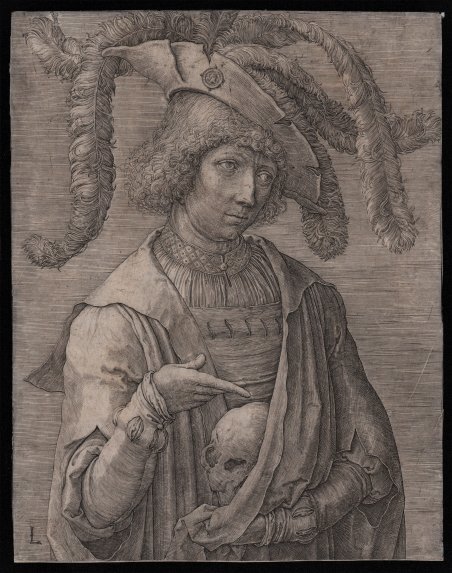
Giovane con un teschio o Vanitas
Payment methods
- PayPal
- Credit card
- Bank transfer
- Pubblica amministrazione
- Carta del Docente
Details
- Year of publication
- 1519
- Size
- 142 X 184
- Engravers
- LEYDEN Lucas van
- Inscription description
- Bartsch/TIB: 174; The New Hollstein, n. 174; Salamon n. 80/81.
Description
Bulino, 1519 circa, firmato in lastra, in basso a sonistra, con il monogramma L. Primo stato di due, variante (b) con alcuni graffi nella lastra, secondo F. Kok (The New Hollstein)Ottima prova, uniformemente inchiostrata, rifilata irregolarmente alla linea del margine, impressa su carta vergata con filigrana “luna crescente con lettere DD intrecciate, sormontata da un quadrifoglio” (Briquet 5316), in buono stato di conservazione.“Lucas nell’incisione a bulino ha costantemente sperimentato allo scopo di differenziare superfici e materiali. In questa stampa i tratteggi incrociati e le lunghe linee parallele descrivono magnificamente gli abiti e il copricapo del giovane. L'uniformità dello sfondo aumenta la ricchezza del suo abbigliamento. Sebbene non vi siano prove dirette, alcuni dei primi commentatori hanno pensato che questa incisione potesse essere un autoritratto. È chiaro, tuttavia, che il suo argomento è una meditazione sulla morte. Il giovane indica il teschio, un promemoria della transitorietà della vita terrena e dell’ineluttabilità della morte. I suoi capi eleganti e il cappello elaborato sottolineano anche il tema della vanitas". [cfr. M. P. McDonald, Ferdinand Columbus: Renaissance Collector, British Museum]. Engraving, 1519 circa, signed in lower left corner with monogram: L. First state, of two, variant (b) according F. Kok (The New Hollstein), grey impression with minor scratches. A good impression, printed on laid paper with “crescent with letters DD with a quaterfoit at top” watermark (Briquet 5316), trimmed at marginal line, in good condition.“Lucas constantly experimented with engraving to differentiate between surfaces and materials. In this print the cross-hatching and long parallel lines beautifully describe the young man's garments and headgear. The uniformity of the background heightens the richness of his attire. Although there is no direct evidence, some early commentators thought this engraving might be a self-portrait. It is clear, however, that its subject is a meditation on death. The young man points to the skull, a reminder of the transitory nature of life. His elegant garments and elaborate hat also underline the vanitas theme.”(From M. P. McDonald, Ferdinand Columbus: Renaissance Collector, British Museum). Cfr. Bartsch/TIB: 174; The New Hollstein, n. 174; Salamon n. 80/81.
