Gotta
Gotta
Payment methods
- PayPal
- Credit card
- Bank transfer
- Pubblica amministrazione
- Carta del Docente
Details
- Year of publication
- 1567
- Place of printing
- Venezia
- Size
- 348 X 238
- Engravers
- NELLI Nicolò
- Keyword
- Cartografia Rara
- Inscription description
- Destombes (1970): n. 170; Ruge (1904-16): IV, n. 90.53; Tavernari (2014): n. 110; Pognon (1968): p. 18; Pütter (1790): vol. 2, pp. 29-30; Tooley (1939): nn. 263-264.
Description
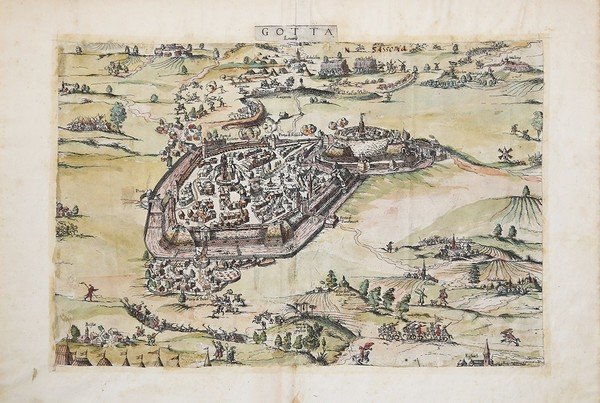
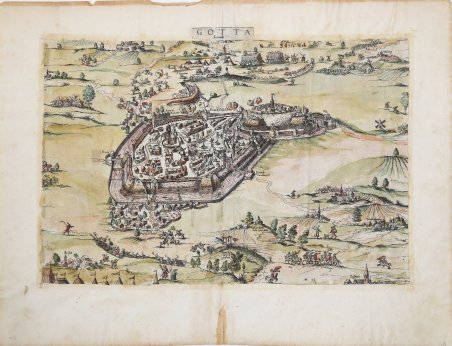
Pianta prospettica della città di Gotha durante l’assedio del gennaio 1567. La città è circondata da truppe ed accampamenti militari dell’esercito imperiale guidato dal principe elettore Augusto di Sassonia. Il motivo dell’attacco fu il rifiuto del duca Giovanni Federico di Sassonia all’estradizione del cavaliere Wilhem von Grumbach (1503-1567), al suo servizio dal 1557, con il quale macchinava una rivolta che doveva dare al duca la dignità elettorale sassone, tolta a suo padre, e al cavaliere i perduti domini della Franconia e altri acquisti. Dopo l’attacco su Würzburg del 1563, l’imperatore Massimiliano II fece pronunciare il bando imperiale contro Grumbach. Dopo un breve assedio, Grumbach, che si era rifugiato nella fortezza di Grimmenstein, fu catturato e quindi giustiziato, mentre il duca fu imprigionato. In alto al centro è inciso il titolo: GOTTA. Orientata con il nord a sinistra. Nella tavola vengono fornite indicazioni toponomastiche. Acquaforte e bulino, coloritura coeva, in buono stato di conservazione. Lastra tagliata di alcuni centimetri nel lato destro. Perspective plan of the city of Gotha during the siege of 1567.The title "GOTTA" is engraved at the top center. Oriented with the north on the left.Toponymic indications are given in the table.Etching and engraving with fine original colouring, trimmed inside the platemark, in good condition.The city is surrounded by troops and military camps of the imperial army led by prince elector Augustus of Saxony. The reason for the attack was the rejection of the duke John Federico of Saxony to the extradition of the knight Wilhem von Grumbach (1503-1567), at his service since 1557, with whom he was driving a revolt that was to give the duke the Saxon electoral dignity, taken from his father, and from the knight, the lost dominions of Franconia and other purchases.After the attack on Würzburg in 1563, Emperor Maximilian II pronounced the imperial ban against Grumbach. After a brief siege, Grumbach, who had taken refuge in the fortress of Grimmenstein, was captured and then executed, while the duke was imprisoned. Cfr. Destombes (1970): n. 170; Ruge (1904-16): IV, n. 90.53; Tavernari (2014): n. 110; Pognon (1968): p. 18; Pütter (1790): vol. 2, pp. 29-30; Tooley (1939): nn. 263-264.
