Details
Engravers
FRANCO Giovanni Battista
Description
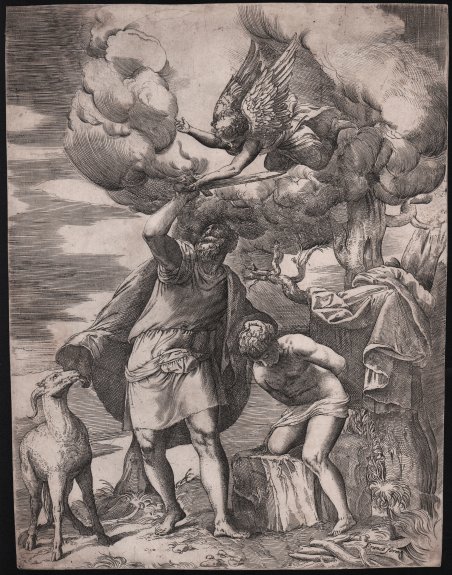
Il sacrificio di Abramo che alza il braccio per uccidere Isacco ma viene fermato dall'angelo che lo sovrasta. Acquaforte e bulino, 1550 circa, firmata in basso a destra “Franco form”. Esemplare di secondo stato con l'aggiunta della firma. Giovanni Battista Franco, noto come Battista Franco Veneziano, ma a volte viene chiamato il Semolei, o semplicemente Battista Franco. Fu tipografo, incisore e pittore, e studiò da vicino il lavoro di Michelangelo (1475-1564). Questo accadde intorno ai suoi vent'anni, nel periodo passato a Roma, dove sviluppò un interesse per le opere allegoriche di grandi dimensioni. Il suo stile pittorico imitava molto quello di Michelangelo, mentre quello che mostrò nelle incisioni era molto più originale, nel suo tocco luminoso e vivace. ' Secondo alcune testimonianze avrebbe imparato l'arte dell'incisione presso Marcantonio Raimondi, e produsse un centinaio di lavori. Molti di questi erano riproduzioni di dipinti dei maestri della pittura Raffaello e Tiziano. Si è propensi a collocare l'inizio dell'attività del Franco come incisore tra il 1545 e il 1551 - anni che coincidono con il periodo marchigiano. La maggior parte delle sue incisioni sembra appartenere all'ultimo periodo veneziano. In questa sua attività il Franco attinse a due filoni principali: la pittura di scuola tosco-romana e la tradizione veneta. Usò la tecnica dell'acquaforte rinforzata spesso con il bulino. Le sue incisioni riproducono in gran parte soggetti sacri - Diluvio universale, Caduta della manna, Adorazione dei pastori, interessanti le incisioni raffiguranti gli affreschi di palazzo Te a Mantova, con le immagini rovesciate - ma anche temi tratti dall'antico. Bellissima prova, impressa con tono su carta vergata coeva, rifilata al rame, in buono stato di conservazione. Bibliografia Bartsch, Le Peintre graveur (XVI.118.1.II). The sacrifice of Abraham who raises his arm to slay Isaac but is stopped by the angel above, to the left is a ram Engraving and etching, circa 1550, lettered at bottom right 'Franco form'. This is the second state with the addition of Franco's name. Giovanni Battista Franco, known as Battista Franco Veneziano, but sometimes called the Semolei, or simply Battista Franco. He was a typographer, engraver, and painter, and closely studied the work of Michelangelo (1475-1564). This was around his early twenties, during the time he spent in Rome, where he developed an interest in large-scale allegorical works. His painting style greatly imitated Michelangelo's, while what he showed in the engravings was much more original in its bright and lively touch. ' According to some accounts he learned the art of engraving from Marcantonio Raimondi and produced about a hundred works. Many of these were reproductions of paintings by the masters of painting Raphael and Titian. One is inclined to place the beginning of Franco's activity as an engraver between 1545 and 1551-the years coinciding with the Marche period. Most of his engravings seem to belong to his last Venetian period. In this activity Franco drew on two main strands: the painting of the Tuscan-Roman school and the Venetian tradition. He used the etching technique often reinforced with the burin. His etchings largely reproduce sacred subjects - The Universal Flood, Fall of Manna, Adoration of the Shepherds, interesting etchings depicting the frescoes of Palazzo Te in Mantua, with the images reversed - but also themes from antiquity. A very good impression, printed with tone on contemporary laid paper, trimmed to the platemark, in good conditions. Bibliografia Bartsch, Le Peintre graveur (XVI.118.1.II). Cfr.

 Find out how to use
 Find out how to use