La femmina di un satiro
La femmina di un satiro | Prints | DUPERAC Etienne
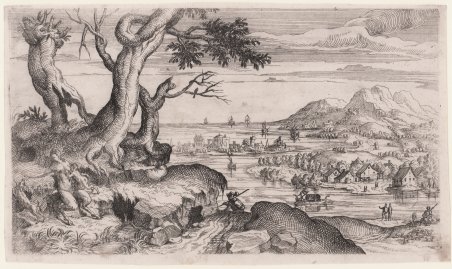
La femmina di un satiro
La femmina di un satiro | Prints | DUPERAC Etienne
Payment methods
- PayPal
- Credit card
- Bank transfer
- Pubblica amministrazione
- Carta del Docente
Details
- Year of publication
- 1559
- Size
- 278 X 160
- Engravers
- DUPERAC Etienne
- Inscription description
- Robert-Dusmenil, VIII, 62.
Description
Acquaforte, circa 1559, priva di firma. Esemplare nel primo stato di due, avanti l’indirizzo di Camocio. Magnifica prova, impressa su carta vergata coeva con filigrana non leggibile, con margini, piccole ossidazioni, per il resto in ottimo stato di conservazione.L’opera appartiene alla serie dei Paesaggi con soggetti mitologici relativa al breve periodo veneziano del Duperac, con le influenze derivanti dalla pittura di Tiziano. Robert-Dusmenil elenca solo la prova con l’indirizzo “Apud Camocium” inserito nella pietra in basso al centro. Rarissima. Etching, circa 1559, without signature. Example of the first state of two, before the address of Camocio. A fine impression, printed on contemporary laid paper with unidentified watermark, with margins, small spots, generally in very good conditions. The work belongs to the series of landscapes with mythological subjects relating to the short period of Venetian Duperac, with influences stemming from painting by Titian. Robert-Dusmenil lists only the test with the address "Apud Camocium" inserted in the stone at the bottom center.Etienne Duperac is an architect , painter , engraver and surveyor. Towards 1559 he came to Rome, where he stayed for more than twenty years, working with compatriot Lafrery . During this period, however, reported several times in France: the Felibien reminds the author of five paintings of sea gods and of the loves of Jupiter and Callisto, were destroyed in 1967, which decorated a bathroom in the palace of Fontainebleau. Along his journey to Rome, staying briefly in Venice, a presence that is attested by some engravings for the publisher Giovanni Francesco Camocio. The work in question is related to the Venetian period, and is clearly influenced by the Venetian painting of the period , especially the works of Domenico Campagnola. However, there are also elements that lead to the landscapes engraved by Leon Davent and also by Battista del Moro and Angelo Falconetto .An extremely rare work. Cfr. Robert-Dusmenil, VIII, 62.